They Laughed at the Black Woman’s Accent — Until Her Travel Empire Crashed Their Terminal.
They Laughed at the Black Woman’s Accent — Until Her Travel Empire Crashed Their Terminal.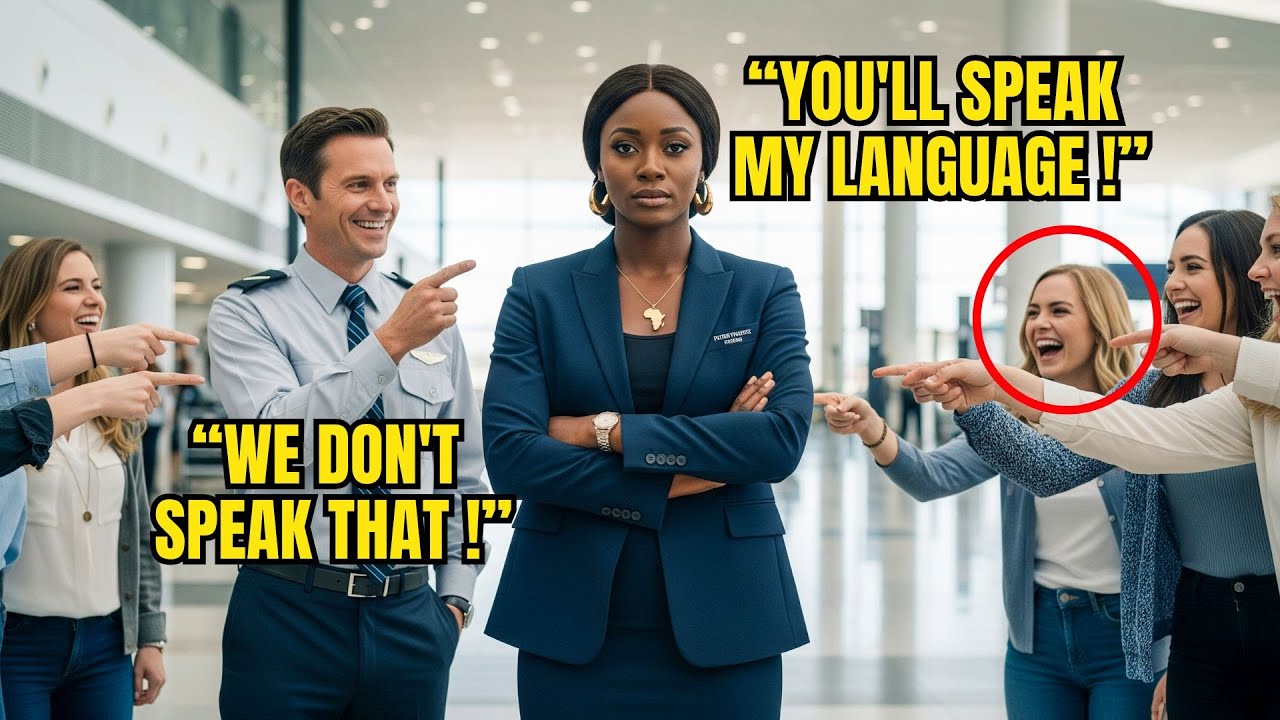
terminal manager. Ellis’s laughter echoes across the counter as Amara approaches, her Nigerian accent flowing like music as she inquires about her delayed flight. “Sorry, ma’am, we don’t speak whatever that is,” Ellis announces loudly, prompting his staff to join in the mockery. Amara repeats her question with perfect composure, her eyes betraying nothing. Ellis grabs her economy ticket and exaggeratedly mimics her accent, each syllable twisted into cruel caricature. “Maybe try the bus next time,” he suggests, triggering another round of laughter. They see a woman they can humiliate without consequence. They don’t see the CEO who just acquired their company. What the laughing staff doesn’t notice is Amara discreetly taking out her phone and pressing record, capturing every word of their discrimination. Evidence that will soon change everything. Amara Okafor strides through the bustling international terminal, her business casual attire impeccable despite the 15-hour day behind her. The tailored blazer and pencil skirt speak of understated wealth, though nothing about her screams executive. She pulls a modest carry-on, its wheels gliding silently across the polished floor. Storm warnings flash on the departure screens, and harried travelers cluster around customer service desks, voices rising in frustration. Terminal operations manager Ellis spots her approaching his counter. His eyes narrow, scanning her from head to toe before straightening the badge that proclaims his modest authority. Something in his posture shifts, a subtle tightening, a barely perceptible change in his expression that happens before Amara speaks a single word. When staff member Zoe moves to assist Amara, Ellis steps forward. I’ll handle this one, he says, his voice carrying a smirk that Zoe recognizes immediately. She retreats, discomfort evident in her eyes, but compliance in her movement. “How can I help you today?” Ellis asks, his words unnaturally slow and loud, as if volume could bridge an imaginary comprehension gap. Amara hasn’t even spoken yet. “Good evening,” Amara says, sliding her economy ticket and passport across the counter. Her smile is professional, but tinged with the weariness of a week’s worth of highstakes negotiations. Ellis examines her documents, his eyebrows rising fractionally at her Nigerian name. “Well, Miz, OKor,” he says, deliberately mangling the pronunciation while sliding her passport back. “What seems to be the problem?” “It’s Okafor,” Amara corrects gently. Her English is flawless. Her accent a melodic reminder of her Lagos upbringing. I’m inquiring about the status of flight RA 217. The boards show a delay, but no updated departure time. Ellis exchanges knowing glances with a colleague before responding. Your flight is delayed. He enunciates with exaggerated clarity as if speaking to a child. Storm weather bad. He gestures toward the windows with sweeping motions. Nearby passengers glance over, some wincing at the interaction, others averting their eyes in uncomfortable silence. Amara’s expression remains composed, though a flicker of recognition passes behind her eyes. This treatment is familiar territory. As Ellis continues his performative rudeness, a quiet airline employee named Jade watches with growing discomfort, unaware her career trajectory is about to drastically change. “I’d appreciate if you could check the system again,” Amara says, her voice steady despite Ellis’s condescension. “I have an important meeting tomorrow morning.” Ellis rolls his eyes theatrically, making sure his colleagues notice. He types a few keys with exaggerated flourishes. Each keystroke a performance of put upon inconvenience. “Listen, sweetie,” he says, leaning forward over the counter. “Your little meeting will have to wait. There’s a storm. See?” He points toward the rain streaked windows and speaks even more slowly. “Big rain. Planes no fly in big rain.” A male colleague snickers. Another mimics Amara’s accent in a whispered aside. Important meeting tomorrow. The mockery isn’t subtle, nor is it meant to be. Amara notices. Her eyes briefly flick toward the whispering staff, but she maintains her dignified posture. “In that case, I’d like to speak with a supervisor,” Amara requests, her strategy shifting. Ellis puffs up, chest expanding beneath his polyester uniform shirt. “I am the terminal operations manager.” He taps his name badge for emphasis. I’m as high as it goes for customer concerns. The pause before the last word carries unmistakable dismissal. Jade, a young employee at the adjacent counter, half rises from her seat. Sir, perhaps I could. Ellis silences her with a sharp glare. Jade, I’ve got this. His tone leaves no room for discussion. Jade sinks back, her mouth tightening into a thin line. Amara tries again. Could you provide any estimate at all? Even a general time frame would help me plan. Ellis makes a show of consulting his computer, typing with dramatic flare. Well, in American time, he says, emphasizing American with a smirk, that would be approximately 3 hours. Several staff members stifle laughs. A white businessman in a tailored suit approaches the counter with the same question about the delayed flight. Ellis’s transformation is immediate. His posture straightens. The mockery vanishes. His tone becomes respectful and professional. Yes, sir. We’re expecting a 3-hour delay due to the thunderstorm system. I’ve already notified catering to prepare additional refreshments in the first class lounge. If you’d like to wait there, I can arrange an escort. Amara observes this exchange silently, her expression betraying nothing, while her eyes catalog every detail. When the businessman leaves, she approaches Ellis again. “I couldn’t help but notice the different service standard,” she says calmly. Ellis bristles visibly. “Maybe if you could speak proper English, I could give you proper service.” As the confrontation escalates, Amara’s phone buzzes with a message. Acquisition complete. Obsidian Sky Travel now owns 51% of Regional Airways terminal operations. I need you to repeat that, Ellis says, leaning over the counter toward Amara. In English this time, Amara meets his gaze. I’ve been speaking English since I approached your counter. Ellis turns to his colleagues, playing to his audience. You hear that? She thinks that’s English. He adopts an exaggerated accent, stretching his vowels and distorting his consonants in a grotesque caricature. This is you. This is how you sound to normal people. The laughter from his colleagues grows louder. A small crowd of travelers has gathered, watching the spectacle unfold. Some shift uncomfortably, others observe with weary resignation, as if witnessing a sadly familiar scene. An elderly white woman tuts disapprovingly, but remains a spectator rather than an ally. “Let me see that passport again,” Ellis demands, holding out his hand with imperious expectation. Amara hands it over, her movements deliberate and controlled. Ellis makes a show of scrutinizing each page, holding it up to the light, flipping through it repeatedly, running his finger over the embossed Nigerian code of arms as if testing for authenticity. “How do we know this is even real?” he questions loudly enough for nearby passengers to hear. He signals to a security guard who reluctantly approaches the counter. “We’ve got a potential documentation issue here.” Jade steps forward again, voice soft but determined. Sir, I can help this customer if you’re busy with other matters. Ellis turns on her immediately. Stay in your lane, Jade. This is a security issue now. His tone contains a warning that makes Jade take a physical step backward, though the conflict in her eyes intensifies. The security guard, a middle-aged man whose discomfort is evident in his body language, clears his throat. Ma’am, I’ll need you to step aside for additional verification. His eyes won’t meet Amara’s, focusing instead on a point just past her shoulder. As Amara is led to a glasswalled security room positioned in full view of the terminal concourse, Ellis addresses the line of waiting passengers with theatrical concern. This is why we have delays, folks. Extra screening takes time. Inside the security room, Amara is instructed to open her luggage. Through the transparent walls, Ellis watches, making exaggerated faces at each item she removes. Professional business attire, a leather portfolio containing presentation materials, a tablet in a sleek case. Throughout this public humiliation, Amara maintains her composure, but the camera of narrative zooms in, capturing microscond flashes of her internal reality. The familiar sting of being otherred, the calculated arithmetic of how to respond without fulfilling stereotypes about angry black women, the weighing of dignity against necessity. When finally allowed to return to the terminal, Ellis delivers one final barb. Next time, book a flight back to where you came from instead. The comment crosses a line, even for this crowd, drawing mutters of disapproval from several witnesses. Amara looks Ellis directly in the eyes for the first time. Her gaze is steady, unnervingly calm. I’ll remember this conversation, Mr. Ellis. Every word of it. Something in her tone makes Ellis falter momentarily before he dismisses her with a wave of his hand. As Amara walks away, her phone lights up. Emergency board meeting confirmed. All regional Airways terminal executives summoned immediately. Amara finds a quiet corner of the terminal, partially obscured by a decorative planter. Only here, momentarily shielded from public view, does her composed facade crack. A single tear of frustration and anger escapes before she wipes it away with precise finality. This isn’t her first encounter with discrimination. Far from it, but the public humiliation stings with particular sharpness. She pulls out her phone, reviewing the recording she secretly made of the entire interaction. Ellis’s mocking voice emerges from the device with damning clarity. Maybe try the bus next time. Followed by the unmistakable sound of collaborative laughter. Amara takes a deep breath, her shoulders squaring as she makes a decision. She places a call. Theodore, it’s Amara. proceed with phase 2 immediately. Her voice carries quiet authority, the Nigerian accent present, but unddeinished by any attempt to neutralize it. There’s a pause on the line before Theodore responds, surprise evident in his tone. That’s 3 weeks ahead of schedule. Are you certain? Absolutely, Amara replies, and adds something to the agenda. Personnel changes. She explains the encounter in concise, factual terms. documented discrimination by a manager, Theodore responds, his tone shifting to cold professionalism. This changes everything. I’ll convene the team. Ellis, still behind the counter, pantomimeing Amara’s accent to appreciative laughter from his colleagues. Can you believe these people fly international? They should stick to buses. Back to Amara, who makes a second call. Maya, it’s me. Contact the board members. Emergency session in 2 hours. Virtual attendance acceptable. She pauses, listening. Yes, that’s correct. And Maya, send the acquisition paperwork to legal. We’re accelerating the integration timeline. Maya’s voice carries a hint of excitement beneath its professional veneer. Yes, Miss Okafor. And may I say, Obsidian Sky Travel is about to make waves again. Amara allows herself a small, determined smile. They have no idea what’s coming. She opens her modest carry-on, revealing an elegant hidden compartment containing a high-end laptop. She powers it on, the screen illuminating with the Obsidian Sky Travel logo, a stylized black jet against a gradient of Midnight Blue. The screen displays a confidential document, regional Airways acquisition, integration timeline. As harried travelers rush past, Amara sits with regal posture amid the airport chaos. In this moment, unseen by those who just mocked her, she transforms from humiliated passenger to commanding CEO. Her fingers move across the keyboard with decisive purpose. Each keystroke cementing Ellis’s fate. The storm outside intensifies, rain lashing against the terminal windows. It mirrors the gathering storm inside Amara. Not the chaotic fury of unchecked emotion, but the organized power of righteous purpose channeled through corporate authority. You didn’t see me, she murmurs to herself. Because you weren’t looking. But I see you clearly. As Amara works, an airportwide announcement requests terminal operations manager Ellis to report to administrative offices immediately while his radio crackles with panicked messages from corporate headquarters. Ellis struts into the administrative offices, adjusting his tie with practiced confidence. The swagger in his step suggests he expects a routine meeting, perhaps a discussion about staffing or scheduling. Instead, he finds a room of grim-faced executives in tailored suits. several more joining via video conference on a large wall-mounted screen. “What’s going on?” he asks, his confident demeanor faltering slightly as he scans the unfamiliar faces. A stern man in his 50s rises from his seat at the conference table. “Mr. Ellis, I’m Theodore Williams, chief legal officer of Obsidian Sky Travel. Please have a seat.” His voice carries the crisp precision of someone who measures words by their legal weight. Ellis remains standing. I don’t understand. I was called to meet with regional management. We are reviewing an incident that occurred approximately 40 minutes ago, Theodore continues, involving discriminatory behavior toward a passenger. Ellis scoffs, crossing his arms. Look, if this is about that African woman who couldn’t speak proper English, Theodore cuts him off, his expression darkening. That African woman, as you call her, is Amara Okafor. The name means nothing to Ellis. So Theodore gestures to a tablet on the table. Perhaps this will clarify things. He presses play. Ellis’s own voice fills the room, mockingly mimicking Amara’s accent. His face drains of color as the recording continues, capturing every derisive comment, every instance of humiliation he orchestrated. “This behavior violates at least six company policies,” Theodore states flatly when the recording ends. “And as of 9:00 a.m. this morning, your company policies are our company policies.” Ellis forces a laugh. “I don’t know what you’re talking about.” Meanwhile, in a different office, Jade sits across from a kind but serious woman who introduces herself as the HR director for Obsidian Sky. We understand you attempted to intervene in the discriminatory incident. We’d like to hear your perspective. Jade’s hands twist nervously in her lap. I tried to help, but back in the conference room, Ellis has moved from confusion to defensive anger. Look, that woman was being difficult. Anyone would have. Mr. Ellis, Theodore interrupts, his voice perfectly measured. Effective immediately, you are suspended pending investigation. Please surrender your credentials. Ellis’s face contorts with rage. You can’t do this. Who the hell do you people think you are? Theodore’s response is ice cold. We’re your new employers, and we have very different standards. As Ellis is escorted to clear out his desk, a large black luxury car pulls up outside the terminal and airport security snaps to attention as if preparing for a VIP arrival. Ellis, trembling with rage, stuffs personal items into a cardboard box while a security officer watches impassively. family photos, a world’s best boss mug, a self- purchase, and a decade’s worth of accumulated desk trinkets disappear into the container. He pulls out his cell phone, jabbing at the screen with unsteady fingers. Frank, it’s Ellis. You need to get down here now. Frank Thompson, regional airways operations director, sounds distracted and stressed. Ellis, I can’t talk right now. We’re in an emergency executive meeting. These people are saying I’m suspended. Some company called Obsidian Sky. What the hell is going on? Ellis’s voice rises, drawing glances from passing employees. Frank’s voice drops to a near whisper. Ellis listened carefully. Obsidian Sky Travel just became our parent company in a surprise acquisition. The CEO is on her way to the terminal now. So what? Get these people off my back. I was just doing my job with some difficult foreigner. A tense silence follows before Frank responds. Ellis, you don’t understand. The difficult foreigner you harassed, that was Amara Aaphor. She’s the CEO of Obsidian Sky. Ellis freezes, the phone nearly slipping from his grasp. The revelation lands like a physical blow, knocking the air from his lungs. The scene shifts to a private airport lounge where Amara enters with commanding presence. Board members from both companies rise as she walks in. The regional airways executives look nervous, tugging at collars and straightening ties. Obsidian skies team stands with the quiet confidence of people who’ve anticipated this moment. Gentlemen, ladies, Amara addresses them, her accent unapologetically present. I’ve just experienced firsthand why Regional’s customer satisfaction ratings are the lowest in the industry. She places her phone on the table and plays the recording. Regional executives wse visibly as Ellis’s voice fills the room, each mocking syllable another nail in his professional coffin. This behavior is systemic, Amara continues when the recording ends. My experience today merely confirmed what our pre-acquisition research suggested. Regional’s CEO Peter Harrington attempts damage control. “Miss Okafor, I assure you this isolated incident is not isolated,” Amara finishes firmly. She gestures to Maya, who distributes tablets to everyone present. “Your terminal operations have a documented history of discriminatory practices. Today, simply provided me firsthand confirmation.” The tablets display presentation slides showing meticulously gathered data, complaint patterns correlated with passengers names, demographics, and countries of origin. The evidence is overwhelming and impossible to dismiss. Integration will proceed, Amara states, her tone brooking no argument, but with immediate leadership changes, beginning with terminal operations. As the meeting concludes, Ellis barges past security, heading straight for the boardroom, his face contorted with rage and panic. Unaware he’s walking into a room filled with executives who’ve just reviewed his discriminatory behavior. Ellis bursts through the boardroom doors, chest heaving, tie a skew. His eyes scan the room before locking on Amara. Recognition dawns on his face, followed by visible shock that transforms his features. you,” he sputters, pointing an accusatory finger. “You’re the CEO.” Amara regards him with the calm appraisal of someone studying an unexpected, but not particularly interesting specimen. Mr. Ellis, I don’t recall this meeting being on your schedule. The Regional Airways executives look mortified. Peter Harrington’s complexion has taken on an unhealthy grayish tinge. Theodore steps forward to intercept Ellis, but Amara raises a hand to stop him. Actually, this is perfect timing, she says. Mr. Ellis, these executives just reviewed your performance from earlier today. Ellis attempts to backpedal, his previous anger morphing into desperate self-preservation. There’s been a misunderstanding. I was following protocol for suspicious travelers. Suspicious? Amara repeats, one eyebrow arched in perfect counterpoint to her level tone. Please elaborate on what made me suspicious. Ellis stammers, each word digging him deeper. Your accent, your documentation, your manner. The room temperature seems to drop 10°. Regional Airways CEO Peter Harrington puts his head in his hands, unable to watch the implosion. Amara turns to the executives around the table. Gentlemen, ladies, this is exactly the culture that will change under Obsidian Skies leadership. Ellis, sensing his rapidly diminishing options, turns to his former bosses. You’re going to let some foreign woman come in and enough. Harington snaps, slamming his palm on the table with enough force to make water glasses jump. Ellis, you’re terminated. effective immediately. Security appears at the doorway. They’ve been waiting just outside, anticipating this exact scenario. Two officers move to flank Ellis, not touching him, but making their presence unmistakable. As he’s led toward the exit, Ellis twists back toward Amara. You set me up. You came in pretending to be nobody. Amara’s response carries through the suddenly silent room with perfect clarity. I never pretended to be nobody, Mr. Ellis. You simply assumed I was nobody because of how I look and sound. That was your mistake, not mine. The doors close behind Ellis and his security escort. The room sits in uncomfortable silence, executives avoiding eye contact with one another and especially with Amara. She turns back to the table, straightening papers that don’t need straightening. A moment of composure rather than necessity. When she looks up, her expression is professionally neutral. Now, shall we continue discussing the future of this company? As the meeting resumes, Jade nervously waits outside the boardroom, clutching a folder containing years of documented discrimination incidents she’s witnessed but been afraid to report. until now. Amara concludes the tense executive meeting with clear directives for immediate cultural reform across regional airways. The executives file out, some shell shocked, others already calculating how to position themselves favorably in the new regime. As the room empties, Maya approaches her boss. Ms. Okapor, there’s an employee named Jade waiting outside. She says she has important information. Amara nods once. Send her in. Jade enters tentatively, her knuckles white around the edges of a worn manila folder. Despite her evident nervousness, she meets Amara’s gaze directly. Amara’s expression softens. You tried to help me earlier. Thank you for that. The simple acknowledgement relaxes some of the tension in Jade’s shoulders. What happened to you was wrong, Miz Aaphor? And she places the folder on the table with the care one might give a volatile substance. It wasn’t an isolated incident. Amara opens the folder to find meticulously organized documentation. I’ve been recording discriminatory incidents at this terminal for 3 years, Jade explains. Complaints dismissed, passengers profiled, staff who objected sidelined or scheduled for inconvenient shifts until they quit. Amara examines the pages, dates, times, descriptions, patterns, all carefully cataloged. Her expression grows increasingly grave. You took a significant risk keeping these records. I couldn’t stay silent anymore, Jade admits. But I needed my job. Amara studies her thoughtfully. Integrity under pressure is rare, Jade. Obsidian Sky needs people like you. Regional Airways has had discrimination complaints for years. Before finalizing our acquisition, I needed to experience their customer service firsthand. As an ordinary traveler, not as a CEO being given VIP treatment. Theodore enters with a tablet displaying updated information. The recording has been shared with the board and legal. They’re unanimously supporting termination for Ellis and a complete overhaul of terminal management. Amara nods, then turns back to Jade. Your documentation will be invaluable for our reforms. We glimpse Ellis in the employee parking lot, standing beside his car in shell shocked stillness. From his vantage point, he watches workers already replacing regional airways signage with Obsidian Sky logos throughout the terminal. The swift, efficient eraser of the world he knew. Meanwhile, Amara conducts a video call with her diverse executive team scattered across global locations. Faces of various ethnicities and backgrounds fill the screen, all focused intently on their CEO. Operation Terminal Integration is ahead of schedule, she informs them. Unfortunately, the cultural issues are worse than we anticipated. Her CFO, a sharp-featured woman with silver streaked hair, responds, “The budget for restructuring is approved. Whatever resources you need,” Amara concludes, “Effective immediately. I’m appointing new terminal leadership.” She glances at Jade, who’s still present, but standing respectfully near the door. Someone who’s demonstrated both integrity and courage. Jade looks up in surprise as Amara continues. Sometimes the best leaders are those who’ve been watching from the sidelines, seeing everything that needs to change. As news of the acquisition and management shakeup spreads through the terminal, Ellis makes a frantic call to his attorney, claiming wrongful termination and discrimination. Unaware that Amara’s legal team has prepared for exactly this response, Ellis sits across from attorney Raymond Diaz in a strip mall law office where the veneer of success, leatherbound law books, framed credentials, mahogany desk can’t quite disguise the worn carpet and water stained ceiling tiles. Diaz initially projected confidence when Ellis called, senting a lucrative wrongful termination case against a major corporation. That confidence has visibly deflated as he reviews the evidence Ellis brought him. “They have recordings, documented patterns of behavior, and multiple witnesses,” Diaz explains, removing his glasses to rub the bridge of his nose. “This isn’t wrongful termination. You’re lucky they haven’t pursued civil rights violations.” Ellis pounds the desk. “She trapped me. She pretended to be a nobody.” Diaz size. Mr. Ellis, she didn’t pretend anything. She simply didn’t announce herself as the CEO. That’s not entrapment. That’s you revealing your actual workplace behavior. Meanwhile, Amara implements systematic changes at the terminal with surgical precision. In the employee breakroom, staff attend new training sessions focused on cultural sensitivity and inclusive customer service. The trainer, a black woman with decades of experience in corporate diversity work, doesn’t sugarcoat the issues. This isn’t about being politically correct, she tells them. It’s about basic human dignity and smart business practice. In the administration offices, a task force reviews all previous discrimination complaints, reaching out to affected passengers with personal apologies and travel vouchers. We can’t undo what happened, the form letter begins, but we can acknowledge it, learn from it, and commit to a different future. Jade, now assistant terminal manager, implements a digital feedback system where passengers can rate their experience and identify staff members who provided exceptional or problematic service. Her colleagues noticed the transformation in her demeanor. The nervous employee who kept her head down has become a confident leader who looks everyone in the eye. Throughout the terminal, digital kiosks offer feedback mechanisms in multiple languages. Signs in diverse languages welcome travelers to an Obsidian Sky travel experience. Regional Airways executives struggle to adapt to Obsidian Sky corporate culture. In boardrooms and private offices, resistance takes the form of passive aggressive compliance. These changes are unnecessary and costly. One director complains during a budget meeting. Our passengers just want to get from point A to point B efficiently. Amara responds without looking up from her notes. Our research indicates otherwise. Passengers want efficiency and dignity. We intend to provide both. Other executives recognize the opportunity presented by the acquisition. Our customer satisfaction numbers have been declining for years. A forward-thinking VP acknowledges during a strategy session. Maybe it’s time to try something different. Peter Harrington, regionals CEO, approaches Amara after a particularly tense integration meeting. The boardroom has emptied except for them. I owe you an apology, Miss Okafor, he says, his expression somber. I knew we had issues, but I didn’t realize the extent. Amara’s response is measured. Acknowledgement is the first step. Action is what matters now. Ellis, meanwhile, attempts to rally support from former colleagues. He sends emails that go unanswered. He makes calls that go to voicemail. He posts vague complaints on social media about foreign takeovers and reverse discrimination. A few sympathize privately, but won’t risk their jobs with public support. Obsidian Sky legal team monitors these posts silently. adding them to an increasingly thick file. Jade flourishes in her new role. We see her implementing ideas she’s had for years but couldn’t execute, reorganizing security checkpoints to reduce bottlenecks, creating express lanes for elderly or disabled travelers, establishing prayer rooms and nursing stations for passengers with specific needs. The results manifest quickly. Travelers move through the terminal more efficiently. Customer complaints decrease. Staff who shared Ellis’s biases quietly resign. Others embrace the new culture with relief. Three weeks after the incident, Ellis files his wrongful termination lawsuit, claiming discrimination against him, defamation, and hostile work environment. Theodore reviews the filing with Amara in her temporary office overlooking the terminal floor. It’s exactly what we expected, he says unsurprised, claiming discrimination against him, defamation, hostile work environment, the standard defensive playbook. Amara nods. And our response? Already prepared. Theodore hands her another document. Counters suit for creating a hostile environment for passengers, violating company policy, and damaging the company’s reputation. Ellis receives Obsidian Skye’s response while sitting in his attorney’s office. Diaz’s expression grows increasingly alarmed as he reads. “They have your performance reviews showing multiple incidents,” he tells Ellis. “Passenger complaints you dismissed and documentation of biased treatment patterns and their counter suing for twice what you’re asking.” Ellis slams his hand on the desk. I don’t care. I want my day in court. Business media catches wind of the story. Headlines appear. Obsidian Sky CEO experiences discrimination at newly acquired terminal. And travel industry giant takes bold stand against airport discrimination. Amara gives a single powerful interview discussing the broader issues. Never mentioning Ellis by name but addressing systemic problems in the travel industry. Travel should connect humanity, not divide it, she tells the interviewer. Her posture regal, her Nigerian accent clear and unmodified. Every passenger deserves dignity regardless of accent, appearance, or origin. The interview goes viral, prompting industry-wide conversations about discrimination in travel. Competitors scramble to review their own policies and practices, fearful of being the next target of public scrutiny. In a particularly telling moment, Amara is asked if her experience was perhaps an overreaction to normal customer service challenges. When you’ve experienced discrimination consistently throughout your life, she responds with quiet intensity. You develop a precise understanding of the difference between poor service and prejudice. One is random, the other is targeted. One is circumstantial, the other is systemic. The interviewer, initially skeptical, finds himself nodding in agreement. Back at the terminal, changes continue. Security procedures are standardized to ensure equal treatment. Customer service scripts are reviewed and updated. Staff receive bonuses based on passenger satisfaction scores rather than processing speed alone. Maya presents Amara with data from the first month under new management. Complaints down 62%. Processing time improved 28%. Staff retention up 40%. Amara nods and Ellis still proceeding with his lawsuit. Maya confirms though his attorney has reached out informally about possible settlement terms. Let Theodore handle it, Amara decides. Our focus is forward, not backward. On the eve of preliminary court proceedings, Ellis receives a thick envelope from Obsidian Sky legal team containing testimonials from dozens of passengers and employees about his discriminatory behavior over years and a final chance to withdraw his lawsuit. Ellis sits in Raymond Diaz’s office, face ashen as they review the mountain of evidence Obsidian Sky has compiled. Page after page of testimonials form a damning collective portrait, not of isolated incidents, but of a consistent pattern spanning years. Former colleagues have provided statements about his behavior. Passengers from diverse backgrounds have come forward with similar experiences of humiliation. They’ve been building this case for weeks, Diaz explains, unable to keep the reluctant admiration from his voice. Miz Aaphor’s personal experience was just the final piece. “So, I’m supposed to just give up?” Ellis demands, desperation edging his voice. Diaz removes his glasses, pinching the bridge of his nose. “Mr. Ellis, proceeding means potential financial ruin. They’re not just defending against your lawsuit. They’re prepared to make an example of you.” Ellis pounds his fist on the desk. I won’t let them win. The preliminary hearing takes place in a woodpaneled courtroom. Ellis sits rigidly beside Diaz, watching as Obsidian Skies legal team. Three impeccably dressed attorneys led by Theodore, arranges materials with practice deficiency. The judge, a stern woman in her 60s, reviews the initial filings. I understand both parties have submitted evidence for review before proceeding to trial. Theodore rises. Yes, your honor. With the court’s permission, we’d like to present a sampling of our evidence. What follows is a methodical dismantling of Ellis’s case and character. The recording of Ellis mocking Amara’s accent plays through the courtroom speakers. Jade’s meticulous documentation illustrates years of overlooked complaints. Statistical analysis demonstrates patterns of discriminatory treatment correlated precisely with passengers ethnic backgrounds. Ellis shrinks in his seat as his own voice echoes through the chamber. The mocking tone and derisive laughter impossible to explain away as misunderstanding or protocol. A parade of witnesses follows. A Nigerian professor whose credentials were questioned despite flying first class. A Kenyan diplomat subjected to additional screening while white colleagues passed through easily. A Ghanaian medical student asked repeatedly if her scholarship was legitimate. The pattern is undeniable, the evidence overwhelming. Ellis watches his attorney’s confident posture dissolve into resigned acceptance of defeat. The judge reviews the materials, her expression growing increasingly stern. She looks up, addressing Ellis directly. Mr. Ellis, based on the evidence presented, I’m inclined to dismiss your wrongful termination claim. Furthermore, I find significant merit in Obsidian Skye’s counter suit. I strongly suggest you reconsider your position before proceeding to full trial. Outside the courtroom, Diaz delivers the final blow. They’re offering a settlement. You drop your case, they drop the countersuit, but there are conditions. The conditions are stringent. a public acknowledgement of wrongdoing, mandatory sensitivity training, and a 5-year exclusion from management positions in the travel industry. This is extortion, Ellis hisses. This is mercy, Diaz corrects him. Take it. Ellis initially refuses, clinging to righteous indignation, but reality sinks in gradually over the following days. His reputation is in tatters. Former colleagues cross the street to avoid him. Job applications go unanswered once potential employers Google his name. The final nail comes when Ellis discovers his mother, a retired school teacher with uncompromising principles, has watched Amara’s viral interview. “I raised you better than this,” she tells him during a painful phone call. Two weeks after the hearing, Ellis signs the settlement agreement in a conference room at Obsidian Sky legal offices. Theodore observes silently as the pen scratches across paper. “Is she here?” Ellis asks bitterly, placing the pen down with excessive force. “I assumed she’d want to watch this.” Theodore shakes his head. “Meaphor isn’t interested in your humiliation, Mr. Ellis. She’s focused on changing systems, not punishing individuals. Your signature is merely a necessary formality in that larger mission.” This realization that he ultimately wasn’t important enough for Amara to personally witness his downfall is perhaps Ellis’s most profound defeat. He’s not even the villain in her story. He’s merely a symptom of the problem she’s solving. As Ellis leaves the legal offices defeated, he passes a wall of monitors displaying news of Obsidian Skye’s newest initiative, an industry-wide coalition against discrimination in travel with several major airlines and terminal operators already signed on. 6 months later, the terminal operates under Obsidian Skies management, transformed almost beyond recognition. Digital screens throughout the concourse display welcome messages in multiple languages. Staff wear pins indicating which languages they speak, Spanish, Mandarin, Arabic, Swahili, creating instant connection points with diverse travelers. Customer satisfaction ratings have soared from among the industry’s worst to its highest. Jade, now fully established as terminal operations manager, leads a morning briefing with her diverse team. Several members were previously sidelined under Ellis’s management. A hijabwearing customer service specialist, a Korean-American operations coordinator, a transgender security supervisor, all now occupy positions that utilize their talents rather than marginalizing them. Remember, Jade tells her team, we’re not just moving people through a building. We’re creating their first and last impression of this city. A news segment plays on terminal screens featuring Amara Okafor accepting an industry innovation award for Obsidian Skies Dignity and Travel Initiative. A comprehensive program being adopted by competitors who initially scoffed at its unnecessary costs. “The true test of progress isn’t how we treat those we perceive as important,” Amara tells the audience of industry executives. Her accent unmodified, her presence commanding, but how we treat those we don’t yet recognize as important. The camera pans across the audience, many looking thoughtful, some uncomfortable, all attentive. The travel industry landscape is shifting beneath their feet, and Amara Okaphor is the seismic force behind it. Back at the terminal, we witness brief vignettes of the cultural shift. A customer service representative patiently assists an elderly South Asian woman speaking broken English, finding creative ways to communicate without condescension. When the passenger finally understands, her relieved smile speaks volumes. In a training room, employees participate in a workshop where they practice recognizing and addressing unconscious bias. The exercises are challenging, sometimes uncomfortable, but the engagement is genuine. Jade interviews a hijabwearing applicant for a customer service position, focusing entirely on her qualifications rather than her appearance. “When can you start?” she asks at the conclusion, extending her hand. At security checkpoints, passengers of various ethnicities move through with equal treatment. No random selections based on appearance or names, no lingering scrutiny of certain passports. A montage shows similar changes spreading across other airports and travel hubs. Obsidian Skies influence expands like ripples in water, visible in updated signage, diverse staffing, and redesigned spaces that accommodate different cultural needs. In a sleek corporate boardroom, Amara meets with executives from competing travel companies who have joined her coalition. Maps on the wall show global transportation networks emphasizing interconnection rather than borders. What happened at regional airways wasn’t unique, she tells them. But our response can be. This is about more than damage control or public relations. It’s about fundamentally changing how the travel industry sees and serves all passengers. A silver-haired executive raises his hand. What about the costs, these programs, the training? Amara slides across documented financial results. Obsidian Sky customer satisfaction is up 47%. Repeat bookings up 32%. Staff turnover down 28%. She allows that to sink in before delivering the conclusion. Dignity isn’t just morally right, it’s profitable. The data speaks volumes. More companies sign onto the coalition. As the industry begins to transform, an unexpected email arrives in Amara’s inbox from Ellis, who has completed his sensitivity training and is asking for a chance to make amends. One year after the initial incident, Amara returns to the same terminal, this time openly as CEO. The transformation is complete. Obsidian Sky branding is everywhere alongside visible commitments to dignity and respect for all travelers. Jade greets her warmly, now confident in her leadership role. We have something to show you. She leads Amara to a wall displaying customer feedback. Testimonials from passengers of all backgrounds describe their positive experiences. Photos show the diverse staff who have been promoted or hired under the new management. This is your legacy, Jade tells her. Not just corporate success, but human dignity. Amara smiles, satisfied, but not complacent. There’s still work to do. They discuss ongoing challenges and future plans while walking through the terminal. Staff recognize Amara now, greeting her respectfully, not with fear, but with genuine appreciation. Amara pauses, noticing a familiar face. Ellis, not in management, but working at a customer service desk. He’s assisting an elderly Nigerian woman with patience and respect. No trace of his former condescension. Later, Amara and Ellis have a brief private conversation. He’s humbled, transformed by his experience. I didn’t understand the impact of my behavior, he admits. The training, the therapy, it opened my eyes to biases I didn’t even know I had. Amara neither condemns nor fully absolves him. Understanding is the beginning. Daily practice is the work. Ellis nods. Thank you for giving me a chance to learn. Not everyone would have allowed me back, even in an entry-level position. Everyone deserves the opportunity to grow, Amara responds, including those who’ve made mistakes. As Amara prepares to leave, she observes the terminal in operation, a model of what travel could be when dignity is the foundation. In a final voice over, Amara reflects, “Power isn’t about having the ability to humiliate others. True power lies in creating systems where dignity is universal. My accent hasn’t changed. My skin hasn’t changed. What changed was creating an environment where difference isn’t just tolerated, but valued.” The final shot shows Amara boarding a plane, exchanging warm greetings with the diverse flight crew. As she settles into her seat, she overhears a flight attendant with an accent similar to hers, confidently addressing passengers. As Amara’s story spreads across social media, the impact reaches far beyond the travel industry. Comments flood in from people sharing their own experiences of accent discrimination and workplace bias. This happened to me last week at a bank, writes one viewer. I left my job because of treatment like this, shares another, I wish I had Amara’s courage and resources, a third admits. The conversation expands, tackling deeper questions about power, dignity, and systemic change. Business schools incorporate the case study into their ethics curriculum. Diversity consultants reference the Obsidian Sky method as a gold standard for corporate cultural transformation. Amara becomes a reluctant icon. Invited to speak at conferences, profiled in major magazines, approached for book deals. She accepts some opportunities and declines others, always redirecting attention to the broader issues rather than her personal experience. The point isn’t what happened to me, she tells a journalist who presses for more personal details. The point is what happens to thousands of people every day who don’t have the power to change their circumstances. Meanwhile, Obsidian Sky continues to expand its influence. The company launches a certification program for dignity and travel standards that other businesses can adopt. They create scholarships for students from underrepresented backgrounds, pursuing careers in transportation and hospitality management. Jade is promoted to regional director of terminal operations, overseeing multiple locations. Her management style, firm but compassionate, focused on both efficiency and dignity, becomes a model throughout the organization. The final scene returns to the terminal where it all began. A new employee orientation is in progress. The trainer shows a video about Obsidian Skies values, which includes a brief reenactment of the confrontation between Amara and Ellis, now used as an educational tool. This is where our transformation began, the trainer explains, with one person who refused to accept discrimination as normal. A young trainee raises her hand. But most of us don’t have the power to buy a company when we’re discriminated against. What can regular employees do? The camera pans to reveal the trainer is Ellis. His response is thoughtful, earned through difficult self-reflection. Document everything. Find allies. Speak up when you can. And remember that cultural change doesn’t always happen from the top down. Sometimes it happens person by person, interaction by interaction, until the old way of doing things simply becomes unacceptable. As the training session ends, the camera pulls back to show a bustling diverse terminal where dignity has become the expected standard rather than the exception. Has this story inspired you to stand up against discrimination in your workplace? Share how in the comments below. If you enjoyed this powerful story of justice and transformation, subscribe to Beat Stories for more narratives that expose workplace injustice and celebrate the triumph of dignity. New stories every week that will move, inspire, and empower you. Hit that subscribe button now. >> Every time someone stands up, speaks out, or refuses to be erased, a new story is born. At Beat Stories, we archive that courage. Subscribe now and help us keep these moments alive because the more we share them, the harder they are to ignore.
You Might Also Enjoy
CEO negro é informado de que seu nome não está na lista em evento — ele cancela o patrocínio de US$ 30 milhões.
Fazendeiro entra no aeroporto para comprar jato — vendedor ri e então vê seu saldo bancário.
“Veterano? Prove.” — Disseram os policiais. Três minutos depois, o Pentágono fechou a delegacia.

Um homem negro sem-teto pede um quarto — eles o expulsam… e depois veem seu nome na escritura.