Undercover Boss Discovers Waitress With Broken Hand — What He Finds Stuns Him
Undercover Boss Discovers Waitress With Broken Hand — What He Finds Stuns Him 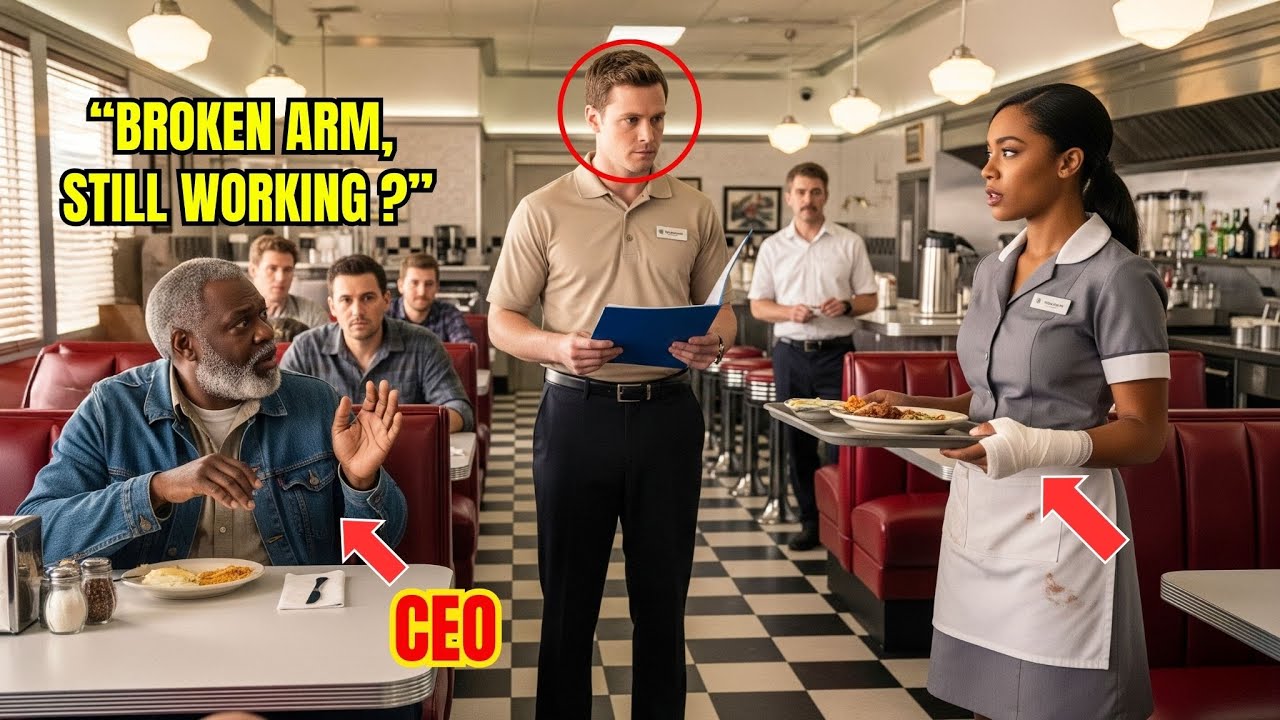
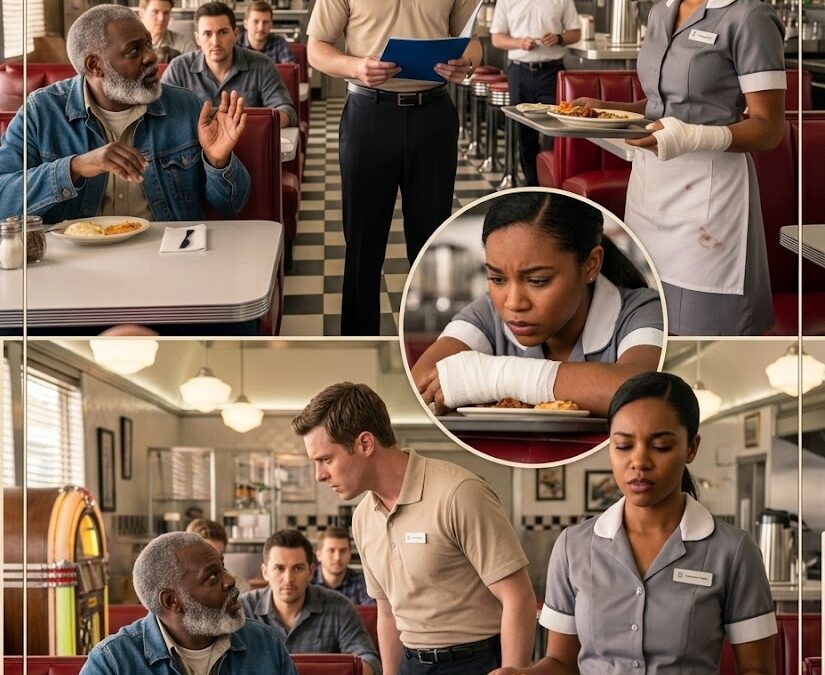
Blood seeped through Jasmine’s white bandage as she balanced four steaming plates along her arm. Her dark skin contrasted sharply with the stark wrapping that failed to hide the grotesque purple swelling beneath. She winced, eyes glistening with unshed tears. From the corner booth, a man in unremarkable clothes watched, coffee untouched.
His eyes caught something unusual. the manager approaching with a clipboard, color-coded staff names visible from across the room. Table 12 is waiting, Jasmine, the manager hissed. Your section’s complaints are up 40% this week. Mr. Davis, the doctor said I shouldn’t. If you can’t handle the pain, maybe this isn’t the place for people like you.
Davis lowered his voice to a dangerous whisper. Your replacement would be here tomorrow. The observer’s jaw tightened. He discreetly adjusted his hidden camera and typed, “Day one, discrimination confirmed. No one sees the owner watching.” Michael Connell stared at the review spreadsheet on his desk, the Riverstone restaurant logo gleaming in the corner of each page.
As third generation owner of the establishment his grandfather had founded in 1962, quarterly reviews had always been a point of pride until now. This can’t be right, he muttered, flipping through employee satisfaction surveys. The pattern was unmistakable. In the 6 months since he’d promoted Marcus Davis to general manager, ratings from black employees had plummeted, while white employee satisfaction had risen.
Even more disturbing, customer complaints citing slow service corresponded almost exclusively to tables served by black staff. Michael’s gaze drifted to the framed photograph on his wall. His grandfather standing proudly with the original Riverstone staff, a deliberately diverse group in an era when that was revolutionary. The restaurant’s mission statement hung beside it.
Dignity and opportunity for all who enter, whether through the front door or the kitchen. How had he missed this shift? After his father’s unexpected death last year, Michael had focused on expanding their second location across town, trusting Davis to maintain the flagship restaurant’s standards. The numbers looked good revenue up 15%, but something felt deeply wrong.
His assistant knocked softly before entering. “This came in anonymously to our feedback email,” she said, placing a printed message on his desk. “I thought you should see it immediately. Michael read it twice, his stomach tightening. To whom it may concern, I’ve been a server at Riverstone for 3 years. In the past 6 months, black staff have been systematically given worse sections, later hours, and harsher discipline than white staff.
Last week, Jasmine Williams was denied medical leave for a broken hand, and told she’d be fired if she didn’t work her shifts. This isn’t what Riverstone stood for when I started. Someone needs to see what’s happening. Michael pulled up the staff directory, finding Jasmine’s file. 5 years of exemplary service, two employee of the month awards, and a note about her three children she was raising alone.
Her recent performance reviews under Davis showed a steep decline with vague comments about attitude and reliability issues. He opened his father’s old leatherbound journal, flipping to a dogeared page marked, “When the restaurant loses its way.” His father had written, “The moment you sense something’s wrong, don’t trust the paperwork. Trust your eyes.
Go back to the floor. See for yourself.” Michael researched racial discrimination in restaurants, discovering disturbing statistics. Black servers earned 30% less in tips when assigned to poorer sections. 65% of discrimination cases never resulted in formal complaints due to fear of retaliation. 72% of restaurant workers had witnessed race-based assignment practices.
His phone buzzed. A text from Davis. Great news. Revenue up another 3% this month. Your hands-off approach is working wonders. Michael’s jaw tightened. He called his lawyer. “If what you’re suspecting is happening, you need concrete evidence,” his attorney advised. “Witness testimony, documentation patterns, recorded statements, anything showing systemic discrimination rather than isolated incidents.
” “How serious could this be legally?” Michael asked. Beyond the moral implications, potential class action lawsuits, labor violations, damage to your family’s legacy. But Michael, if your manager is creating a hostile work environment based on race, the greatest cost isn’t financial. It’s what happens to the people experiencing it every day.
That evening, Michael sat in his car in the restaurant parking lot, watching staff exit after closing. Jasmine emerged last, moving slowly, her bandaged hand cradled against her chest. She paused at the bus stop, checking her watch anxiously. When she finally boarded, her exhaustion was visible even from a distance.
The next morning, Michael called a trusted family friend who’d worked as a restaurant consultant. “I need to go undercover in my own restaurant,” he explained. “I’ve been away from daily operations too long. Most owners would just fire the manager and issue a statement,” his friend observed. Michael shook his head. “I need to understand how deep this goes.
If there’s a system of discrimination operating in my family’s restaurant, I need to see it with my own eyes. Only then can I truly fix it.” He looked again at the photograph of his grandfather and the diverse staff who had built Riverstone’s reputation. I owe them that much. 3 weeks earlier, Jasmine Williams had arrived for her shift 15 minutes early, as always.
The morning rush at Riverstone brought the usual mix of business meetings and tourist brunches. She tied her apron with practice deficiency, scanning the day specials on the kitchen whiteboard. Morning, Jasmine. Luis, the veteran server, greeted her. At 62, he’d been with Riverstone since before Michael’s father ran the place.
You’re on sections 5 through 8 today. Jasmine’s smile faltered. Sections 58 were the restaurant’s notorious dead zone tables nearest the kitchen door and restrooms, known for lower tips and higher complaints about noise. Again, that’s my fourth straight week, she said. Luis shrugged sympathetically. Davis makes the assignments.
You know how it is now. What Luis didn’t say hung in the air between them. Every black server had been assigned to sections 5 to 28 for months. The front sections with window views and business clientele were staffed exclusively by white servers. The morning proceeded without incident until a bus boy missed a spill near the kitchen entrance.
Jasmine, carrying a tray of water glasses hit the slick spot. She managed to stabilize the tray but twisted awkwardly, her right hand slamming against the edge of a nearby service station. Pain shot up her arm like lightning. The tray clattered to the floor, glasses shattering. “I’m so sorry,” she gasped, clutching her wrist as other servers rushed to help.
Davis emerged from his office at the commotion. “Clean that up immediately,” he ordered, glaring at Jasmine. “Then see me.” In his office, Davis barely looked up from his scheduling book, a leatherbound ledger he kept locked in his desk. That’s coming out of your tips, Marcus. I think my hand is broken, Jasmine said, her wrist already swelling visibly. I need to see a doctor.
We are fully booked and short staffed. Get some ice from the kitchen and finish your shift, he replied coldly. The lunch rush starts in 30 minutes. But I You’re on thin ice already, Jasmine. Three customer complaints this month. Those weren’t my fault. You know, section 6 always gets complaints about weight times because it’s furthest from the kitchen.
Davis finally looked up, eyes narrowing. Are you suggesting I’m assigning you bad sections on purpose? The threat in his voice was unmistakable. Jasmine thought of her three children, the rent due next week, her oldest daughter’s college application fees. No, sir, she answered quietly. Good, because I’d hate for your hours to be reduced further.
The urgent care doctor confirmed what Jasmine already knew. A hairline fracture requiring immobilization for at least 3 weeks. You absolutely cannot be lifting trays or carrying plates. The doctor emphasized, writing out a medical leave note. This needs rest to heal properly. The next morning, Jasmine presented the note to Davis.
3 weeks? Impossible, he said, barely glancing at it. We need you on the floor. But the doctor said, “The doctor doesn’t sign your paychecks,” Davis interrupted. “I need reliable people, Jasmine. If you can’t work your assigned shifts, I’ll find someone who can.” 2 days later, Jasmine returned to work, her hand throbbing inside a medical brace.
She dropped a plate within the first hour, drawing Davis’s immediate attention. That’s coming out of your pay,” he snapped. A regular customer at table 6, an older woman who came for lunch twice weekly, noticed Jasmine’s struggle. “What happened to your hand, dear?” she asked. “Just a small accident?” Jasmine answered, attempting a smile.
“That looks serious. Should you be working?” “I’m fine, really.” The customer frowned, unconvinced. When Davis passed by, she flagged him down. Excuse me, but your server is clearly injured. Surely you have accommodations for injured staff. Davis’s professional smile appeared instantly. Ma’am, we take employee welfare very seriously.
I’ll speak with her immediately. After the customer left, Davis cornered Jasmine in the service alley. Don’t air our business to customers, he hissed. If you can’t do your job without complaining, there are plenty of people who would gladly take your position. That afternoon, Jasmine dropped a full tray when her injured hand gave out.
As she knelt to clean up, tears of pain and frustration finally escaped. A young man at a nearby table captured the moment on his phone. A black server with a clearly broken hand cleaning shattered dishes while her manager watched with crossed arms. The video would reach Michael Connell’s desk the next morning, labeled simply, “Is this really Riverstone’s values now? Michael replayed the video for the fifth time, his anger intensifying with each viewing.
Jasmine’s medical brace was clearly visible as she struggled to clean broken dishes one-handed. Even more damning was Davis’s expression, not concern, but irritation, checking his watch as if her injury was merely an inconvenience to the lunch service. “This ends now,” Michael muttered, reaching for his phone to call Davis. His finger hovered over the contact. No.
Firing Davis might remove one problem, but wouldn’t expose the full extent of what was happening. Michael called his attorney instead. I’ve seen enough. I’m going in undercover to document everything, he said when Amanda Peters answered. Risky move, she replied. What’s your actual plan? I’ll pose as a new hire.
I’ve been absent enough that most newer staff won’t recognize me. I need to see firsthand how deep this discrimination runs. And if Davis recognizes you, he won’t. We’ve only met in person twice, both times briefly. I’ll change my appearance glasses, different hairstyle. My family’s heritage works in my favor here. Davis has shown he doesn’t pay much attention to non-white staff.
Amanda sideighed. Let’s discuss the legal ramifications. You’ll need proper documentation for any evidence to be useful in potential proceedings. Over the next hour, they outlined a strategy. Michael would need to capture documented patterns in scheduling and section assignments, differential treatment in disciplinary actions, any explicitly discriminatory statements, witness accounts from multiple employees, financial records showing tip distribution and advancement opportunities.
Remember, your goal isn’t just to fire one manager, Amanda cautioned. It’s to identify and correct any systemic issues in your restaurant’s operations. Michael spent the following day researching best practices for workplace discrimination investigations. He purchased a discrete recording device legal in their state for single party consent recording and practiced activating it without looking.
He studied Riverstone’s hiring procedures, creating a believable backstory as Mike Connors, a server with 5 years of experience recently relocated from Seattle. Working with HR’s head office who was sworn to secrecy, he arranged to be hired and placed on the schedule starting Monday. Michael visited a stylist who cut his usual neat businessman’s haircut into something more casual.
He grew out 3 days of stubble, added non-prescription glasses, and purchased clothing distinctly different from his usual business attire. Before proceeding, Michael needed an ally inside. He contacted Luis, the veteran server, who had known Michael since childhood. They met at a coffee shop across town. “I’ve seen this before,” Luis said gravely after Michael explained his suspicions.
Your father would never have let it happen, and neither would your grandfather. “Why didn’t you come to me sooner?” Michael asked. Louis’s weathered face showed his discomfort. Davis has been careful. Creates plausible reasons for everything. Someone gets a bad section, it’s because of customer complaints, denied a promotion, performance issues.
But the pattern is obvious to those of us who’ve been around. I need your help, Luis. I’m going undercover as a new server to document what’s happening. And Luis nodded slowly. Davis has created a climate of fear. Black staff are afraid to complain because they need their jobs. White staff either benefit from favoritism or stay quiet to avoid becoming targets.
What about Jasmine? Is she someone I can trust? Absolutely. Single mother of three, works harder than anyone. Davis has been particularly hard on her since she requested a schedule change to attend her daughter’s school events. And her hand Louise’s expression darkened. Workplace accident. Should have been covered by workers comp with paid medical leave.
Instead, Davis threatened her job if she didn’t keep working. Michael felt sick. How many others are being treated this way? At least five black servers, two Latino busers. It’s gotten worse in the past 3 months around when Davis implemented his new efficiency system. What system? His scheduling book. He keeps it locked up, but I’ve glimpsed inside.
Color-coded staff assignments, notes on who gets which sections. He calls it customer preference optimization. Michael leaned forward. That book is key evidence. I need to see it. Before leaving, Michael accessed the restaurant’s digital records. He discovered a buried HR complaint from a former black hostess alleging racial discrimination.
Davis had marked it resolved with a note claiming the employee had performance issues unrelated to her allegations. She’d been fired two weeks later. The night before his undercover operation began, Michael couldn’t sleep. His family had built Riverstone on principles of equality and opportunity. His grandfather had insisted on hiring diverse staff when many restaurants remained segregated.
Now that legacy was being corrupted under his watch. Monday morning arrived. Michael, now Mike, dressed in black pants and a white button-down, the standard Riverstone server uniform. He’d memorized his cover story and rehearsed activating the recording device discreetly. He arrived early for orientation, joining two other new hires in the manager’s office.
Davis barely looked up from his computer as he distributed employment forms. “Fill these out, then shadow your assigned trainers. Don’t make me regret hiring you,” he said dismissively. Michael noticed Davis’s eyes lingering slightly longer on the white female hire, his tone noticeably warmer as he added, “Brittany, you’ll be with Kevin in sections one and two are premium tables. Make a good impression.
” Turning to Michael and the other new hire, a young black man named Jamal, Davis’s expression hardened. “You two will train in sections 6 through 8. Mike with Luis, Jamal with Jasmine. Those sections require a certain type of server. The implication hung in the air, unmistakable. As they left the office, Michael caught sight of Davis’s scheduling book leather bound with the Riverstone logo embossed on the cover before Davis quickly locked it in his desk drawer.
“What did he mean by a certain type of server?” Jamal whispered as they headed to the locker room. Michael shook his head. “I don’t know, but I intend to find out.” In the staff area, Michael spotted Jasmine adjusting her hand brace before slipping it partially under her sleeve. Their eyes met briefly, and Michael saw what his absence had allowed.
Resignation in the face of injustice. The weariness of fighting a rigged system alone. He activated his hidden recorder and approached Luis, who greeted him with the perfect mix of professional courtesy and appropriate distance. Welcome to Riverstone, Luis said loud enough for others to hear, then barely moving his lips.
Ready? Michael nodded imperceptibly. Ready to learn everything about how this place really works. Michael’s first shift began with Luis showing him the rope’s point of sale system, menu specials, and service protocols. But beneath the standard training, Luis discreetly highlighted troubling patterns. Sections are assigned at Davis’s discretion, Luis explained, gesturing toward the digital floor plan.
Notice anything about who’s where today? Michael scanned the layout. Every front section tables with window views and higher check averages was assigned to white servers. All black staff were relegated to back sections near kitchen noise and restrooms. “Has it always been like this?” Michael asked quietly. Never under your father,” Luis replied.
Sections rotated fairly. Then everyone got equal opportunity for prime tables. Throughout the morning, Michael observed Davis’s interactions with staff. His tone shifted noticeably professional with white employees, Curt and often condescending with black staff. Minor mistakes received dramatically different responses.
A white server who dropped silverware got a casual, “No problem, grab new ones.” When Jasmine spilled water, Davis loudly announced they’d discuss her performance later. During a brief lull, Michael slipped into the breakroom where Jasmine sat alone, massaging her injured hand. “Rough day?” he asked, sitting across from her.
She quickly straightened, hiding the pain. “Just busy. You’re new, right, Mike? Yeah. First day. How long have you worked here? 5 years. It used to be the best restaurant job in town. Something in her tone made Michael lean closer. And now? Jasmine hesitated, eyeing the doorway. It’s different since Davis took over.
Some of us are just trying to survive until something changes because of how he treats people. She lowered her voice. Let me give you some advice. If you’re not white, document everything. Every schedule change, every section assignment, every disciplinary conversation. You’ll need it. Has anyone complained? A bitter smile crossed her face.
Angela filed a formal complaint. She was fired 2 weeks later for unrelated performance issues. Terrell requested a meeting with upper management to discuss discrimination. His hours were cut to almost nothing until he quit. The breakroom door swung open. Davis entered, his eyes narrowing at their conversation. “Break’s over, Jasmine.
Section 7 needs pre-busing,” he said sharply. “I still have 3 minutes,” she replied, glancing at the clock. “Did I ask for your opinion? Table 7 now.” After she left, Davis turned to Michael. First day advice, choose your friends carefully here. Some staff have attitude problems that might reflect poorly on you by association. The implied threat was unmistakable.
Michael nodded meekly, playing his role. That evening, Michael shadowed Luis during dinner service. From the service station, they overheard Davis speaking to a white server named Kevin. Take these VIP customers in section two, Davis instructed. They’re regulars who spend big. We need our best face forward.
Kevin glanced at Jasmine, who had more seniority. Shouldn’t Jasmine take them? She’s been here longer. Davis lowered his voice, but Michael’s recording device caught his response. Between us, you need to be selective about who represents your business. Some people just don’t fit the image we want. That’s why I have my system. After closing, Michael helped with side work, using the opportunity to chat with other staff.
A pattern emerged through their whispered conversations. Black servers received harsher discipline for identical infractions. They were scheduled for the least desirable shifts, often closing one night and opening the next morning. Their requests for time off were scrutinized with medical documentation demanded, while white staff’s requests were approved with a simple verbal explanation.
Most disturbing was the tip distribution system. Michael discovered Davis had implemented a policy of pooling tips from certain large parties, ostensibly for fair distribution, but the pools mysteriously benefited white servers disproportionately. He says it’s because front sections require more experienced servers, explained Jamal, the other new hire.
But Jasmine has 5 years experience and has never been scheduled in front sections under Davis. On his third undercover day, Michael witnessed a particularly painful incident. Jasmine was taking pain medication for her hand when Davis caught her. “What are you doing?” he demanded. Doctor prescribed pain medication, she explained, showing him the bottle for my fracture.
No unauthorized substances during shifts, Davis said. It’s grounds for immediate termination. It’s prescribed. I have documentation. Are you arguing with me? Davis stepped closer, intimidating. You’re already on thin ice with your performance lately. Jasmine straightened her spine, voice steady despite the clear fear in her eyes.
I’m aware of my legal right to take prescribed medication for a workplace injury. I’ve documented the injury, the doctor’s orders, and your previous refusal to provide medical leave. Davis stepped back, momentarily caught off guard by her direct reference to documentation. “Just keep it out of sight of customers,” he muttered before walking away. Michael approached her afterward.
“That was brave.” Jasmine’s hands trembled slightly as she organized her serving tray. Not brave, desperate. I have three kids who need me to keep this job. She glanced around before continuing. A few of us have started keeping records, schedules, incidents, everything. Not that it matters. Who would believe us against management? What if someone did believe you? Michael asked carefully. Her tired eyes met his.
then maybe things could change. But I’ve stopped hoping for white nights. That night, Michael stayed late, volunteering to help with inventory a task that gave him access to the office area. While Davis was occupied in the wine celler, Michael quickly examined the posted schedules. The pattern was undeniable.
Black staff consistently received the worst shifts, often scheduled to close, then open the next morning. a physically punishing combination known as a clopen in restaurant terminology. Even more telling were the shift swaps. Requests from white servers were approved with simple initials while similar requests from black staff were marked denied insufficient coverage or denied find replacement.
On his fifth undercover day, Michael made his most significant discovery. During a particularly busy lunch service, Davis stepped away from the host stand, leaving his keys on the counter. Michael, seizing the opportunity, quietly took them, making a mental note of which key opened the office.
Later, volunteering to close, Michael waited until the restaurant emptied. With Luis keeping watch, he slipped into Davis’s office and unlocked the desk drawer containing the scheduling book. What he found shocked him despite his suspicions. The book contained detailed color coding. White staff in green, black staff in red, other minorities in yellow.
Next to each name were notes about customer compatibility and front of house suitability. Most damning were Davis’s personal notes about specific employees. Jasmine keep and back sections too ethnic for corporate clients. Kevin priority for sections 1 to three. presents appropriate image. Jamal, new hire, back sections only, regardless of performance.
Michael photographed every page, hands shaking with anger. In the margins of one page, Davis had written, “Limit front of house diversity to 25% maximum for optimal customer comfort.” As Michael replaced the book and relocked the drawer, his resolve hardened. He now had irrefutable evidence of systematic discrimination, a deliberate strategy, not isolated incidents.
The next morning, Michael arrived early and positioned himself where he could observe Davis making schedule adjustments. When a white server requested a day off for a concert, Davis immediately approved it. 30 minutes later, a black server asked for the same day off for a family event. Davis claimed they were already understaffed and denied the request.
Michael activated his recorder. Excuse me, Mr. Davis. I couldn’t help overhearing. Didn’t you just give someone else that same day off? Davis’s eyes narrowed. Different circumstances. Mind your own business if you want to last here. I’m just trying to understand the system, Michael pressed. Davis lowered his voice.
Listen, certain staff are more reliable, more valuable to our operation. That’s just business reality. The entire exchange was captured clearly on Michael’s recorder, the final piece of evidence he needed. That night, Michael contacted his attorney. I’ve seen enough, he said. It’s time to end this.
Michael sat in Amanda Peters’s law office, spreading evidence across her desk, photographs of the color-coded scheduling book, transcripts of recorded conversations, statistical analyses of section assignments, and documented patterns of disciplinary actions. This is extensive, Amanda said, reviewing the materials. You’ve been thorough. I needed to be certain, Michael replied.
This isn’t just about one bad manager. I needed to understand how deeply this had penetrated my restaurant’s operations. Amanda picked up the photographs of Davis’s scheduling book. This is your smoking gun. The color coding by race, the explicit notes about keeping black staff in back sections.
It demonstrates deliberate systematic discrimination. Is it enough? More than enough for termination with cause. potentially enough for affected employees to pursue legal action against Davis personally, though that would be their decision. She examined the statistical breakdown Michael had compiled. Black staff received 83% of documented disciplinary actions despite comprising only 32% of your workforce.
They were assigned to lower tipping sections 94% of the time. Not a single black server has been promoted under Davis’s management. Michael stared at the numbers, each statistic representing real people, real livelihoods. I need to make this right. Before we proceed, we should discuss your approach. Amanda cautioned.
The evidence is clear, but how you handle this will determine whether you’re simply removing one problem or addressing a systemic issue. I want complete transparency. Michael said firmly. Full accountability, comprehensive change, and appropriate compensation for affected staff. Then we need one more piece of evidence, Amanda replied.
Something that shows intent beyond the documentation, a clear admission from Davis. That evening, Michael returned to Riverstone with a plan. He approached Davis near the end of service, still in his mic disguise. Mr. Davis, could I speak with you privately about advancement opportunities? Davis looked annoyed, but led him to the office. Make it quick.
I have schedules to finalize. Michael closed the door. I’ve noticed patterns in how sections are assigned. The front sections seem reserved for certain types of servers. Davis studied him, then relaxed slightly. You’re observant. That’s good. I want to make sure I’m positioned for success here, Michael continued. What’s the best way to ensure I get those premium sections? Davis leaned back in his chair, guard lowering.
Look, this is just between us, but restaurant management is about understanding customer preferences. Our clientele feels more comfortable with certain servers handling their experience. You mean white servers, Michael stated bluntly. Davis didn’t flinch. I’m talking about business reality. Our highest paying customers prefer servers who reflect a certain professional image.
It’s nothing personal, just maximizing revenue. That’s why you keep Jasmine and others in the back sections despite their experience. Experience isn’t everything. Front of house staff represent our brand. I have a responsibility to create the dining experience our premium customers expect. Davis tapped his scheduling book. My system optimizes for profitability while working with the staff I have.
Some people are better suited for back of house roles based on their race. Michael pressed. Davis frowned. I wouldn’t put it so crudely. Let’s call it demographic alignment with customer preferences. and the disciplinary actions, the denied time off, the clopins scheduled predominantly for black staff, performance issues, Davis dismissed.
Some staff just require more correction than others, like Jasmine working with a broken hand. Davis’s expression hardened. You ask a lot of questions for someone on probationary status. One last question, Michael said, reaching into his pocket. Do you think the owner would approve of your system? Davis snorted.
Connell, he hasn’t set foot in this restaurant for months. He only cares about the bottom line, which my system delivers. Revenue is up 15% since I implemented demographic optimization. Demographic optimization? Michael repeated, activating his recorder. Could you explain exactly what that entails? Believing he was speaking to a like-minded employee, Davis detailed his approach.
Limiting ethnic staff to less visible roles, scheduling challenges to encourage unwanted employees to quit, and manipulating disciplinary records to justify his actions. It’s all about creating plausible deniability, Davis explained. Every decision has a business justification on paper, unassalable. Very clever, Michael said, standing.
I have just one more question. What’s that? Michael removed his glasses, standing straighter as he shed his subservient posture. How do you plan to explain this system to the team tomorrow morning? Davis’s face drained of color as recognition dawned. You’re Michael Connell, owner of Riverstone, and you’re fired. Effective immediately.
Michael arrived at Riverstone the next morning, 2 hours before opening. He’d abandoned his undercover appearance, dressed instead in a crisp charcoal suit that marked him instantly as management. Amanda Peters accompanied him, carrying a leather portfolio containing all the evidence they’d compiled.
“How do you want to handle this?” she asked as they entered through the back door. “Clete transparency,” Michael replied. “The entire staff needs to witness this.” Davis was already in his office updating schedules for the coming week. He looked up with irritation at the intrusion, then froze when he recognized Michael.
“Mr. Connell, I wasn’t expecting.” “Clearly!” Michael cut him off. “Call an emergency staff meeting, everyone, now.” Davis pald, but reached for the intercom. All staff to the main dining room for an emergency meeting. Within 15 minutes, Riverstone’s entire staff had assembled servers, kitchen staff, hosts, and busers.
Curious murmurss filled the room as people noticed Michael standing at the front, a stranger with a legal pad beside him. Jasmine entered last, her injured hand cradled protectively. When she spotted Michael, recognition flickered in her eyes, not of the owner, but of Mike from the past week.
Her expression shifted from confusion to realization. “Thank you all for coming,” Michael began, his voice carrying across the suddenly silent room. “For those who don’t know me, I’m Michael Connell, owner of Riverstone Restaurant.” Gasps and whispers erupted, especially from staff who had worked alongside Mike the past week.
What some of you do know, Michael continued, is that I’ve spent the past week working undercover as a server named Mike Connors. Davis stood rigidly by the wall, his face a mask of controlled panic. I took this unusual step because serious allegations of workplace discrimination were brought to my attention, Michael explained.
Rather than making assumptions, I wanted to experience firsthand what was happening in the restaurant my grandfather founded on principles of equal opportunity and dignity for all. Michael gestured to Amanda. This is Amanda Peters, legal counsel. She’s here because what I discovered was more disturbing than I could have imagined.
A systematic pattern of racial discrimination that violates not only Riverstone’s founding values, but federal employment law. He moved to a table where Amanda had arranged key evidence, photographs of the color-coded scheduling book, statistical breakdowns of section assignments, and transcripts of recorded conversations.
For the past 6 months, black employees at Riverstone have been deliberately assigned to lower tipping sections, given more physically demanding schedules, subjected to harsher discipline, denied equal opportunities for advancement, and in some cases, Michael’s eyes found Jasmine, even forced to work while injured under threat of termination.
The room erupted in a mix of shocked exclamations and knowing nods. Luis caught Michael’s eye with a subtle nod of approval. “This was not accidental,” Michael continued once the noise subsided. “It was deliberate policy implemented by general manager Marcus Davis, who referred to it as demographic optimization.
” All eyes turned to Davis, who stepped forward. “These allegations are absurd. I’ve managed by performance metrics alone. Any statistical anomalies can be explained by objective performance differences. Really? Michael picked up the scheduling book, opening to pages he’d marked. Is that why your own notes specify keeping ethnic staff in back sections regardless of performance? Why you labeled staff by race with color codes? Why you wrote, and I quote, limit front of house diversity to 25% maximum for optimal customer comfort?
Davis’s professional facade cracked. “Those are taken out of context. As manager, I have discretion to optimize customer experience.” “By discriminating based on race,” Amanda interjected. “Which violates Title 7 of the Civil Rights Act.” “You don’t understand business reality,” Davis snapped, composure slipping further.
“Certain demographics affect customer comfort. The numbers don’t lie. Revenue is up since I implemented my system.” Michael’s voice hardened. Let me be absolutely clear. I would rather close this restaurant than profit from discrimination. He turned to address the staff directly. To everyone who has suffered under this system.
I failed you by not being present, by not noticing what was happening. For that, I apologize. But today, that changes. Michael faced Davis again. Marcus Davis, you’re terminated for cause. Effective immediately. Ms. Peters will escort you to collect your personal belongings. Your final paycheck will be mailed after an audit of tip distribution records.
Davis’s face flushed with anger. You’ll regret this. The system works. Revenue doesn’t lie. No, but you did, Michael replied evenly. to me, to this staff, and most importantly to yourself about what kind of business we’re running. As Amanda led a sthing Davis toward his office, Michael turned back to the stunned staff.
His eyes found Jasmine, who stood straight despite her injury, a single tear tracking down her cheek. “This isn’t just about removing one manager,” Michael addressed everyone. “This is about acknowledging a systemic failure and committing to rebuild. In the coming days, every affected employee will be contacted regarding compensation for lost wages and opportunities, but more importantly, we’re going to rebuild Riverstone’s culture from the ground up.
” He picked up the color-coded scheduling book, holding it for all to see. “This system ends today, and together we’ll create something better in its place.” The room remained silent for a moment before Luis began to applaud. Others joined gradually until the applause filled the dining room, not celebrating a victory, but acknowledging the beginning of healing.
The applause faded into a buzz of uncertain conversation. Michael raised his hands for quiet. I know you all have questions. First, we’re closing the restaurant today with full pay for scheduled shifts so we can begin implementing immediate changes. I’ll be meeting with each of you individually over the next 2 days.
Louise stepped forward. What happens tomorrow? We have reservations. We reopen with an interim management team, Michael explained. Which brings me to my next announcement, he gestured to Luis. Luis Garcia has been with Riverstone for over 20 years. He will serve as interim general manager while we restructure. Surprise and then approval rippled through the staff.
Luis had earned universal respect for his fairness and institutional knowledge. Additionally, Michael continued, “We’ll be forming a staff council with representatives from every department to review and redesign our operational systems. Everything from scheduling to section assignments to disciplinary procedures will be rebuilt with transparency and equity as core principles.
” Michael moved to the large digital screen normally used for reservation tracking. He pulled up a presentation prepared overnight. These are the immediate changes effective today. First, compensation. Every employee who experienced wage discrimination under the previous system will receive back pay for estimated lost earnings calculated by comparing average section earnings and tip differences.
Second, scheduling. We’re implementing a rotation system ensuring equal access to all sections for all qualified servers regardless of race or any other protected characteristic. No more clapping shifts unless specifically requested. The new schedule will be digital, transparent, and accessible to all staff.
Third, advancement. We’re creating clear, objective criteria for promotions and section assignments based solely on performance metrics, customer feedback, and seniority. Fourth, reporting. We’re establishing an anonymous reporting system connected directly to ownership and an external HR consultant, bypassing management entirely if necessary.
Michael paused, making eye contact with various staff members. But perhaps most importantly, we’re changing the power structure at Riverstone, he gestured to Jasmine. Jasmine Williams, I’d like you to join Luis and me in my office after this meeting. Your insights will be essential to our restructuring. Jasmine’s eyes widened in surprise.
She nodded, standing slightly taller. “For too long, I’ve been an absentee owner,” Michael acknowledged. “That ends today. I’ll be personally overseeing operations for the next month as we rebuild. This isn’t just about removing discrimination. It’s about creating a model workplace that lives up to my grandfather’s original vision.
” After addressing numerous questions, Michael dismissed the general staff and invited the senior employees to his office. Jasmine lingered uncertainly until Michael specifically asked her to join them. In the office, Michael got straight to business. Jasmine, first things first. You’re on paid medical leave effective immediately.
Take whatever time you need for your hand to heal properly. Your position will be waiting. I can’t afford, she began. Full pay, Michael clarified. And I’ve already arranged for our insurance to cover all medical expenses, which should have happened immediately after your injury. Relief washed over her face. Thank you.
Don’t thank me for meeting basic obligations, Michael replied. Now, Luis has agreed to serve as interim GM, but we need to restructure management entirely. Over the next 2 hours, they mapped out a complete reorganization. Instead of a single general manager with near absolute power, Riverstone would implement a distributed management system with checks and balances.
Luis would oversee general operations. A newly created position of staff advocate would have authority to review and challenge any disciplinary actions. Section assignments would rotate automatically through a transparent algorithm. Scheduling would require approval from two managers to prevent individual bias.
All staff would receive equity and anti-discrimination training. Michael opened his laptop, pulling up financial records. Davis claimed revenue was up 15% under his system. What he didn’t mention was that staff turnover increased 340%. Customer return visits decreased 28% and Yelp reviews specifically mentioning slow service or unfriendly staff were almost exclusively for tables in sections 58.
The sections where he placed black servers. Jasmine noted exactly. He created a self-fulfilling prophecy by putting black servers in the worst sections with higher workloads than denying them support. He manufactured performance issues to justify his discrimination. Louise shook his head. I should have spoken up sooner.
We all should have, Michael acknowledged. Now we make it right. By late afternoon, they had established concrete action items. Immediate review of all disciplinary records with removal of biased documentation. Creation of a transparent digital scheduling system visible to all staff. Establishment of an independent review process for customer complaints.
Implementation of regular blind audits of section assignments and tip distribution. Development of objective promotion criteria with diverse evaluation committees. Mandatory monthly review of key equity metrics by ownership. Michael then addressed Jasmine directly. When you return from medical leave, I’d like you to consider a new position we’re creating.
Staff advocate and training director. You’ve shown exceptional resilience and commitment to fairness. Those are precisely the qualities we need in leadership. Jasmine’s expression shifted from surprise to determination. I never wanted to leave Riverstone. I just wanted it to be the place it claimed to be.
It will be, Michael promised. But I need your help to make that happen. As they wrapped up, Michael gathered his notes. Tomorrow morning, I’ll present these changes to the full staff. Luis will begin individual meetings with affected employees regarding compensation, and I’ll be on the floor personally during service to answer questions and demonstrate our commitment to change.
Before leaving, Jasmine paused at the door. Can I ask why you went undercover? Why not just fire Davis when you first suspected discrimination? Michael considered the question because this was never just about one bad manager. I needed to understand how discrimination functioned in my restaurant, how it affected real people, what systems enabled it.
Only by experiencing it firsthand could I truly commit to fixing it at every level. She nodded. Thank you for seeing us. No, Michael replied. Thank you for not giving up on what Riverstone could be. 3 weeks after the confrontation, Riverstone hummed with renewed energy. The physical space remained the same. Elegant lighting, polished wood tables, the signature stone fireplace that gave the restaurant its name, but the atmosphere had transformed completely.
In the main dining room, Louise led the pre-shift meeting with the weight staff gathered in a circle rather than the previous rows that had subtly reinforced hierarchy. The new digital scheduling system displayed on a wall-mounted screen showed a perfectly balanced rotation of sections across all staff members.
Remember, we have the Johnson party at 8. They specifically requested Marcus as their server because of the excellent experience last time, Luis announced. Marcus, a black server who had previously been confined to back sections, nodded with quiet pride. I’ll make sure they’re well taken care of. After reviewing specials and VIP reservations, Luis concluded with a new tradition recognition moment.
Who stood out this week? Hands rose around the circle. A white server named Emma spoke first. Jamal handled that difficult table last night with incredible patience. The woman sent her steak back three times, but he never lost his professional approach. Jamal, the new hire who had started the same day as Undercover Michael, grinned.
Just doing my job. That’s the point, Luis replied. Everyone doing their job with dignity and receiving equal recognition. As staff dispersed to prepare for dinner service, Michael observed from near the bar. The transformation wasn’t just in policy, but in dozens of small interactions.
Servers helping each other regardless of race. the relaxed posture of black staff who no longer braced for arbitrary criticism. The easy collaboration between departments. The front door opened and Jasmine entered, her hand finally free of its brace. Staff members called greetings as she made her way through the restaurant. “Welcome back,” Michael said, meeting her near the host stand.
“How’s the hand?” “Fully healed,” she replied, flexing her fingers. and just in time for my first official day as staff advocate. Michael nodded toward a new plaque installed near the entrance. Riverstone Restaurant, founded 1962 on principles of dignity, opportunity, and excellence for all who enter, whether through the front door or the kitchen.
Your grandfather’s words, Jasmine noted. Words we lost sight of, Michael acknowledged. But never again. A customer approached on her way out, touching Jasmine’s arm. Excuse me. I just wanted to say how wonderful our experience was tonight. There’s such a positive energy here. After the customer left, Jasmine turned to Michael.
That’s the third comment like that tonight. People can feel the difference. Because it’s real, Michael replied. Not a marketing strategy or temporary fix, a fundamental recommitment to what Riverstone was always meant to be. They watched as the diverse staff moved through the restaurant with newfound confidence.
Each person finally visible for their skill rather than their skin color. If this story of workplace transformation moved you, don’t miss more powerful undercover investigations on the Beat Stories channel. Each week, we expose injustice and celebrate the leaders brave enough to make real change. Hit subscribe now and tap the notification bell to join our community of justice seekers.
And if this story resonated with you, smash that like button to help us reach others who believe in equality and dignity for all workers. Remember, sometimes the most powerful change begins with simply paying attention. Beat stories. Revealing truth one story at a time. One story can wake up a crowd. One moment of clarity can crack years of silence.
At Beat Stories, we find those moments and we share them loud and clear. If this made you think, hit subscribe. This is just the beginning.
You Might Also Enjoy
A Milionária Jogou o Dinheiro No Engraxate… Então Ele Voltou Para Comprar A Empresa Dela

O Empresário Riu Do Sonho Do Peão… Até Precisar De 8 Caminhões Dele Para Salvar A Fábrica

Dono Disfarçado Deixou A Carteira Para Testar A Garçonete… Até Ela Colocar O Próprio Dinheiro Dentro.

A Empresária Riu Quando a Costureira Pediu Demissão… Até Perder Seus Maiores Clientes Para Ela

A Costureira Salvou O Vestido De 40 Anos Da Mãe Do Milionário… Então Ele Bateu À Sua Porta