Top Chef Mocks Black Cook in Front of Staff — Then Gets Fired by the “Nobody” He Insulted
Top Chef Mocks Black Cook in Front of Staff — Then Gets Fired by the “Nobody” He Insulted 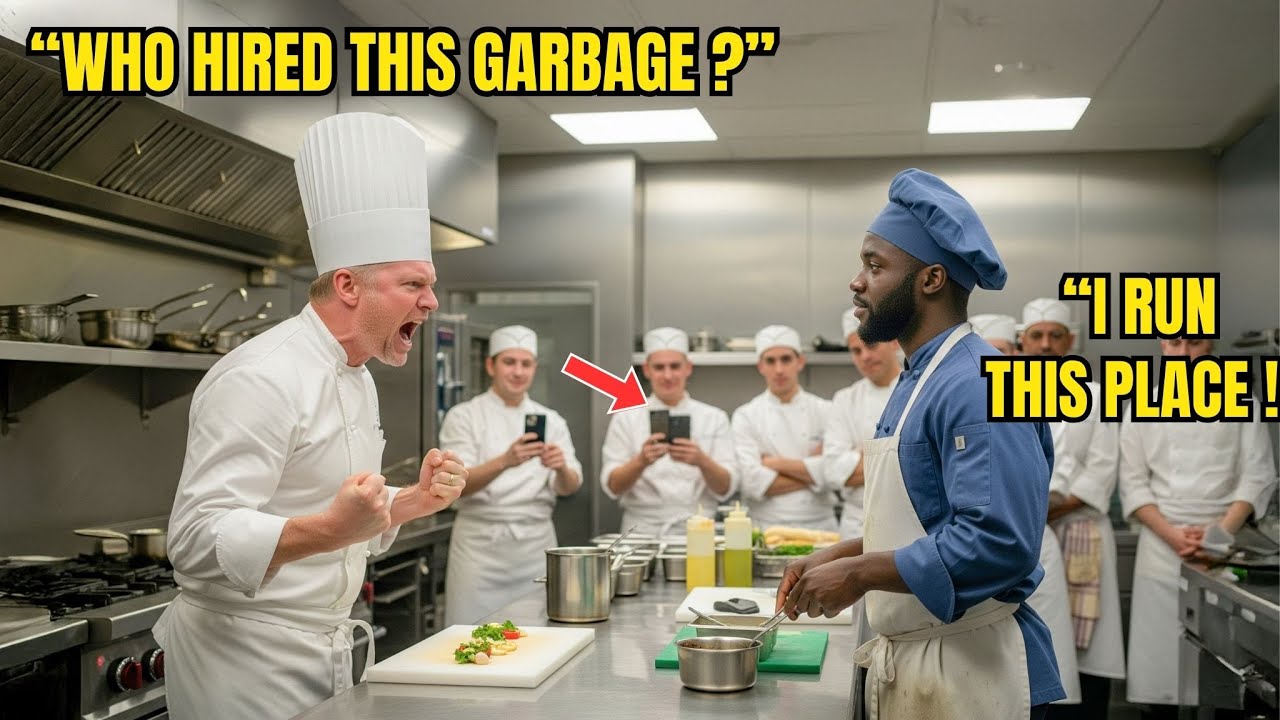
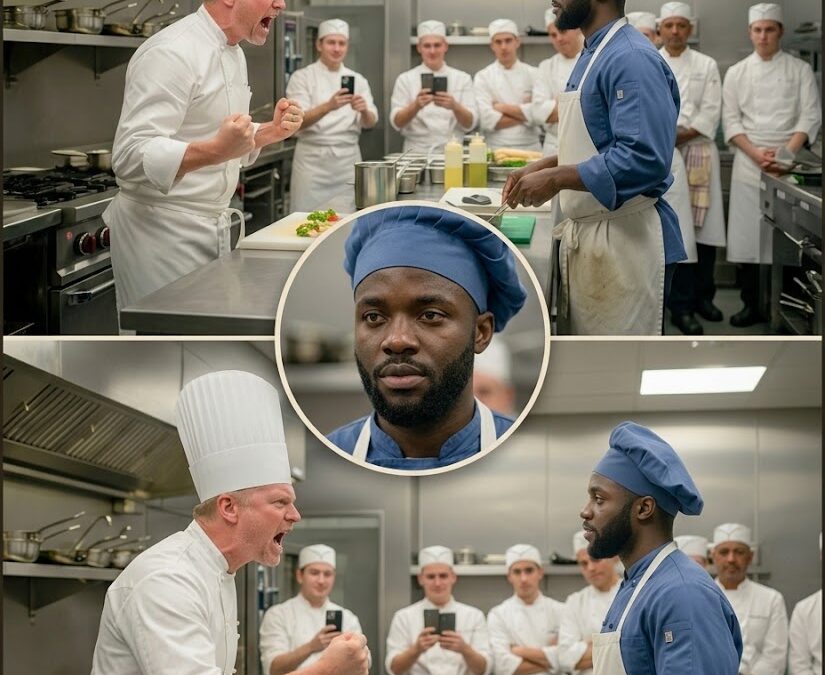
This garbage wouldn’t be served in a prison cafeteria. Who taught you to cook? Your street corner friends? Head chef Gordon grabs the carefully plated dish, his face contorting with rage, and hurls it across the counter. The porcelain shatters against the wall, sending braised short ribs and root vegetables scattering across the immaculate floor.
The entire kitchen freezes. Line cooks stop mid-chop. Servers halt with trays suspended. Only the industrial ventilation hums in the sudden silence as all eyes fix on the black cook standing at station three. Gordon stalks closer, voice dropping to a theatrical whisper that carries to every corner of the kitchen.
You call this a reduction? This is what happens when you hire people for their color instead of their competence. This, he jabs a finger at the splattered dish, is ghetto cooking at its finest. The black cook’s jaw tightens. His eyes, focused somewhere beyond Gordon’s shoulder, betray nothing. With deliberate calm, he unties his apron, folds it precisely, and places it on the stainless steel counter.
He pulls out his phone and dials a single number. Gordon snorts. Running to cry to someone? Nobody can help you here. This is my kitchen. The cook ends his call, pockets the phone, and meets Gordon’s gaze directly for the first time. You’ll see exactly who I am tomorrow. The black cook walks out, leaving Gordon laughing, unaware that several staff members have quietly recorded the entire incident.
The morning sun glints off the polished steel letters adorning Chicago’s latest culinary sensation, Altitude. Inside, the kitchen staff moves with practiced precision, preparing for another day of gastronomic excellence. Altitude has become the city’s most coveted reservation since celebrity chef Gordon Thorne took over 6 months ago, bringing his television persona and Michelin starred expertise to the upscale establishment.
Gordon strides through the kitchen, trailing intimidation like cologne. His crisp white uniform bears not a single stain despite hours of prep work. Faster on those brunoise carrots, Davis. They look like they were cut by a child. His British accent sharpens when he’s displeased, which is most of the time. The back door opens at precisely 9:00 a.m.
A man enters wearing dark jeans, a simple button-down shirt, and clean but casual shoes. His confident posture and observant eyes scan the kitchen layout methodically. Gordon turns, eyebrows rising. Looking for the dishwasher position? Service entrance is around the corner. Several line cooks smother uncomfortable smiles.
I’m Andre Wilson. The man extends his hand with practiced professionalism. Starting today as the new line cook. Chef Morales hired me last week. Gordon’s face shifts, friendliness evaporating like water on a hot flat top. He ignores the extended hand. Ah, yes. Wilson. He studies the resume on his clipboard with exaggerated scrutiny.
Le Cordon Bleu Paris, externship at Noma, sous chef at Harlequin. Impressive on paper. The emphasis on paper hangs in the air like smoke. Thank you, Chef. I’m excited to join the team. Andre’s voice remains steady, professional. Gordon snaps his fingers at a nearby cook. Evans, show Wilson where to store his things.
No introduction to the staff. No tour of the facilities. No welcome. Within 20 minutes, Andre stands at a prep station assigned to mundane vegetable preparation while cooks with far less experience handle more complex tasks. Gordon appears at his shoulder every few minutes finding fault with his knife technique, his speed, his organization despite Andre’s textbook precision.
Across the kitchen, a white cook uses identical technique on identical ingredients. Beautiful work, Thompson. Gordon praises. Perfect technique. Andre notices. Says nothing. Continues working. During pre-service briefing, Gordon reviews daily specials without making eye contact with Andre. Staff members exchange glances.
They’ve seen this before. He won’t last a week in my kitchen, Gordon murmurs to his sous chef voice intentionally carrying to Andre’s station. Mark my words. As service begins, Gordon deliberately assigns Andre to the most challenging station smiling when he says, Let’s see what you’re really made of. The dinner rush hits Altitude like a tidal wave.
Tickets stream from the printer in an endless ribbon while Gordon barks orders across the line. Andre works the fish station notorious for its complexity and unforgiving timing. His movements flow with practiced efficiency. Each plate emerging precisely to specification. Table nine, halibut fire now. Gordon calls. Andre responds instantly.
His timing immaculate. The fish sears to golden perfection plated with an artistic arrangement of seasonal vegetables and citrus emulsion. He slides the dish to the pass with quiet confidence. Gordon inspects it. Face tightening. He runs a finger along the plate’s edge. There’s a fingerprint here. And this sauce is pooling on the left side.
He pushes it back. Do it again, properly this time. Andre doesn’t argue. He starts over while simultaneously managing three other active tickets. The second plate emerges flawless. “Passable.” Gordon mutters, finding no legitimate fault. 40 minutes into service, the maître d’ approaches the pass. “Chef, the ambassador’s table has requested a special off-menu seafood sampler.
They need it in 15 minutes for an important toast.” Gordon turns to Andre’s station. “Wilson, ambassador’s table needs a five-component seafood tasting in 15. Make it happen.” The kitchen collectively tenses. It’s an impossible time frame for such complexity. Andre adjusts without complaint. His hands move with surgical precision, searing scallops while simultaneously preparing crab, coordinating with the garde manger for accompaniments, building a progressive tasting of escalating flavors.
Against all odds, the platter arrives at the pass with 20 seconds to spare. Gordon tastes each component, his face betraying momentary surprise before resetting to disdain. “It lacks refinement. The flavor progression is pedestrian.” He sends it anyway, having no legitimate reason to reject it.
When the server returns, she beams. “The ambassador asked to personally compliment the chef on the seafood platter. Said it was the best he’s had in Chicago.” Gordon’s jaw clenches. “Wilson.” He calls across the kitchen. “Where did you say you trained again?” “Le Cordon Bleu Paris, Chef.” Andre responds without looking up from his station.
“Funny, your technique doesn’t reflect that pedigree.” Gordon’s voice carries across the kitchen. “I know several graduates from there. Wonder if you were one of those diversity admissions they’ve been prioritizing.” The kitchen falls silent. Cooks focus intently on their stations, unwilling to make eye contact with either man.
Andre continues working, dignity intact. My techniques speak for themselves, Chef. Gordon stalks to Andre’s station and adjusts his sous vide temperature setting without explanation, then walks away. The sabotage is subtle, but could ruin every protein in the bath. Andre notices immediately and quietly corrects it, earning subtle nods of respect from nearby cooks.
A server returns with compliments specifically for Andre’s dishes, causing Gordon’s face to darken with jealousy as he mutters, “We’ll see who’s still standing at the end of the week.” “Tomorrow we host potential investors,” Gordon announces during morning lineup, pacing before his assembled staff. “Each chef will prepare a signature dish for tasting.
This is your opportunity to demonstrate your value to this establishment.” His gaze lingers on Andre. Or lack thereof. The kitchen buzzes with nervous energy as preparations begin. Stakes couldn’t be higher. These moments define careers in the culinary world. Andre selects premium ingredients with thoughtful precision. His concept, a sophisticated reinterpretation of his grandmother’s Caribbean-influenced bouillabaisse, featuring local Lake Michigan whitefish alongside traditional seafood, brightened with Scotch bonnet and green mango. The dish honors his heritage
while showcasing classical French technique. Gordon prowls between stations, offering praise and constructive criticism to most cooks. When he reaches Andre, his demeanor shifts. “What’s this supposed to be?” Gordon picks up a Scotch bonnet pepper with exaggerated caution. “It’s a key flavor component in my grandmother’s recipe, Chef.
I’m creating a refined interpretation of ah, soul food. Gordon’s voice projects for the entire kitchen to hear. I suppose we should be grateful it’s not fried chicken or watermelon. He laughs at his own joke. Several cooks wince, but no one intervenes. Andre continues his meticulous preparation, refusing to engage with the provocation.
His sauce reduces to silky perfection, aromatics filling his corner of the kitchen. In fine dining, Wilson, Gordon continues, we typically avoid overwhelming flavors that mask subtlety. But I suppose that’s cultural, isn’t it? The implication hangs poisonously in the air. As Andre begins final plating, each component arranged with artistic precision, Gordon passes behind him, bumping his elbow.
The container of painstakingly prepared saffron emulsion spills across Andre’s station. Clumsy, Gordon remarks without apology. Better clean that up quickly. Investors arrive in 10 minutes. Andre’s expression reveals nothing as he immediately begins remaking the sauce, working with double efficiency. Somehow he completes the dish seconds before investors enter the kitchen.
Eight immaculately dressed financial representatives follow the restaurant owner through the kitchen, stopping at each station to taste and evaluate. They respond positively to each offering until they reach Andre’s station. And what do we have here? asks the lead investor, a silver-haired woman whose Hermes scarf probably costs more than a line cook’s monthly salary.
Before Andre can speak, Gordon interjects. This is Wilson’s ethnic interpretation. The way he emphasizes ethnic transforms it from descriptor to dismissal. It’s a modernist take on Caribbean bouillabaisse,” Andre explains professionally. “Traditional scotch bonnet and green mango brightens the seafood profile while honoring classical French techniques.
” The investor samples it, eyebrows rising in pleasant surprise. “This is remarkable. The heat is present but controlled, and the balance” Gordon interrupts by taking his own taste, face contorting in exaggerated disgust. “The technique is fundamentally flawed. Wilson, taste this yourself and tell me you don’t detect the imbalance.
” Andre accepts a clean spoon, but as he reaches for the plate, Gordon’s hand accidentally knocks the utensil from his grasp. It clatters to the floor. “Coordination issues today?” Gordon smirks. “Perhaps fine dining isn’t your natural environment.” The investors shift uncomfortably. The owner’s smile becomes fixed and plastic.
Andre retrieves another spoon, with unbroken dignity, tastes his creation, and responds with quiet confidence. “The dish is precisely as intended, Chef.” Gordon’s face flushes crimson. He grabs the plate and hurls it across the counter, shattering porcelain and sending carefully crafted food across the polished floor.
“This garbage wouldn’t be served in a prison cafeteria. Who taught you to cook? Your street corner friends?” Silence falls like a guillotine. Every eye in the kitchen witnesses the escalation from professional criticism to naked racism. “This,” Gordon jabs his finger at the splattered remains of Andre’s creation, “is what happens when kitchens prioritize diversity over quality.
This is ghetto cooking at its finest.” Andre’s jaw tightens. With deliberate calm, he unties his apron, folds it precisely, and pulls out his phone. He dials a single number. Gordon sneers. Running to cry to someone? Nobody can help you here. Andre pockets his phone, his gaze direct and unnerving. You’ll see exactly who I am tomorrow.
As the door closes behind Andre, several kitchen staff exchange meaningful glances and begin texting, while Gordon notices one cook has been recording the incident with phone partially hidden. Andre’s composure holds until his apartment door locks behind him. Only then does his professional mask crack. His hands tremble, not with fear, but with controlled rage that ripples beneath his skin like electrical current.
He places both palms flat against the cool granite of his kitchen counter, exhales slowly, and closes his eyes. This isn’t the first time. Images flash through his mind. Culinary school instructors assuming he needed remedial training despite his straight A’s. Externship coordinators assigning him to prep work while less qualified classmates handled signature dishes.
Hiring managers examining his resume with poorly concealed skepticism. But never this blatant. Never this public. Andre opens his eyes, decision made. He retrieves his phone and dials a number from memory. Sir, it’s Blackwood. His voice transforms, gaining authority and precision that was deliberately absent in the kitchen.
The situation at Altitude is worse than our initial reports indicated. Gordon Thorne isn’t merely difficult, he’s actively discriminatory. The voice on the other end responds inaudibly. Yes, sir. I’ve documented everything according to protocol. Today’s incident crossed every line. Racial slurs, physical intimidation, deliberate sabotage.
Several staff members recorded it. Andre straightens his shoulders. I believe we have sufficient evidence to proceed. Another pause as he listens. Understood. I’ll initiate protocol immediately. He ends the call and immediately begins a series of others, speaking in efficient clipped sentences to unseen colleagues. In his home office, Andre slides back a panel revealing a wall covered with framed achievements.
James Beard certificates, Michelin recognition, a degree from Harvard Business School, and a corporate leadership award from Elevation Hospitality Group, parent company of 37 upscale restaurants nationwide, including Altitude. On his laptop, Andre opens an encrypted folder labeled Operation Clean Kitchen. Inside are meticulous notes documenting 3 weeks of observations alongside HR complaints from former employees spanning 5 years.
He begins typing his official report, attaching today’s witness statements already arriving in his secure email. Meanwhile, at Altitude, Gordon struts through the kitchen, energized rather than chastened by the confrontation. That’s what happens when you can’t take the heat, he announces to the subdued staff.
Real kitchens require real chefs, not diversity hires looking for special treatment. Line cook Evans glances nervously at sous chef Michaels. That was really out of line, even for Chef Thorne. Not our business, Michaels mutters, though his expression betray discomfort. In the locker room, pastry chef Jiang sends a video file to three contacts with the message, This is worse than I told you.
Sending to that reporter friend of yours now. Gordon appears in the doorway. Problem, Jiang? No, Chef. She pockets her phone. Just checking tonight’s dessert specifications. Good. And remember, what happens in my kitchen stays in my kitchen. Loyalty matters in this business. Gordon’s smile doesn’t reach his eyes. Wilson was a nobody. I’m Gordon Thorne.
Remember which side your bread is buttered on. As Gordon returns to his office, he misses the exchange of glances among his staff. The first social media post containing the video appears anonymously on a chef’s forum with the caption, “This is what really happens at celebrity chef Gordon Thorne’s prestigious kitchen.
” In his apartment, Andre receives notification of an emergency board meeting scheduled for 9:00 a.m. He forwards several files to the corporate legal team, then texts a simple confirmation. “All evidence secured. Proceeding as discussed.” He stands at his window overlooking Chicago’s glittering skyline, straightens his shoulders, and allows himself a single moment of anticipation.
Tomorrow, Chef Thorne learns who I really am. Andre stares at notification of an emergency board meeting scheduled for tomorrow morning as he calmly says into phone, “Everything is in place. Tomorrow, Chef Thorne learns who I really am.” Gordon arrives at Altitude the following morning to find the kitchen unnervingly quiet.
Four station chefs are conspicuously absent, including Jiang and Evans. “Pathetic,” Gordon announces, tossing his bag into his office. “Loyalty is dead in this generation. If they’re standing with Wilson, they can stay gone.” Sous Chef Michaels approaches cautiously. “Chef, HR called. They’re sending someone this morning.
” “For what?” Gordon snaps, yanking his whites from their hanger. “Didn’t say. Just that they need to review some documentation.” Gordon dismisses this with a wave. “Corporate nonsense. Probably updating harassment policies again because someone got their feelings hurt. The kitchen prep continues with skeleton staff, tension thickening the air.
At precisely 10:00 a.m., a woman in a charcoal suit enters through the back door. Chef Thorne? Vanessa Reynolds, human resources. She extends a hand that Gordon barely acknowledges. I need to review your staff complaint records. Gordon’s smile is all teeth. My kitchen runs on excellence, not coddling.
If someone files a complaint, they’re probably not cut out for professional kitchens. Nevertheless, Reynolds continues unruffled. I need to see those records. Along with any performance improvement plans you’ve implemented. Michael’s can help you, Gordon delegates with obvious irritation. I have a restaurant to run. As Reynolds follows Michael’s to the office, Gordon barks orders with increased aggression, his British accent sharpening with each command.
A young prep cook nearly slices his finger when Gordon slams a pot beside him. By noon, the dining room opens with tension simmering beneath the kitchen’s professional veneer. Gordon scrutinizes every plate with hypercritical attention, rejecting dishes for imperceptible flaws. During a momentary lull, Michael’s approaches again.
Chef, there’s something you should know. The video from yesterday What video? Gordon’s head snaps up. Someone recorded what happened with Wilson. It’s circulating. Gordon’s face darkens. If I find out who recorded in my kitchen without permission, they’re finished in this industry. I’ll sue them for defamation. Michael’s swallows hard.
It’s on several chef forums already. Gordon’s phone chimes with a notification. The maître d’ approaches with uncharacteristic hesitation. Chef, we’ve had three cancellations in the last hour. One party specifically mentioned the ethical concerns.” “Coincidence,” Gordon dismisses. Another notification, his publicist.
Another, his agent. A third, the network that airs his competition show. Before he can check any messages, the dining room manager appears. “Chef Thorne, James Moretti canceled his reservation. He said, and I’m quoting, ‘I won’t support establishments that tolerate racism.'” “Moretti? The food critic?” Gordon’s confidence wavers for the first time.
“Yes, Chef.” Gordon’s phone rings, the restaurant owner. He answers immediately, stepping away from staff. “Charles, this is all being blown out of proportion. Wilson couldn’t handle professional standards, and” the voice on the other end cuts him off. Gordon’s expression cycles through disbelief, anger, and the first flicker of concern.
“Of course I can explain. This is nothing but cancel culture targeting success. I’ve built Altitude’s reputation from nothing. The investors yesterday were impressed with” He’s interrupted again, listening longer this time, face paling slightly. “I understand. Yes. I’ll handle it personally.” Gordon hangs up, composure momentarily fractured before he reassembles his confident facade.
“Listen up,” he announces to the kitchen. “Someone here betrayed this team by leaking false information. When I find out who’s responsible, the back door opens. Two men in suits enter, Altitude’s security team, typically present only for celebrity guests. “Chef Thorne,” the taller one says, “your presence is requested at corporate headquarters immediately.
” As Gordon is led away, his phone buzzes with notification of trending social media hashtag #gordonthornracist alongside the viral video of yesterday’s incident. Andre sits in a sleek conference room at Elevation Hospitality Group’s downtown Chicago headquarters. Across from him, Eleanor Winters, the company’s lead counsel, reviews documentation with methodical precision.
“Your notes are impressively thorough, Mr. Blackwood,” she says, using Andre’s real surname. “Timestamps, witnesses, direct quotes, and you’ve maintained this documentation since your first day undercover?” “Since before that,” Andre corrects, sliding another folder across the polished table.
“These are complaints filed by former employees dating back 5 years, 17 total. All settled quietly with non-disclosure agreements.” Eleanor’s eyebrows rise. “This establishes a clear pattern of behavior.” “That was precisely my assignment,” Andre confirms. “After the third discrimination settlement last year, the board suspected a systemic issue rather than isolated incidents.
” His phone vibrates. “Excuse me,” he says, checking the screen. “That’s Jesse from legal. Three more staff members have come forward as witnesses from yesterday. They’re giving statements now.” Eleanor nods approvingly. “The video evidence is damning on its own, but corroborating testimony strengthens our position considerably.
” Andre opens his laptop displaying a social media monitoring dashboard. “Gordon Thorn racist trends at number three nationally, with engagement climbing by the minute. Celebrity chefs have begun issuing statements distancing themselves from Gordon’s behavior. The court of public opinion has already reached its verdict,” Andre observes without satisfaction.
“Our concern is protecting the company and creating meaningful change.” Meanwhile, Gordon sits in a small windowless room at the same corporate headquarters, accompanied only by Bradley Carter, a junior associate from the legal department. “This is absurd,” Gordon fumes, checking his vibrating phone for the dozenth time.
“One cook couldn’t handle criticism and suddenly I’m summoned like some entry-level prep cook?” Chen maintains a neutral expression. “Chef Thorn, I understand your frustration. Your celebrity status is valuable to Elevation Hospitality Group. I’m confident this situation can be resolved appropriately.” Gordon relaxes marginally.
“Finally, someone talking sense. Wilson clearly couldn’t handle a professional kitchen. If he’s making accusations “I didn’t specify any accusations,” Carter interrupts mildly. Gordon waves this away. “The video’s being taken out of context. Kitchens are high-pressure environments, language gets colorful, everyone knows this.
” “Of course,” Carter agrees diplomatically. “The board simply wants your perspective on the incident.” Gordon’s phone rings, his television agent. He answers immediately. “Martin, what’s happening with the network?” Gordon listens, face darkening. “Suspended? The contract specifically states Yes, I understand optics, but Well, tell them.
Hello? Hello?” He stares at the phone. “He hung up on me. Martin hung up on me.” Chen pretends to review notes, offering Gordon privacy during his unraveling. Gordon attempts three more calls, each going directly to voicemail. He fires off text messages that remain unanswered. With each passing minute, his legendary confidence deteriorates.
Outside in the hallway, doors open and close, Voices murmur. Gordon recognizes one, Zhang, his pastry chef, speaking to someone who responds with the gravitas of authority. “This isn’t right.” Gordon mutters, loosening his collar. “I need to speak with Charles. Where’s the actual owner in all this?” “Mr.
Devereaux is meeting with the board.” Carter replies carefully. “As is the parent company’s senior leadership.” “Over one incident? This is preposterous. I’ve made Altitude the hottest reservation in Chicago.” Gordon’s voice rises. “I’m Gordon bloody Thorn. I have three shows and a cookbook coming out next month.” His phone chimes with a news alert.
Celebrity chef Gordon Thorn under fire for racist tirade. Another notification follows from his publisher. Urgent. Call immediately re: cookbook release. Chen’s phone vibrates. He checks it, nods once, and stands. “Chef Thorn, the board will see you now.” Gordon smooths his chef’s jacket, squares his shoulders, and follows Carter down a long hallway to an imposing boardroom.
Through the glass walls, he sees a full complement of executives seated around a massive table. “Remember your value.” Gordon mutters to himself. “They need you more than you need them.” The door opens. Carter gestures him inside. “Please wait here. The final participant will arrive momentarily.” “Final participant? What is this, a bloody tribunal?” Gordon demands, but Carter has already retreated.
Gordon scans the room, recognizing Charles Devereaux, Altitude’s owner, alongside Elevation Hospitality Group’s CEO and various executives. Their faces reveal nothing. The door behind him opens once more. Security returns with message for Gordon. “Your presence is requested immediately at corporate headquarters.
Board members have flown in specifically to meet with you.” Gordon arrives at Elevation Hospitality Group’s corporate headquarters, escorted by security through the gleaming lobby. The receptionist avoids eye contact as she directs them to the executive floor. “This is completely unnecessary,” Gordon protests as they ride the elevator.
“I could have driven myself.” The security officers remain professionally silent. Stepping off on the 42nd floor, Gordon notices immediate irregularities. Conference rooms normally reserved for marketing presentations now contain small groups of Altitude staff. Through glass walls, he glimpses Jiang gesturing emphatically to two people taking notes.
In another room, Evans demonstrates something with his hands while a woman records his statement. “What’s happening here?” Gordon demands. “This way, please, Chef Thorne,” the security officer responds, ignoring the question. As they pass another conference room, Gordon clearly hears the phrase “pattern of behavior” followed by “liability concerns.
” His confidence wavers momentarily before he straightens his shoulders, adjusting his chef’s jacket. Gordon checks his phone again. No response from his agent. Three missed calls from his publicist. A text from his TV producer. “Need to discuss show status. Contract clause 18.3 specifically addresses public image concerns.
” “Bloody vultures,” Gordon mutters, pocketing the phone. They direct him to a small waiting area outside the main board room. Through partially open blinds, he sees board members in intense discussion. Charles Devereaux, Altitude’s owner, gestures with unusual animation. “Charles,” Gordon calls, moving toward the door.
Security steps smoothly into his path. “Please wait here, Chef Thorne. They’ll call you when they’re ready. 20 excruciating minutes pass. Gordon alternates between pacing and checking his increasingly concerning messages. His cookbook publisher has postponed their marketing campaign. A celebrity chef colleague who yesterday invited him to co-host a charity event now regrettably must reconsider given recent developments.
Finally, Bradley Carter emerges from the boardroom. They’re ready for you now, Chef. Gordon enters a room designed to intimidate. Floor-to-ceiling windows showcasing Chicago’s skyline, a massive conference table of polished walnut, and 12 grave-faced executives whose combined net worth could buy a small country.
“Gordon,” Charles begins without preamble, “we’ve called you here regarding yesterday’s incident with a staff member. Hardly an incident,” Gordon attempts his characteristic charm. “A simple matter of kitchen standards. If Wilson couldn’t handle constructive criticism, “We’ve reviewed the video,” interrupts Elaine Barrington, Elevation’s CEO.
Her tone could freeze lava. Multiple videos, actually, from different angles, along with statements from 17 staff members. Gordon pivots smoothly. Kitchen environments are necessarily intense. Perhaps to outsiders the language seems harsh, but every serious chef understands “This isn’t about intensity,” Charles cuts in.
“This is about explicitly racist language, physical intimidation, and creating a hostile work environment. That’s absurd. I run the most successful kitchen in your portfolio. Altitude’s reservation list extends 3 months out. We’ve doubled revenue since I took over. “At what cost?” Elaine asks. “Our staff turnover under your management is triple the industry average, particularly among minority employees.
Gordon scoffs. If they can’t handle professional standards, We’ve reviewed your performance metrics against staff demographics, interjects a man Gordon doesn’t recognize. There’s a statistically significant correlation between negative evaluations and employees racial backgrounds. This is ridiculous. I’m Gordon Thorne.
I’ve built my brand on excellence, not coddling mediocrity. My reputation Your reputation is precisely why we’re here, Elaine interrupts. The board was already reviewing complaints before yesterday’s incident. We have a responsibility to our shareholders, our employees, and our guests. Gordon’s strategy shifts.
Look, perhaps I was overly harsh with Wilson. I’m willing to issue an apology, do some sensitivity training nonsense if that’s what the PR team recommends, but let’s be reasonable about this. My name brings customers through the door. The boardroom door opens behind him. Gordon doesn’t turn, assuming it’s an assistant with refreshments.
Elaine’s expression shifts subtly. Ah, here’s the final participant in our discussion. Gordon turns, expecting perhaps a diversity consultant or HR director. Instead, he finds himself face-to-face with Andre Wilson. Except the man now wears an impeccable suit with an Elevation Hospitality Group executive badge. Gordon’s face drains of color as Andre walks in wearing an executive suit with company leadership badge, followed by several people carrying documentation boxes labeled Thorne Investigation.
Allow me to reintroduce myself, Andre says, extending his hand with perfect professionalism. Anthony Blackwood, senior vice president of operations for Elevation Hospitality Group. Gordon stares at the extended hand as if it might bite him. His mouth opens, closes, then opens again without producing sound. Please, sit down, Chef Thorne.
Anthony gestures to the empty chair as assistants arrange labeled document boxes on a side table. The nameplate at his designated seat reads Anthony Blackwood, SVP Operations, in gleaming brass. Gordon sinks into the chair, cognitive dissonance evident on his face. This is I don’t understand. Elaine Barrington leans forward.
Three months ago, our board received the seventh discrimination complaint in 2 years from Altitude’s kitchen staff. Rather than simply process another settlement, we decided to investigate the root cause. Mr. Blackwood volunteered to conduct an undercover assessment, Charles adds, a direct observation of kitchen culture and management practices.
Anthony opens a leather portfolio. To be completely transparent, Chef Thorne, I didn’t arrive with any predetermined conclusions. My assignment was simple: observe and document the daily operations at Altitude without the influence of my position or authority. You lied to me. Gordon manages, finding his voice.
You infiltrated my kitchen under false pretenses. My culinary credentials are entirely legitimate, Anthony corrects. Le Cordon Bleu Paris, externship at Noma, sous chef position at Harlequin. The only misrepresentation was my current executive role. Gordon’s shock transforms to indignation. This is entrapment. You deliberately provoked me to create this situation.
Anthony calmly slides a tablet toward Gordon. This contains a compilation of documented incidents from my 2 months of observation prior to actually working in your kitchen. 64 instances of racially coded language, 27 cases of disparate treatment based on perceived ethnicity, 19 examples of sabotaging minority staff members work.
Gordon pushes the tablet away. Kitchens are high-pressure environments. If you don’t have the temperament I’ve worked in and managed some of the world’s finest kitchens, Chef Thorne. Anthony interrupts, steel beneath his professional tone. Pressure doesn’t explain systemic bias. It doesn’t justify racial slurs.
It certainly doesn’t excuse deliberately undermining staff based on their skin color. Charles Devereaux clears his throat. Gordon, we have statements from 12 current and former staff members submitted just this morning. They came forward independently after yesterday’s incident. Everyone has an axe to grind in this business, Gordon dismisses, though his legendary confidence shows cracks.
Disgruntled employees seeing an opportunity. I didn’t come looking for this behavior, Chef Thorne, Anthony says quietly. You volunteered it from day one. My first morning, you assumed I was applying to wash dishes based solely on my appearance. Before seeing my resume, before exchanging a single word, you made a determination about my capabilities that had nothing to do with my skills.
Gordon shifts strategy. Perhaps I made some inappropriate assumptions. Everyone has unconscious biases. But to suggest I deliberately The financial impact of your management style is measurable, interrupts a woman at the far end of the table. She slides a financial report across the polished surface. Staff turnover under your leadership costs Altitude approximately $382,000 annually in recruitment, training, and productivity loss.
Anthony nods. That turnover is not evenly distributed. Minority staff leave at three times the rate of white employees. Exit interviews consistently cite hostile work environment and discriminatory treatment as primary factors. Gordon’s eyes dart around the table, seeking any sympathetic face. Finding none, he falls back on his final leverage point.
My name on the door brings in reservations. My reputation generates press coverage you couldn’t buy with a million-dollar marketing budget. Customers come to Altitude because Gordon Thorne is executive chef. And they’re canceling those reservations just as quickly now, Charles responds. We’ve lost over 200 covers since yesterday.
Three major corporate events have pulled their bookings this morning. Gordon straightens, regaining some composure. This will blow over. The public has a short memory. A carefully worded apology, perhaps a donation to some appropriate organization. The board was already considering leadership changes at Altitude before yesterday’s incident, Elaine interrupts.
Your behavior simply accelerated our timeline. You can’t be serious, Gordon’s voice rises. I’ll take my brand elsewhere. Daniels has been trying to recruit me for his restaurant group for months. He’ll have a contract in front of me by dinner. Anthony’s expression remains professional, but his eyes hold something like pity.
We’ve already briefed our industry colleagues as a professional courtesy. No reputable restaurant group will risk association with this situation. Gordon’s phone buzzes with an incoming call. His agent again. He silences it without looking away from Anthony. You set me up, he accuses. You deliberately infiltrated my kitchen to engineer this outcome.
I documented what I witnessed, Anthony corrects. The behavior was yours, the words were yours, the choices were yours. Elaine slides a document across the table. This is a separation agreement, Chef Thorne. It includes a generous severance package in exchange for your immediate resignation and a mutual non-disparagement clause.
Gordon stares at the document without touching it. And if I refuse? Charles sighs. Then we terminate your contract for cause with no severance and the evidence collected becomes part of the public record through subsequent legal proceedings. Gordon’s carefully constructed world collapses in slow motion before his eyes.
His gaze returns to Anthony, searching for weakness, for uncertainty, for any crack in the professional veneer. He finds none. Have you ever made a mistake, Mr. Blackwood? Gordon asks, voice uncharacteristically quiet. Ever said something in the heat of the moment you regretted? Many times, Anthony acknowledges. The difference is learning from those mistakes rather than establishing them as standard operating procedure.
Anthony slides termination agreement across table saying, You have a choice, Chef Thorne. Sign this with its confidentiality clause and generous severance or face public litigation where all evidence becomes court record. Gordon signs the termination agreement, his once confident signature now trembling slightly.
Without meeting anyone’s eyes, he exits the board room, leaving behind the ruins of his carefully constructed empire. That’s one phase complete, Elaine observes as the door closes. Anthony, the real work begins now. Anthony nods, shifting mentally from investigator to rebuilder. I’ve prepared a transformation plan for Altitude’s kitchen culture that we should implement immediately.
Charles Devereaux frowns. Altitude’s reputation will suffer regardless. That video has almost 2 million views already. Which presents an opportunity, Anthony counters opening his laptop. We can show that Elevation doesn’t just remove problems. We create solutions. The boardroom transforms into a command center over the next 3 hours.
Legal drafts statements while Anthony presents sobering industry statistics. The restaurant industry’s discrimination problem isn’t unique to Altitude, he explains advancing through data-rich slides. Nearly half of minority chefs report direct discrimination. Over 60% believe racial bias hindered their advancement.
And almost 80% have witnessed discriminatory behavior toward colleagues. Board members absorb these statistics with growing concern as Anthony connects them to business metrics, staff turnover, training costs, litigation risks, and brand damage. The good news, he continues, is that addressing these issues creates measurable benefits beyond risk mitigation.
His charts display productivity increases, innovation metrics, and retention rates from restaurants with diverse leadership. By afternoon, the crisis response crystallizes. Altitude will close for 2 weeks for comprehensive retraining. Anthony will personally oversee kitchen restructuring, and Elevation will launch a $2 million scholarship program for minority culinary students.
Meanwhile, Altitude’s kitchen staff gathers in the employee lounge, exchanging worried glances as news of Gordon’s departure spreads through texts and whispers. “Is it true?” a line cook asks. “Gordon’s really gone?” Sous Chef Michaels nods, looking simultaneously relieved and terrified. “Effective immediately.
No replacement named yet.” The door opens and Anthony enters, now fully embodying his executive role, yet maintaining the approachable demeanor they recognized from their colleague Andre. “I owe you all an apology,” he begins. “My undercover assessment wasn’t meant to deceive you personally, but to observe authentic kitchen operations without my position influencing behavior.
” Silence greets this revelation as staff process the transformation from colleague to executive. “I want complete transparency about what happens next,” Anthony continues. “Altitude will close for 2 weeks. All staff receive full pay during this period. No one loses their job unless they personally participated in discriminatory behavior.
” Pastry chef Jiang raises her hand. “Will we face retaliation for providing statements?” “Absolutely not,” Anthony assures her. “Those who came forward demonstrated the integrity essential to Altitude’s future.” Anthony outlines the transformation plan, answering questions with straightforward honesty. Staff gradually shift from shocked silence to cautious engagement, especially as he details new reporting systems designed to prevent future abuses.
“I’d like those who provided statements to meet with our legal team,” Anthony explains. “Your experiences will help shape policies not just for Altitude, but potentially our entire restaurant group.” Three days later, Elevation Hospitality Group issues a carefully worded press release. Elevation announces leadership changes at Altitude Chicago.
Chef Gordon Thorn has departed to pursue other opportunities. We thank him for his contributions. Altitude will temporarily close for renovation and staff training focusing on inclusive excellence in culinary arts. We’re excited to announce a new scholarship initiative supporting diverse culinary talent, demonstrating our commitment to leadership in both cuisine and workplace culture.
Industry insiders immediately recognize the statement for what it is. Gordon was terminated for cause with legal agreements preventing either party from discussing specifics. Gordon’s professional world collapses with stunning speed. His agent calls that evening. Gordon, I’ve reviewed the situation with my partners.
Given the current climate and your separation agreement, we’re terminating our representation. Before Gordon can respond, the agent continues. The network has officially canceled your show. They’re citing creative differences publicly, but privately they’ve invoked the morality clause. Each day brings new losses. Cookbook release indefinitely postponed.
Restaurant consulting contracts quietly not renewed. Speaking engagements regrettably canceled due to scheduling conflicts. Even his crisis management PR firm drops him after viewing the complete evidence file citing insurmountable challenges and misalignment with our firm’s values. At Altitude, transformation proceeds methodically.
Anthony implements an open door policy and conducts personal meetings with every staff member. Kitchen stations are reorganized to eliminate the hierarchy that facilitated abuse. Training programs emphasize both culinary excellence and professional communication. “Chef doesn’t mean tyrant,” Anthony explains during a staff workshop.
“The best kitchens operate with mutual respect and clear standards. Intensity and precision don’t require intimidation.” Between meetings, Anthony pauses before a framed photograph in his new office. His younger self in chef whites outside a Paris restaurant. The black chef beside him has his arm around Anthony’s shoulders, both beaming with accomplishment.
“I promised you I’d change things, Uncle James,” Anthony murmurs, “one kitchen at a time if necessary.” As Altitude prepares to reopen, reservation requests flood in despite, or perhaps because of, the leadership change. Food critics request opening night tables. Culinary students submit applications at unprecedented rates. The morning of reopening, Anthony gathers the staff for a final briefing.
“Today isn’t just about serving exceptional food,” he tells them. “It’s about demonstrating that excellence and humanity are complementary, not contradictory. Every guest should taste the difference, not just in our cuisine, but in the culture that created it.” A text arrives from Charles Devereaux. “Press asking for comment on Gordon Thorn situation.
How do you want to handle?” Anthony weighs professional ethics against personal satisfaction before responding. “Altitude is focused on the future, not the past. We’re excited to welcome guests to experience our new culinary direction.” At a press conference announcing the restaurant’s reopening, a reporter asks Anthony directly, “Is it true Gordon Thorn was terminated due to racial discrimination?” And all cameras focus on his carefully considered response.
Gordon Thorn sits alone in his luxury condo, staring at the scattered rejection letters across his granite countertop. Three weeks since his Altitude termination, and his carefully constructed empire continues its spectacular collapse. His phone rings. First callback in days. “Yes, this is Gordon Thorn.” “Mr.
Thorn, Emily from Chef’s Classical Academy regarding your guest lecturer application. Yes, I’ve developed an excellent curriculum on advanced sauces that We won’t be proceeding with your application. The academy maintains strict ethical standards for all instructors. The line goes dead. Gordon hurls his phone across the room, hand trembling as he pours his third scotch of the afternoon.
His tablet notification reads, Culinary Visionaries Festival announces updated judge panel. His name has been replaced by Anna Cortez, a rising star known for mentoring young talent. The doorbell rings. A legal courier delivers a thick envelope. Contract termination from Harden publishing for his cookbook Kitchen Command.
The final paragraph cites significant reputational concerns and commercial viability reassessment. His cell phone rings again. Unknown number. Gordon? It’s Daniel Woodson. Gordon straightens. His former protege, now an executive chef at a prestigious New York restaurant. Daniel? Good to hear from you. About that restaurant group expansion? That’s not why I’m calling, Woodson interrupts coldly.
I’ve been watching what’s happening. It’s brought back memories. Daniel, the media exaggerates. I saw the video. It wasn’t exaggerated or isolated. You did the same to Miguel Rodriguez in 2015. I watched you destroy his confidence with identical racist tactics. That’s completely different. No, it’s exactly the same.
I stayed silent then because I feared for my career. Not anymore. The American Culinary Federation Ethics Committee has requested statements. I’m submitting mine tomorrow. The call ends. Gordon stares at the phone comprehending the threat to his ACF credentials, the foundation of his professional standing. Three days later, Gordon sits before the ACF Ethics Committee.
Seven distinguished culinary professionals regard him with expressions ranging from disappointment to outright contempt. Chef Thorne, we’ve reviewed video evidence and 17 sworn statements regarding your conduct. Your response? Gordon delivers his prepared statement about kitchen intensity and maintaining standards.
The words ring hollow even to himself. Former employees testify one by one. A Filipino sous chef assigned to garbage duty whenever VIPs visited. A black pastry chef whose innovations Gordon repeatedly claimed as his own. A Mexican line cook whose accent Gordon mocked during staff meals. The committee’s unanimous decision, Gordon’s ACF certification is revoked for egregious violations of professional ethics and conduct unbecoming of the culinary profession.
Outside, a process server delivers notice of a class action lawsuit from former employees alleging hostile work environment and discrimination. Gordon’s final play comes 2 weeks later. A carefully choreographed social media video. Looking appropriately somber in his home kitchen, he offers what his budget rate PR consultant calls “contrition with dignity.
” “I’ve always believed in pushing people to achieve excellence,” Gordon tells the camera. “Perhaps my methods were sometimes The comment section explodes within minutes. Former employees sharing experiences, colleagues expressing disgust, culinary students vowing to build a different kitchen culture.
His attempted redemption backfires spectacularly. 6 months later, a food blogger posts a blurry photo that quickly goes viral. Gordon Thorne, former celebrity chef, working the line at an airport restaurant chain. His name tag reads Greg. 6 months later, Gordon is recognized working as line cook in an airport restaurant wearing name tag reading Greg instead of Gordon.
As customer secretly takes photo that’s about to go viral. Anthony addresses Altitude’s expanded staff 3 months after reopening. Behind him, digital dashboards display impressive metrics. Revenue up 28% staff satisfaction at 92% guest return rate at 87%. But he points to a different chart. Incident reporting now near zero. “This is our real success.
” He emphasizes. “Excellence without sacrificing dignity.” The transformation ripples across Chicago’s restaurant scene. Elevation Hospitality Group implements Anthony’s reporting system throughout its 37 restaurants. Anonymous channels allow staff to report concerns without fear, while clear accountability ensures appropriate responses.
Industry-wide changes accelerate. The James Beard Foundation adds ethics requirements for award consideration. Culinary schools introduce mandatory courses on professional kitchen culture. Trade publications examine the costs of traditional kitchen hierarchies. “The Altitude Effect.” proclaims Chef’s Quarterly’s cover featuring Anthony alongside his diverse leadership team.
The article details business benefits. Improved retention, reduced training costs, increased innovation, and enhanced guest experiences. Former Altitude staff become change agents elsewhere. Jiang conducts kitchen culture workshops nationwide. Evans consults on implementing anonymous reporting systems. Their first-hand experiences lend credibility to the movement.
Anthony Scholarship Foundation, initially funded by Elevation but now supported by industry partners, enables culinary education for students from underrepresented communities. 30 scholars begin training at prestigious institutions, each with an Altitude Network mentor. “We’re changing how kitchens operate,” Anthony explains to culinary students.
“Abuse disguised as training doesn’t produce better chefs. It produces traumatized people who either perpetuate the cycle or leave entirely.” The data proves his point. Restaurants implementing similar reforms report dramatic improvements in staff retention, particularly among minority employees. Restaurant groups once proud of intense kitchen cultures quietly revise policies, recognizing the business advantages of inclusion.
Celebrity chefs sign a public pledge against abusive practices, some with conviction, others with reluctant acknowledgement of changing standards. Either way, the declaration signals a fundamental shift in what the industry considers acceptable. “This revolution isn’t about political correctness,” Anthony tells the Chicago Tribune.
“It’s recognizing that psychological safety and professional excellence aren’t mutually exclusive. They’re mutually reinforcing.” At prestigious industry awards ceremony, Anthony is called to stage to receive unexpected lifetime achievement award for transformation of kitchen culture, as cameras pan to several famous chefs looking uncomfortable.
One year after Gordon Thorne’s departure, Altitude operates with synchronized precision that comes not from fear, but from shared purpose. Chefs communicate with respect, offering guidance rather than criticism. Plates emerge perfect through collaboration rather than intimidation. Anthony pauses beside Jamal, who started as a dishwasher and now manages garde manger.
“Beautiful plating,” Anthony observes. “Your color balance is exceptional.” Jamal straightens pride, not fear. “Thank you, Chef. The farmers market inspired me this morning.” These small moments validate Anthony’s transformation efforts. Altitude now boasts the lowest staff turnover in Chicago’s fine dining scene.
Applications flood in from professionals eager to work in an environment known for both excellence and humanity. Former staff who witnessed Gordon’s abuse have moved into management positions throughout Elevation Hospitality Group. Michael’s, once the intimidated sous chef, now runs his own kitchen at a sister restaurant implementing the cultural practices he learned during Altitude’s transformation.
In a small town hundreds of miles away Gordon Thorne operates a modest catering business. His voice, once weaponized to intimidate now carries the measured tone of someone learning hard lessons about power and its misuse. A therapy journal sits open on his desk. Today’s entry reads recognized old pattern when critiquing Tyler’s sauce work.
Stopped demonstrated instead of criticizing. Better results better response. Meanwhile Anthony addresses culinary students at Johnson & Wales University. “My journey began with my Uncle James.” he explains showing a photograph of the black chef who mentored him. “The most talented chef I’ve known yet he repeatedly hit glass ceilings based solely on his appearance.
He taught me that true culinary excellence requires more than technique. It demands fundamental respect for every contributor to a memorable meal.” The students absorb his words recognizing both professional and moral implications. “Accountability matters more than punishment.” Anthony continues. “The goal isn’t permanent exile, but transforming behaviors and systems.
Every kitchen can become a place where diversity strengthens creativity and respect enhances excellence. Five new restaurants will open next year under Elevation Hospitality Group, each with leadership reflecting Anthony’s commitment to diverse perspectives. The business case proves as compelling as the moral one.
Profits have increased 22% since implementing reforms. Back at Altitude, Anthony watches culinary students tour the kitchen during service. Their wide eyes take in not just the culinary choreography, but the respectful interactions and evident joy in collective creation. “This,” Anthony tells a young woman asking about Altitude’s success, “is what becomes possible when we recognize a fundamental truth.
True culinary excellence can only exist in kitchens where every voice is respected and every culture honored.” If you enjoyed this story of justice and transformation, don’t forget to hit that subscribe button on the Beat Stories channel. We bring you the most powerful true stories of justice, redemption, and karmic retribution every week.
Click the notification bell so you never miss our newest uploads. Like this video if you believe in workplace dignity and share it with someone who needs to hear this message today. Join our growing community of justice lovers. We’re just getting started. Remember, your subscription powers more stories like this one.
>> This isn’t the end of the story. It’s the beginning of what happens when truth meets visibility. At Beat Stories, we believe exposure is the first step to transformation. Subscribe and stay tuned because the next story might be yours.
You Might Also Enjoy
A Milionária Jogou o Dinheiro No Engraxate… Então Ele Voltou Para Comprar A Empresa Dela

O Empresário Riu Do Sonho Do Peão… Até Precisar De 8 Caminhões Dele Para Salvar A Fábrica

Dono Disfarçado Deixou A Carteira Para Testar A Garçonete… Até Ela Colocar O Próprio Dinheiro Dentro.

A Empresária Riu Quando a Costureira Pediu Demissão… Até Perder Seus Maiores Clientes Para Ela

A Costureira Salvou O Vestido De 40 Anos Da Mãe Do Milionário… Então Ele Bateu À Sua Porta