The Bullies Laughed When the Blind Girl Touched the Piano — Then Her Hands Froze the Room
The Bullies Laughed When the Blind Girl Touched the Piano — Then Her Hands Froze the Room 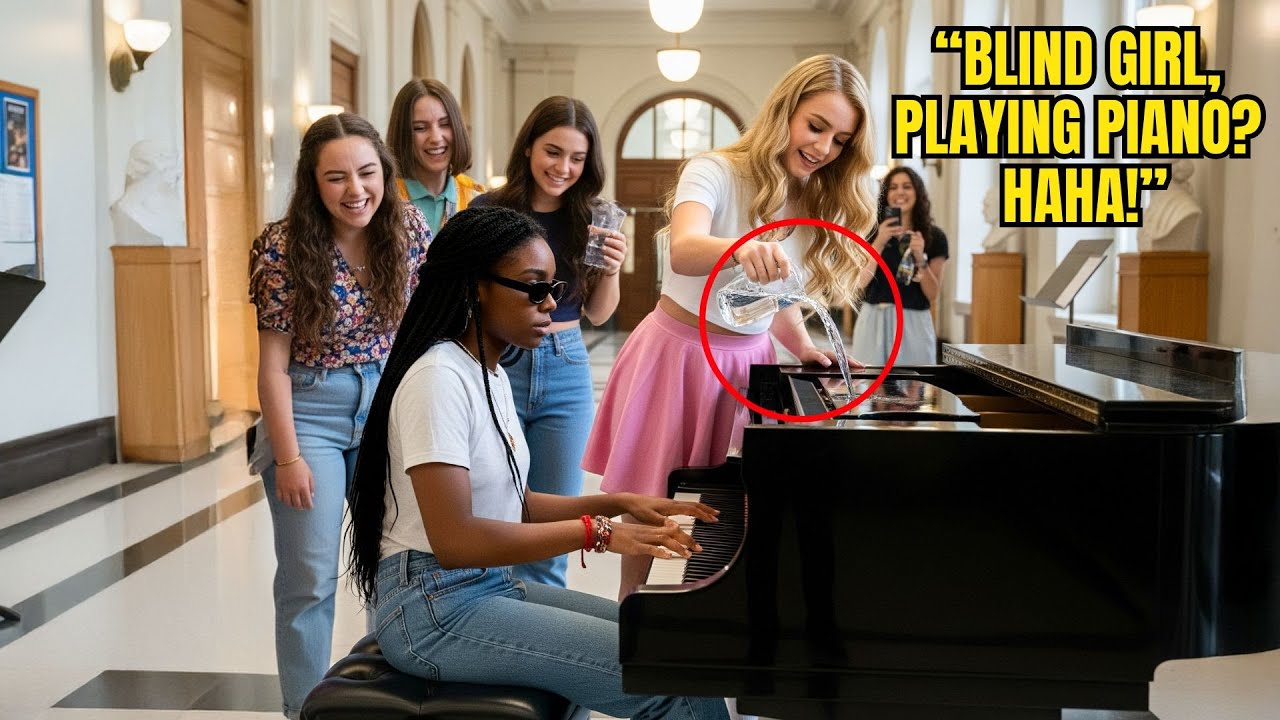
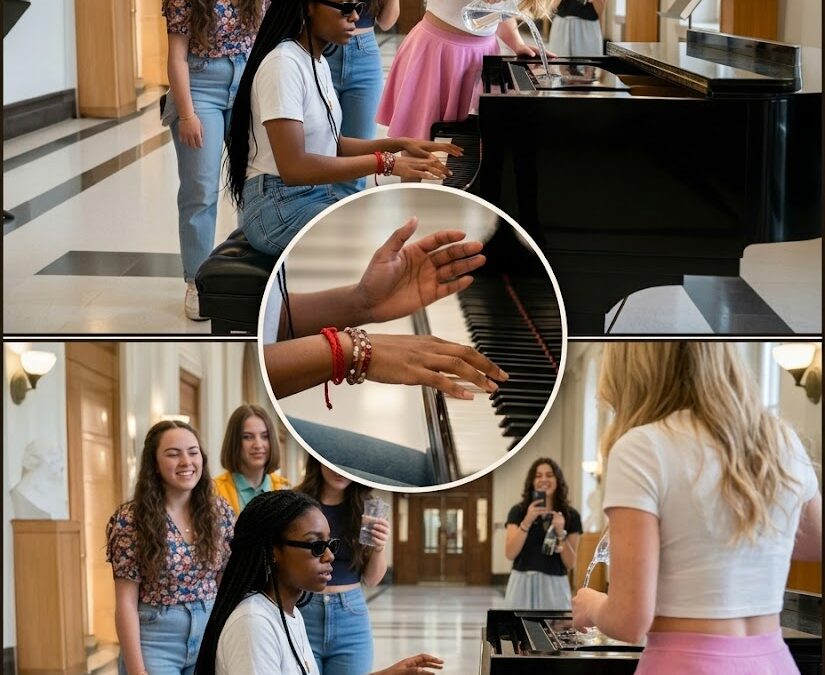
What’s a blind girl going to do at a music school? Count the beats while everyone else plays. The words slice through the pristine marble hallway of Clayton Conservatory, followed by cruel laughter that bounces off the walls. Jayla Green freezes midstep, white cane suddenly heavy in her grip. 19 years old and blind since birth, she’s navigated a world of prejudice before, but this this is different.
The conservatory hallway has a distinct acoustic signature that tells her exactly how many people just heard that comment. Wealth, privilege, exclusion, all wrapped in the sharp echo of deliberate cruelty. The gentle rustle of designer clothing approaches. The hallway smells of lemon polish and entitlement now mixed with the sickening sweetness of expensive perfume drawing closer.
I’m sorry, but are you actually lost? The voice is female, dripping with false concern. This is Clayton Conservatory. You know, for musicians, people who can actually see what they’re playing. More laughter erupts louder now. Jayla catalogs each voice, mapping them in her mind. Five people, no, six. I’m not lost, Jalla says firmly, grip tightening on her cane.
I’m here to register for the Whitmore scholarship auditions. The laughter stops abruptly, replaced by something worse. Stunned silence. “You’re auditioning?” the same voice asks, incredulous. “For a piano performance?” “Yes, one word, dignified.” “I’m Madison Wells. My father is Terrence Wells, head of the board of trustees.” The voice moves closer, trailing vanilla and sandalwood. And you are Jayla Green.
Well, Jayla Green, Madison says, honey sweet with poison underneath. This isn’t some inspirational Lifetime movie where the blind girl gets a pity spotlight. This is the most prestigious music program in the country. Someone gasps. Another person laughs nervously. I’m not here for pity, Jayla says. I’m here to compete.
Compete? Madison’s laugh is like glass breaking against students who’ve trained since they were three. Who can actually read sheet music? Who don’t need a service dog to find the stage. The hallway has gone completely silent now. Jayla can feel multiple people watching. Nobody intervening. Let me demonstrate something.
Madison continues. Footsteps approach and suddenly Madison’s hand grabs Jalla’s wrist, yanking her forward. “Hey,” Jalla protests, disoriented by the sudden movement. “This is a piano keyboard,” Madison says loudly, pulling Jayla’s hand onto what feels like a display case containing a miniature model keyboard in the hallway.
“These white things are called keys. The black ones make different notes. Can you even tell which is which without looking?” Someone in the growing crowd whispers. Madison, that’s enough. No, I’m helping her. Madison insists, voice rising. The scholarship committee should know what they’re dealing with. It’s a waste of everyone’s time.
Madison releases Jalla’s wrist with a small shove that causes her to stumble backward. Jayla’s cane catches on something. Someone’s foot deliberately extended, and she loses her balance completely. Her body crashes to the marble floor. her bags spilling open, braille sheets and personal items scattering across the polished surface.
Pain shoots through her hip and palms. Worse is the explosion of laughter and the sound of a phone camera clicking. Smile for Tik Tok, Helen Keller. Blind girl thinks she can play Shopan. Madison announces to more laughter. This is going viral for sure. Jayla’s face burns with humiliation as she feels around for her scattered belongings.
Her fingers brush against her phone, the custom recording app her friend designed that timestamps audio automatically. For a moment, she considers pressing record, capturing this cruelty. Evidence: Not today. Not yet. Her grandmother’s voice echoes in her mind. They can look down on you only if you stay down. Let me help you with that, says a new voice.
Older female with a slight accent. The laughter immediately dies. Professor Chen, Madison says, her tone instantly transforming. We were just helping a visitor find her way. I can see exactly what kind of help was being offered, Miss Wells. Professor Chen’s voice is cold steel. Perhaps your practice room is too comfortable.
I believe room 14 in the basement is available. The one with the dehumidifier problem, but that piano is terribly out of tune. Then you’ll have the opportunity to develop your relative pitch, won’t you? Silence falls as Jayla gathers the last of her papers. Professor Chen kneels beside her, helping collect a few scattered items. You must be Jayla Green, the professor says quietly.
Your application materials were noteworthy. Madison’s voice cuts in, honeyed again, but with an edge. Professor, with all due respect, how exactly would someone in her condition perform the required classical repertoire? The scholarship has standards. Standards which are mine to evaluate Miss Wells, not yours. Professor Chen’s voice is sharp.
Now, I believe you have a basement practice room waiting. As Professor Chen walks away, Jalla stands perfectly still, processing what just happened. Her hip throbs, her pride burns, but her resolve hardens. As she reaches for the door handle, Jayla’s perfect pitch catches something. A practice room piano slightly out of tune in the upper register.
A single note that most would never notice. But Jayla notices everything about sound. She always has. The two-bedroom apartment Jayla shares with her grandmother smells of tiger bomb, blackeyed peas, and the sweet earthy scent of the homemade sav Esther Green makes for her granddaughter’s fingers. “It’s 16 bus stops from Clayton Conservatory, but it might as well be another universe.
” “You’re quiet tonight,” Esther observes, her voice warm, but worn at the edges like everything else they own. At 72, she still works double shifts at Mercy Hospital’s cafeteria. Her arthritic hands preparing food for doctors who earn in an hour what she makes in a week. Jayla’s fingers dance across the kitchen table, finding her grandmother’s hand.
Just tired. The conservatory is bigger than I expected. Did you get registered for the audition? I did. 2 weeks from today, 3:15 p.m. The alumni showcase is 3 weeks after auditions, Esther says, voice brightening. I heard on the radio that sponsors come from all over the country, record labels even.
Let’s not get ahead of ourselves, Graham. First, I need to get past the audition. Esther squeezes her hand. You will. You’ve worked too hard not to. After dinner, Jayla retreats to the small al cove where her upright piano sits. A Baldwin from the 1970s, salvaged from a church basement. It’s not the Steinway and conservatory practice rooms, but it’s hers.
Esther sacrificed 6 months of lunch breaks to afford it when Jalla was seven. Jalla settles at the bench, runs her fingers over the keys without pressing down. The ivory is worn smooth in places, each key with its own distinct texture that only her fingers know. She begins with scales, then arpeggios, the foundation work. Then she plays.
Shopan’s ballad number one in G minor flows from her fingers, the notes rising and falling like waves. She doesn’t need sheet music. She never has. Once she hears a piece, just once, it lives in her mind. perfect and complete. But tonight, something different happens. As the final chords of Shopan fade, her fingers stay on the keys, finding new patterns.
Jayla closes her eyes, a meaningless gesture to others, but for her, a turning inward. The sounds of the city filter through the thin apartment walls, car horns, voices, a distant siren, and somehow they begin to weave into her playing. Her right hand finds a delicate melody that echoes her grandmother’s humming in the kitchen.
Her left hand builds a complex rhythm that matches the cadence of the subway they rode home. The music transforms, becoming something beyond classical tradition, something that is uniquely hers. Each note creates a physical sensation across her skin. Some like sparkles of light she can only imagine, others like the brush of fabric.
Still others like the memory of rain. The music builds architectural spaces in her mind, rooms and corridors of sound that she alone can navigate. She doesn’t hear Esther enter the room. Doesn’t know she’s listening until the final notes fade and her grandmother speaks. Child, what was that? I’ve never heard anything like it.
Jayla’s hands retreat to her lap. Just playing around. That wasn’t just playing around. That was your music. It won’t help me with the audition. Jayla’s voice tightens. They want Bach, Beethoven, Shopan. They want tradition. And after you show them you can play their music better than anyone, maybe one day they’ll be ready for yours.
Esther’s hand rests on Jayla’s shoulder. Your mama had that gift, too. You know, making something new from what she heard around her. The mention of her mother, dead for 12 years now, sends a pang through Jayla’s chest. I didn’t know that. She never had the chances you’re fighting for. That night, as Jayla lies in bed, the day’s humiliations replay in her mind.
Madison’s voice, the laughter, the floor against her body, the taste of blood in her mouth from biting her cheek to keep from crying. Sometimes being exceptional isn’t enough. You have to be exponential. The next morning brings her first official class at the conservatory, a preparatory session for scholarship candidates.
Professor Chen pairs students for the upcoming duet competition which will determine half the scholarship recipients. Green and Samuels, Professor Chen announces. A male voice from across the room sigh audibly. Seriously? Jalla stiffens, recognizing the pattern of footsteps approaching. Long stride, slight drag on the left foot. I’m Elias, the voice says flatly.
Professor Chen says we’re partners. Jayla, she extends her hand, which he takes briefly, his grip cool and impersonal. Look, I need this scholarship, he says, voice low. My family sacrificed everything for me to be here. I can’t can’t be paired with a blind girl. Jayla finishes, keeping her voice neutral despite the anger curling in her stomach. I didn’t say that.
You didn’t have to. Madison’s voice cuts across the room deliberately loud. Daddy says the board’s discussing reasonable accommodations, but there’s a line between inclusion and lowering standards. Jayla’s hands curl into fists. She catalogs the breathing patterns around her. 12 students, most holding their breath or shifting uncomfortably.
No one challenges Madison. Professor Chen interrupts. Miss Wells, your opinions on board matters are as unnecessary as they are uninformed. Now, partners will prepare a selection from the required repertoire, plus an original interpretation piece. Original interpretation. The words linger in Jayla’s mind as she and Elias claim a corner of the room to discuss their piece.
I was thinking Rakmanov, Elias says. Conventional choice. Conventional works. His voice is clipped. You do read music, right? I mean, in whatever way you braille sheet music, she says, and I can learn by ear. Great. I’ll send you the recordings. I won’t need them. Elias scoffs. Rock Manov’s piano conerto number two has some of the most complex.
Play the first page. Jayla interrupts. Just once. We don’t have time for games. Just do it. With a sigh, Elias moves to the piano. His playing is technically proficient, but rigid, all precision, no soul. Jayla listens, her head slightly tilted, fingers twitching subtly at her sides. When he finishes the first page, she sits beside him on the bench. Move over.
Jayla places her hands on the keys and recreates what she just heard. Every note, every dynamic marking, every subtlety of tempo. But where Elias played with mechanical accuracy, her version breathes with life. When she finishes, silence hangs between them. “That’s impossible,” he finally says. You can’t have memorized it that quickly. I didn’t memorize it.
I heard it. Jayla stands. I need to use the restroom. Where is it? Down the hall. Third door on the right. He says automatically, still stunned. As Jayla navigates the hallway with her cane, she hears Madison’s voice from a practice room. Did you see what Chen did? Pairing that blind charity case with Elias. It’s like she’s trying to sabotage the real musicians.
Jayla’s hand moves to her pocket, hovers over her phone with the recording app. Not yet, she thinks again. But soon. What if I perform perfectly, but they still don’t see me. The thought ambushes her, stealing her breath for a moment. It’s not enough to be good. It’s not enough to be great in this world.
She needs to be undeniable. Someone’s erased your name again, Elias says, voiced tight with barely contained anger. They stand before the practice room signup sheet where Jayla Green has been crossed out for the third time this week. Jalla’s fingers trace the indentation on the paper. They used a pen this time, pressed hard.
It’s Madison’s group. They always book rooms G through J, then leave half of them empty. Elias hesitates. I have room C at 4. You can share my time. His offer surprises her. Since their first rehearsal two weeks ago, Elias has remained professionally distant, impressed by her ability, but guarded. The son of Jamaican immigrants, he earned his spot through a grueling competition in Brooklyn.
He has his own battles to fight. “Thanks,” Jalla says simply. As they walk, Jalla catalogs the conservatory’s acoustic signatures. The highse ceiling main corridor with its 18-second echo. The cramped administrative hallway where sound dies instantly. The practice wing with its carefully controlled resonance. Each space has its own voice telling her where she is more precisely than any sighted guide could.
Elias’s practice room has a distinctive character slightly larger than standard with a peculiar warmth in the lower register of its Yamaha Grand. As they rehearse Rockmon Manoff, Jayla senses the tension in Elias’s playing, a controlled anger that gives unexpected emotional depth to the piece. “You’re holding back,” she says during a pause.
“What do you mean?” “Your technique is flawless, but you’re afraid to fully express what you feel through the music.” “And you know what I feel?” His voice carries a defensive edge. “I know what the music feels like when you play it. Restrained. Careful. Jayla’s fingers find the keys again. Like this. She plays his part. Technically perfect, emotionally muted.
Now like this, she plays again. This time allowing the notes to carry the rage and determination she senses beneath his controlled exterior. When she finishes, the silence between them has a different quality. The last diversity scholarship student didn’t make it through the first semester.
Elias finally says Tobias, brilliant violinist from East St. Louis. What happened? Madison’s group happened. They sabotaged his recital, misplaced his sheet music, tampered with his violin before performance, made it look like he was unprepared, unprofessional. The board suggested he might be more comfortable elsewhere. Jalla absorbs this, understanding now why Elias has kept his distance.
You think the same will happen to me? I think maybe we should stop playing their game by their rules. He pauses. My sister runs a YouTube channel called Truth Uprising, Social Justice Focus. She’s been documenting discrimination in elite institutions. Before Jayla can respond, the door swings open without a knock. Oh.
Madison’s voice drips with false surprise. I didn’t realize this room was occupied. It’s booked, Elias says flatly. Check the schedule. So hostile, Madison laughs. I just came to let you know we’re having a little gathering before midterm evaluations. Professor Chen will be there and daddy, of course.
Network building, crucial for anyone serious about a music career. Her voice shifts, addressing Jayla directly, though I suppose that’s not really relevant to everyone here. The door closes, but Madison’s perfume lingers, clawing and expensive. She’s planning something, Elias mutters. He’s right.
3 days later, during technique demonstrations, Madison positions herself beside Jayla as they wait their turns at the department’s prized Bozorfer piano. water? Madison offers sweetly. No, thank you, Jalla replies, suspicious. Suit yourself. Madison’s voice carries staged concern. It must be so difficult having to memorize everything rather than being able to read music during performance.
Before Jayla can respond, Professor Chen calls her name. As she rises, navigating by memory to the piano, she hears a soft gasp, then liquid splashing. Oh my god, I’m so clumsy, Madison exclaims. I spilled water all over the piano. Chaos erupts. Professor Chen rushes forward. Move away from the instrument.
Someone get towels. I’m so sorry, Madison says, voice trembling with manufactured remorse. Jayla bumped into me as she passed and my water bottle just I was nowhere near you, Jalla says firmly. Well, you wouldn’t know, would you? Madison’s voice drops to a whisper meant only for Jayla. Some instruments are too precious for everyone to touch.
As technicians are called to examine the piano, Professor Chen reschedules the remaining demonstrations. Jalla stands perfectly still. The horrifying sound of water droplets hitting piano strings replaying in her mind. That evening, a letter arrives at the apartment. A bill for her grandmother’s arthritis treatment.
Their insurance won’t cover the specialized medication. The figure at the bottom of the page makes Jalla’s stomach drop. It’s nothing to worry about, Esther insists, but her voice betrays her concern. How much? Jayla asks. We’ll manage. How much, Graham? When Esther tells her, Jalla’s mind immediately calculates 3 months of her part-time teaching wages.
If she drops out of the conservatory program and takes on more students, “Don’t you dare think about it,” Esther says, reading her silence. “This scholarship is your future.” “You’re my present,” Jayla counters. “And what good is my present if it costs you your future?” Esther’s papery hands take the bill from Jalla’s fingers.
“The payment deadline isn’t until next month, the same day they announce scholarship recipients. That’s no coincidence. God’s timing. Jayla doesn’t argue, but the weight of the bill seems to follow her, heavier than stone. The next day brings another escalation. As Jalla and Elias rehearse in a basement practice room, the only one available to them, the door opens without warning.
Ah, Mr. Samuels, Miss Green. The voice is male, deep, with the same entitled cadence as Madison’s, but more refined. I don’t believe we’ve met. Terrence Wells, board chairman. Elias immediately stands. Sir, please continue your rehearsal. I’m just observing various scholarship candidates.
Madison speaks highly of your technical abilities, Mr. Samuels. The silence that follows makes it clear he has nothing positive to relay about Jalla. Miss Green, I understand you have a unique approach to music performance. Perhaps you could demonstrate. It’s not a request. Jayla moves to the piano, choosing a Bach prelude. Technically flawless, mathematically precise, the kind of performance no one could critique objectively.
When she finishes, Wells clears his throat. Technically adequate, certainly, but Bach requires more than just hitting the correct notes in sequence. There’s a spiritual depth that must be conveyed, a soul to the music that I’m afraid is lacking here. The subtle shift in room temperature as wealthy donors speak their pronouncements.
Another conservatory signature Jalla has learned to recognize. Perhaps you’d be more comfortable with something less demanding. Wells continues. Clemente perhaps. Or a simple shopan nocturn. I’m comfortable with the entire required repertoire, Mr. Wells, Jayla replies evenly. Admirable confidence. His tone suggests it’s anything but.
Well, I won’t interrupt further. The duet competition is next week, I believe. I look forward to seeing what you and Mr. Samuels have prepared. After he leaves, Elias exhales slowly. They’ve already decided, haven’t they? Jayla doesn’t answer immediately. Her hand slips into her pocket, pressing stop on her recording app.
Maybe, but I haven’t. That night, alone in the practice room after hours, Jayla makes a decision. Her fingers slide from Bach to something entirely different. A composition taking shape in real time, incorporating classical structure with elements from her neighborhood, her life, her truth. As the piece builds, she doesn’t hear the door open slightly.
Doesn’t realize Professor Chen is listening, witnessing the birth of something extraordinary. How are you doing that with only two hands? The whispered question cuts through Jalla’s concentration. Her fingers freeze on the keys as she realizes she’s no longer alone. Professor Chen’s voice came from the doorway.
How long has she been standing there? I’m sorry for practicing after hours, Jayla says quickly. I was just That’s not what I asked. Professor Chen’s footsteps approach, measured and deliberate. What you were playing? It’s not possible with only 10 fingers. Jayla turns toward the voice, uncertain how to respond. Her composition, her private creation, wasn’t meant for anyone else yet. It’s nothing.
Just experimenting. Experimenting. Chen’s laugh is soft, genuine. That was not experimenting. That was innovation. The piano bench caks as Chen sits beside her. For a moment, neither speaks. Jalla can hear the professor’s breathing, controlled like a vocalists, and beneath that, the subtle electrical hum of the practice room lights that most people never notice.
You were incorporating at least five distinct voices in that piece. Chen continues. I’ve taught piano for 37 years, and I’ve never heard anyone create that texture with just two hands. Jayla’s fingers twitch in her lap. I hear music differently. Clearly, a pause. Play it again, please. Hesitantly, Jayla returns her hands to the keys.
For a moment, she considers playing something traditional instead. safer, more acceptable. But something in Chen’s voice gives her courage. She begins softly building the foundation, a classical structure that any conservatory professor would recognize. But then she allows the piece to transform, incorporating jazz harmonies, subtle hip hop rhythms, and environmental sounds translated into musical notation.
The subways rumble, her grandmother’s humming, even the distinctive acoustic signature of the conservatory’s marble hallway. As the piece progresses, Jayla’s fingers move in patterns that shouldn’t be physically possible. Her right hand carrying three separate melodic lines, while her left maintains both rhythm and harmonic progression.
The technique she’s developed allows her to play parts most pianists would consider impossible. When she finishes, the silence feels charged with something new. Respect. Where did you learn to play like that? Chen finally asks. I didn’t learn it anywhere. I just hear it. And then I find a way to make the piano say it. Another long pause.
I sit on the scholarship committee, Chen says finally. and I’ve been watching how certain people have treated you since you arrived.” Jalla’s heart stutters. “This is it?” The gentle let down, the suggestion that perhaps this isn’t the right environment for her unique talents. Instead, Chen says, “The alumni showcase is in 10 days.” I know.
Scholarship finalists traditionally perform there in front of major donors, recording industry professionals, and the entire board. I understand. I want you to perform this piece, your original composition, instead of the traditional required piece. Jayla’s breath catches. What? You heard me correctly. But that would be a risk. Yes.
Chen’s voice hardens slightly. Mr. Wells tried to block your admission entirely. Did you know that? He argued that accommodating a blind student would compromise the integrity of the program. The revelation lands like a physical blow. Jayla had suspected bias, but such blatant discrimination. I fought for your admission because your audition recording showed extraordinary promise.
But this, Chen’s hand gestures toward the piano, a movement Jayla senses rather than sees. This is beyond promise. This is revolution. Jayla’s mind races. The showcase is the most prestigious event of the semester. to perform an original boundary pushing composition instead of the expected classical piece could either secure her place or destroy her chances completely.
I’d need to refine it, she says slowly. Develop the middle section. The transitions need work. Chen laughs softly. So, you’ll do it. That night, Jayla sits at her kitchen table, her grandmother’s worn hands holding hers as they discuss the choice before her. It’s not just about the scholarship anymore, Jalla explains. It’s about changing how they see music, what’s possible, what’s valuable.
And if they’re not ready for that change, Esther asks gently. Jayla’s fingers trace the grain of the wooden table, feeling the years of history in its surface. The music in my head scares me sometimes, she admits. It’s too much of who I really am. Too revealing. Your mother was the same way, Esther says.
So talented the world didn’t know what to do with her. She played it safe. Took the conventional path and regretted it every day. Jalla nods slowly, decision crystallizing. I’d rather fail being fully myself than succeed being what they expect. S. The next day, she finds Elias in their usual practice room working through a difficult passage of Rakmanov.
I need to talk to you about the showcase. She begins. Professor Chen already told me. His playing stops. You’re going rogue. She told you? Asked if I’d help arrange your composition for dual pianos. A pause. I said yes. The unexpected alliance catches Jayla off guard. Why? Because I heard you practicing it last week when you thought no one was listening.
His fingers brush the keys without pressing down. What you’re doing, it’s not just good music. It’s truth. For the first time since they met, Jalla senses no reservation in Elias’s voice. Just genuine admiration and a shared purpose. It’s going to make a lot of people uncomfortable, she warns. Good. The piano bench caks as he shifts.
My sister wants to meet you, by the way. Maya, the one with the Truth Uprising channel. The showcase could get ugly, Jayla says. Madison and her father won’t just let this happen. I know. Elias’s voice carries a smile. That’s why I thought you might want this. He places something in her hand. A small USB drive.
What’s this? I’ve been recording too, he says simply. Every accident, every comment, every time they’ve erased your name or moved your belongings. Thought we might compare notes. Jayla’s fingers close around the drive. A smile spreading across her face as she reaches for her phone with the recording app. Elias Samuels, she says.
I think this is the beginning of a beautiful collaboration. The piano’s bass notes vibrate through the floor as Jayla and Elias hammer out a thunderous sequence that would require three hands to play conventionally. Instead, they’ve developed a revolutionary dual piano technique that allows them to create sounds no conservatory audience has ever heard.
Again, Jalla insists, brushing sweat from her forehead. The transition at measure 48 isn’t smooth enough. They’ve been working 16-hour days transforming Jalla’s solo composition into a dual piano masterpiece that showcases her ability to play complex poly rhythms impossible for most pianists. The physical sensation of creating this music together feels entirely different.
Where solo playing builds architectural spaces in her mind, this collaboration constructs entire landscapes. You feel that? Jayla asks during the pause, fingers hovering over the keys. Feel what? When we hit that G minor 7th with the altered baseline, it’s like the air changes density. Elias is silent for a moment.
I don’t feel it, but I hear it. It’s like something breaks open. They continue working, their breathing synchronized, developing a wordless communication that allows them to anticipate each other’s movements. The composition has evolved beyond what either could have created alone. A perfect fusion of Jalla’s innovative structures and Elias’s technical brilliance.
The practice room door swings open without warning. Well, this is interesting. Madison’s voice, honey sweet with malice underneath. I came to book this room for tomorrow, but it seems you’re doing something unconventional. Jayla’s fingers pause on the keys. She can sense two other people with Madison. The faint scuff of expensive shoes.
The subtle scent of cologne. We’ve booked this room until 9, Elias says flatly. Have you? Madison’s heels click across the floor. Because according to the schedule outside, this room is reserved for approved repertoire practice only. And whatever this is, she hits a discordant note on Jayla’s piano. It certainly doesn’t sound like approved repertoire.
We have permission from Professor Chen, Jayla says evenly. How fortunate for you. Madison’s voice moves as she circles the pianos. Unfortunately, Professor Chen doesn’t make policy for practice room usage. The administration does and they’ve just been informed that certain students are using conservatory resources to prepare inappropriate material for the showcase.
Inappropriate. Elias stands chair scraping against the floor. What exactly is inappropriate about it? The showcase has standards. Madison says traditions. Donors expect to hear masterworks performed with technical excellence, not experimental noise. One of Madison’s companions laughs softly. You haven’t even heard the full piece.
Jayla protests. I’ve heard enough. Madison’s voice hardens. My father agrees. He’s speaking with the dean right now. 2 hours later, they receive official notice. Their practice room access has been restricted. Due to concerns about appropriate use of facilities, the email reads, certain rooms are being reserved for traditional repertoire preparation only.
They can’t do this, Elias fumes as they stand outside the now locked door of their usual practice room. This is blatant discrimination. They’re not blocking us because of who we are, Jayla says quietly. They’re blocking us because of what we’re playing. They’re protecting what music is allowed to be. With their practice time cut in half, they’re forced to use the facility during off hours, early mornings, and late nights when Madison’s group is absent.
The schedule compression adds enormous pressure with the showcase just 7 days away. Worse news arrives 3 days later. Jayla returns from the conservatory to find her grandmother in bed, feverish and weak. It’s nothing, Esther insists. Just overdid it at work. But by morning, her condition has deteriorated.
The hospital diagnosis, pneumonia, exacerbated by exhaustion and her already compromised immune system. She needs rest, the doctor tells Jayla. Complete rest and these medications. He presses a prescription into her hand. Does she have someone to care for her at home? Me, Jayla says simply. The antiseptic hospital smell surrounds her, triggering memories of when she lost her parents, the same antiseptic smell, the same beeping machines, the same hollow feeling in her chest.
That night, Jayla sits beside her grandmother’s hospital bed, torn between her obligation to prepare for the showcase and her need to care for the only family she has left. “You should be practicing,” Esther says weekly. “I’m exactly where I need to be. No. Esther’s hand finds Jayla’s squeezing with surprising strength.
Your music is our medicine. It always has been. The next morning, Elias meets Jalla outside the hospital with unexpected news. I talk to my sister. He says, “Maya wants to help.” Maya Samuels operates her Truth Uprising channel from a community center in a predominantly black neighborhood 15 minutes from the conservatory.
When Jayla and Elias arrive, she greets them with the same direct intensity as her brother. Elias played me some of your rehearsal recordings, Maya says, skipping preliminaries. What you’re doing isn’t just music, it’s revolution. The community cent’s main room has two upright pianos. Not the quality of the conservatory’s instruments, but serviceable.
More importantly, it has different acoustic properties. raw, unfiltered, authentic that add new dimensions to their composition. We can practice here, Maya continues. And I want to document it. People need to see what real barriers look like and what breaking through them sounds like. As they settle at the pianos, Maya sets up her camera equipment.
The live stream for the showcase. You still want to do it? Jayla nods. Regardless of the conservatory’s reaction, the Clayton Conservatory’s Witmore Hall gleams with old money and tradition, crystal chandeliers, mahogany paneling, and the quiet rustle of program notes printed on heavy card stock.
The showcase venue has a specific resonance that Jalla mentally maps within seconds of entering. 18 ft ceilings, hardwood stage, plush seating for 400. Perfect acoustics designed to elevate classical repertoire, not challenge it. Backstage, scholarship finalists prepare in tense silence. Jayla runs her fingers over the keys of the Steinway Concert Grand without pressing down, memorizing its action.
Elias stands beside her, his breathing controlled but quicker than normal. They moved us to last on the program, he murmurs. Of course they did, Jayla replies. They’re hoping people will leave early. Madison’s voice carries from across the green room. Daddy says the board already decided the scholarship recipients last night.
This is just formality. The words are pitched to carry, designed to unsettle. Jayla feels a momentary tremor in her hands, then steadies herself. She’s lying, Elias whispers. Doesn’t matter if she is, Jayla says. We’re not playing for them anymore. She centers herself, focusing on the sensations in her fingertips.
Years of practice have heightened her tactile sensitivity to an extraordinary degree. Each key has its own distinct feel. Each pianisimo requires precisely calibrated pressure. While other pianists rely primarily on their ears, Jalla’s entire body has become an instrument for detecting and creating sound. 5 minutes, the stage manager announces.
Jayla tilts her head. Maya’s here, back row near the exit. Elias glances toward the auditorium. How could you possibly know that? I can hear her camera equipment and she’s wearing the same perfume she had on yesterday. sandalwood and something citrus. The previous performer finishes to polite applause. Now it’s their turn.
As they walk on stage, Jayla navigates by memory and sound, her cane folded and tucked into her pocket. She wants nothing to distract from what’s about to happen. The audience’s subtle shift, papers rustling, whispers, tells her they’ve noticed her blindness. She ignores it, settling at the primary piano while Elias takes the second instrument.
Professor Chen’s introduction is brief and pointed. Our final performers will present an original composition. Jayla Green and Elias Samuels. More murmurss from the audience. Original compositions are not part of the showcase tradition. Jayla’s internal mantra steadies her. They don’t know what’s coming.
They can’t see what I hear. They begin with a seemingly traditional opening, technically brilliant, but structurally conventional enough to lull the audience into complacency. The response is polite, but reserved. From her position on stage, Jalla can sense Madison’s father visibly relaxing, thinking the performance will be appropriate.
What the audience doesn’t yet realize is how Jalla’s blindness has given her unique advantages in certain techniques. Without visual distractions, her brain has rewired to process auditory information with extraordinary precision. She can distinguish and reproduce frequencies most trained musicians cannot even detect.
3 minutes in, the transformation begins. The music shifts, incorporating jazz elements and complex polyw rhythms. Jayla’s hands move in patterns that shouldn’t be physically possible. her right executing three separate melodic lines simultaneously while her left maintains both bass structure and counterpoint. A slight gasp from Professor Chen reaches Jalla’s ears as she executes a technique thought impossible.
A 10-ote chord with precise dynamic control of each individual note, creating the illusion of an entire orchestra condensed into two hands. The audience’s energy changes. Murmurss of both appreciation and discomfort ripple through the traditional donors in the front rows while younger audience members lean forward in their seats.
Jalla and Elias move into the piece’s second movement. Structured chaos representing societal barriers. Their synchronized breathing allows them to coordinate without visual cues, creating seamless transitions between lead and support roles. The physical sensation of piano strings vibrating in new patterns flows through Jayla’s body.
She can feel the subtle resistance of each key. The minute variations in the instrument’s response as she pushes it beyond conventional techniques. The piano becomes an extension of her nervous system. Pain and pleasure indistinguishable as she demands more from the instrument than it was designed to give.
Now comes the climactic sequence. the part they’ve rehearsed most intensively. Jayla performs a physically impossible passage that requires maintaining five separate rhythm patterns simultaneously. Her brain processes each line independently, creating a textural complexity that most listeners can’t consciously track but feel emotionally.
Time slows as she enters a flow state where each note creates visible colors in her mind. s kinesthetic patterns that guide her fingers to places conventional theory would never reach. The audience’s collective intake of breath tells her they’re witnessing something unprecedented. Elias follows her lead perfectly, anticipating each deviation and embellishment.
Their musical conversation builds to levels of complexity that blur the line between classical virtuosity and avantguard innovation. In the penultimate movement, they incorporate the recorded elements, subtle samples of Madison’s discriminatory comments, transformed into rhythmic elements of the piece itself.
These snippets are processed and woven so artfully that they become musical motifs rather than spoken words, recognizable to those who were present, but transformed into art. The vibration of hidden speakers subtly enhances the acoustic pianos. On Madison’s father’s face, growing discomfort appears as he recognizes fragments of his daughter’s voice embedded in the crescendo.
Maya’s camera captures the stunned expressions of board members as they identify the recorded phrases, their own exclusionary policies turned into musical critique before a room of donors and industry professionals. For the final movement, Jalla unleashes techniques she’s never shown anyone, not even Elias.
During rehearsals, her fingers become a blur, creating sounds that no piano pedigogy has names for. The keys become extensions of her nervous system. Each motion precisely calibrated to extract impossible resonances from the instrument. The piece culminates in a thunderous sequence that combines classical virtuosity with innovative techniques Jayla pioneered, creating a sonic experience that’s undeniably brilliant regardless of genre classification.
The final notes incorporate sounds from her grandmother’s healing songs, a personal tribute woven into a public statement. As the last chord reverberates through Witmore Hall, complete silence falls. For three eternal seconds, no one moves. No one breathes. Then from the back of the hall, someone stands and begins to applaud.
Another joins, then another. Soon, the younger audience members are on their feet while the older patrons remain seated, expressions ranging from confusion to displeasure to reluctant admiration. Through it all, Jalla remains still at the piano, hands finally at rest, face lifted slightly toward the sound of recognition washing over her.
Not pity, not charity, but genuine, earned acknowledgement of what they’ve just witnessed. Madison’s father approaches the podium, clutching a prepared speech with scholarship recipients already listed. His face is tight with controlled anger as he tries to regain command of his showcase. Thank you for that.
unconventional performance, he begins, voice strained. Now, as we conclude our program, “Excuse me.” A new voice cuts through the hall. Maya standing in the center aisle, phone held high. “Maya Samuels, Truth Uprising. I’d like to address the audience before you announce those scholarship decisions.” “This is highly irregular,” Terrence Wells says, Knuckles white against the podium. We have a program to follow.
So do I, Maya replies, walking confidently toward the stage. Mine’s called accountability. The audience stirs, some uncomfortable, others intrigued. Jayla remains at the piano, fingers still tingling from the performance, cataloging each shifted breath and rustled program in the hall. The acoustics have changed with the audience’s collective tension, anticipation thickening the air.
For those who don’t know me, Maya continues, reaching the edge of the stage. I’m a journalist documenting discrimination in elite institutions. For the past month, I’ve been following the experiences of two exceptional musicians at Clayton Conservatory. Madison’s voice cuts through. Daddy, she can’t do this. Maya holds up her phone.
I have compiled evidence of systematic bias against scholarship students, particularly those from minority backgrounds. The changing acoustics intensify as audience members shift uncomfortably in their seats. Jalla’s recording app had provided timestamps and authentication for every incident. Madison’s accidents, Wells’s dismissive evaluations, practice room lockouts, deleted signup slots.
Before Mr. Wells announces his predetermined scholarship recipients, Maya says, “I’d like you to hear what these musicians have endured while creating the revolutionary performance you just witnessed.” She presses play. Madison’s voice fills the hall. Diversity quota doesn’t mean we accept the helpless.
Some talents can’t be taught. Then Wells himself. There’s a spiritual depth that must be conveyed. A soul to the music that I’m afraid is lacking here. An administrator. The board feels these accommodations compromise our standards. Clip after clip plays, building an undeniable pattern. Board members visibly squirm.
Wells attempts to interrupt, but Maya continues, her voice rising with controlled passion. This isn’t just about two students. This is about who gets to define excellence, who decides what music deserves to be heard, who belongs in these hallowed halls. From the fifth row, an elderly man rises slowly. The audience falls silent.
James Witmore, he announces, the grandson of the conservatory’s founding benefactor and head of the Witmore Foundation. I believe I have some relevance to this discussion, as my family’s name is on both this building and the scholarship in question. His distinctive voice, which Jayla recognizes immediately from radio interviews, carries natural authority.
I came tonight expecting the usual technical displays. Instead, I heard something I haven’t experienced in 50 years of attending these showcases. Genuine innovation. Wells attempts to interject. James, with all due respect, “I’m not finished, Terrence.” Whitmore’s tone brooks no argument. “My grandfather built this institution to advance musical excellence, not preserve it in amber.
What we just witnessed wasn’t just technically brilliant. It was boundary breaking.” He turns toward the audience. The Witmore Foundation will be establishing a new scholarship specifically for innovative musicians from underrepresented backgrounds with Miz Green as our first recipient. Murmurss ripple through the crowd.
Wells steps forward, struggling to regain control. This is not how we do things here, he says tightly. Whitmore turns to him, one eyebrow raised. Then perhaps it’s time to do things differently. One month later, Jayla performs at a community benefit concert for Mercy Hospital where her grandmother is recovering.
The event organized by Maya’s Truth Uprising platform and sponsored by the Whitmore Foundation has raised enough not only for Esther’s treatment, but to establish a music therapy program for long-term patients. Backstage, Jayla adjusts her Braille sheet music when a familiar scent approaches. Vanilla and sandalwood, but somehow less cloying than before.
Jayla, Madison’s voice, stripped of its usual artificial sweetness. Can I talk to you? I’m listening. A hesitation. I wanted to apologize, not because my father made me or because of the disciplinary hearing, but because Another pause. What you played at the showcase. It made me realize how small my understanding of music has been, how small my thinking has been.
The different quality of Madison’s voice when speaking truth versus performance is striking, lower, less practiced, more human. Why should I believe you? Jayla asks simply. You shouldn’t based on my actions. Madison’s voice waivers. But maybe based on this. She presses something into Jayla’s hand. A flash drive.
What’s this? My father’s emails to the board about maintaining standards. His communications with donors about preserving tradition. His instructions to me about making certain students feel unwelcome. Madison takes a shaky breath. Maya isn’t the only one who can document things. Jayla’s fingers close around the drive, momentarily speechless.
It won’t undo what I did to you, Madison continues. But it might help the next student who doesn’t fit the Clayton mold. As Madison turns to leave, Jayla calls after her. There’s a simple accompaniment part in my second piece tonight if you’re interested. It’s a small gesture, nowhere near forgiveness, but a recognition that transformation is possible, that her music can change more than just her own circumstances.
3 months later, Jalla sits in her new studio space at the conservatory, a room specifically designed for her needs, part of the institutional changes implemented after the showcase. Sunlight streams through the windows, warming her face as she works on a more challenging composition that pushes boundaries even further.
Her fingers run over Braille music sheets, then set them aside to play purely from instinct. The new piece incorporates even more ambitious techniques, innovations that are already influencing advanced performance studies at the conservatory. From the doorway, Professor Chen observes silently for a moment before speaking.
You’ve changed how we teach here. Jalla smiles, not pausing in her playing. Good. The Whitmore Foundation wants to record your original compositions for their educational initiative. And James asked if you’d consider guest lectures on your innovative techniques. I’d be happy to, Jayla says, but first I need to finish this piece. Professor Chen leaves her to work, closing the door softly.
Alone again, Jayla lets the music flow purely from within. No limitations, no boundaries, no traditions to confine her. Her hands move with renewed purpose. Still creating, still growing, still transforming sound into something the world hasn’t heard before. In her pocket, her phone vibrates with a text from Elias.
Their dual piano composition has been accepted for the national showcase in New York. Another opportunity, another barrier to break. But for now, there is only this moment. Her fingers on the keys, creating invisible architecture that only she can see, building bridges between what music has been and what it could become. Some talents can’t be taught, Madison had once mocked.
She was right, but not in the way she intended. Some talents can’t be taught because they’ve never been imagined before until someone comes along who hears what others cannot and finds a way to make the world listen. Did this story move you? Are you hungry for more powerful narratives about underdogs who rise against all odds? Then subscribe to Beat Stories now.
Our channel brings you emotionally charged stories of triumph, justice, and transformation that will leave you inspired and craving more. Join Beat Stories today where underdogs become legends. Every time someone stands up, speaks out, or refuses to be erased, a new story is born. At Beat Stories, we archive that courage.
Subscribe now and help us keep these moments alive because the more we share them, the harder they are to ignore.
You Might Also Enjoy
A Milionária Jogou o Dinheiro No Engraxate… Então Ele Voltou Para Comprar A Empresa Dela

O Empresário Riu Do Sonho Do Peão… Até Precisar De 8 Caminhões Dele Para Salvar A Fábrica
Dono Disfarçado Deixou A Carteira Para Testar A Garçonete… Até Ela Colocar O Próprio Dinheiro Dentro.

A Empresária Riu Quando a Costureira Pediu Demissão… Até Perder Seus Maiores Clientes Para Ela
A Costureira Salvou O Vestido De 40 Anos Da Mãe Do Milionário… Então Ele Bateu À Sua Porta