Strict Teacher Sneers at the Quiet Girl — Then Turns Pale When the Girl Outsmarts Her on the Spot
Strict Teacher Sneers at the Quiet Girl — Then Turns Pale When the Girl Outsmarts Her on the Spot 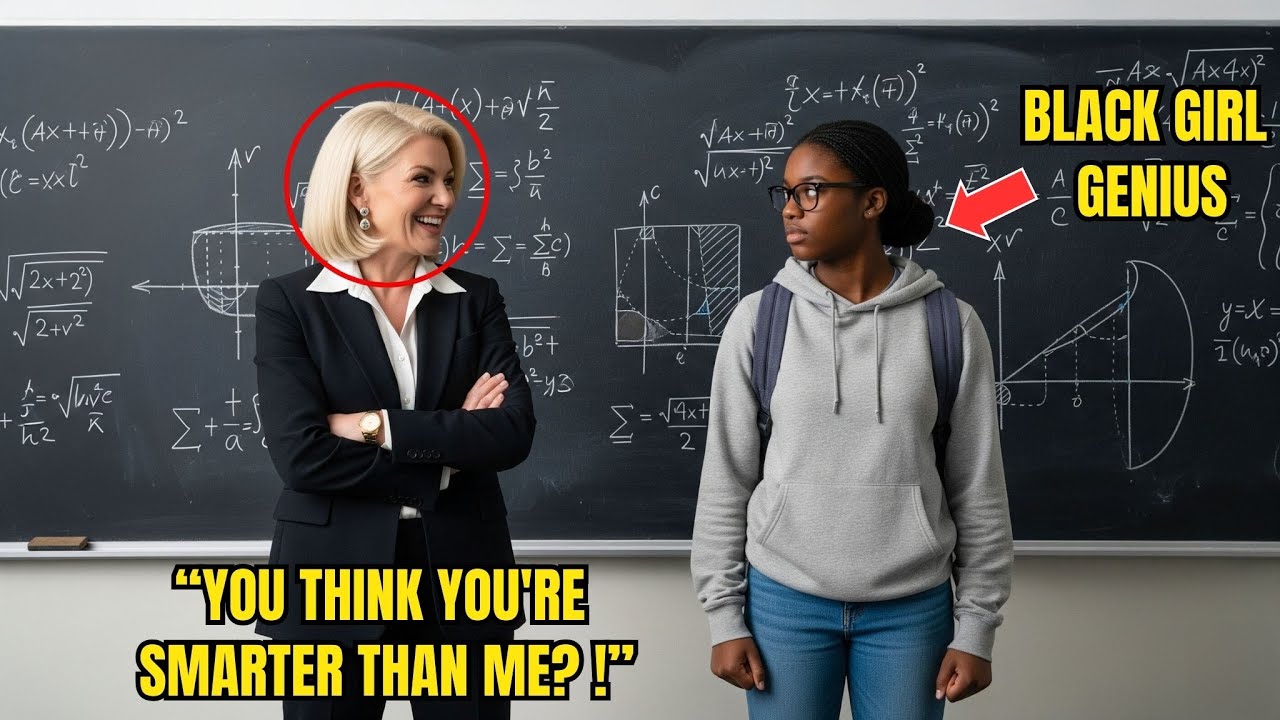
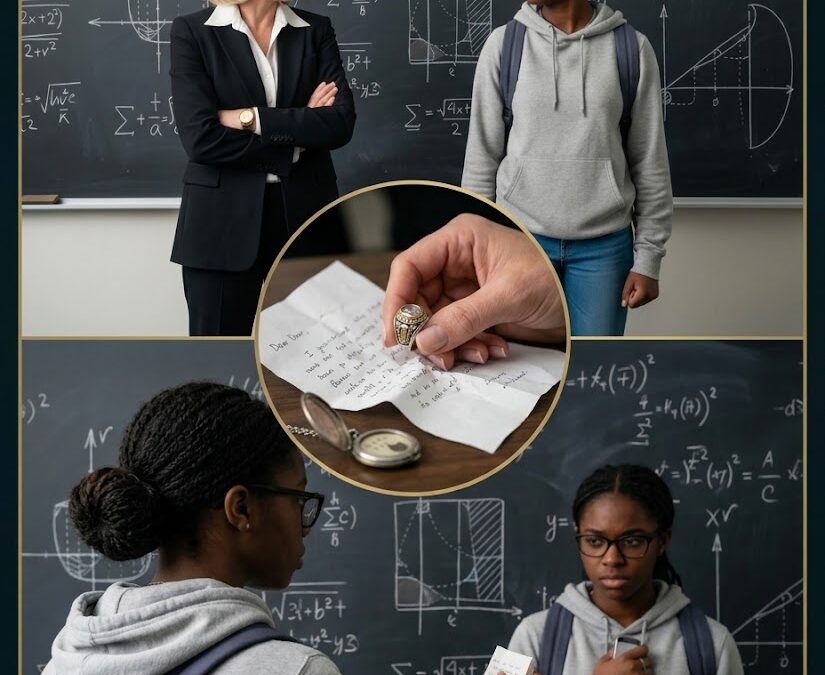
She’s cheating. There’s no other explanation. Ms. Blackwood’s accusation sliced through the stunned silence as Lily’s elegant solution to an impossible math problem covered the whiteboard. 30 seconds of brilliance had just destroyed the girl’s future. What happens when the quietest student in America’s most prestigious academy is falsely accused by the teacher everyone trusts? Lily has 48 hours to prove her mathematical genius or lose everything she’s worked for. But here’s what no one saw coming.
The system designed to protect academic integrity was about to be dismantled by the very student it was trying to crush. This isn’t about a grade. It’s about a quiet revolution that will change how we recognize brilliance forever. Hit subscribe to Beat Stories for more moments of justice served.
Where are you listening from today? Everest Academy isn’t just any high school. With ivy covered brick walls and a list of alumni that reads like a who’s who of American achievement, it demands excellence in its most traditional forms. Here, success has a specific formula. Speak confidently, follow established methods, and never question authority.
Students who don’t fit this mold typically don’t survive, much less thrive. Lily Thompson doesn’t speak unless absolutely necessary. Her social anxiety manifests in averted gazes and hesitant body language that many teachers mistake for disinterest or lack of intelligence. She sits in the back corner of every classroom, making herself as invisible as possible.
But behind her, silence lives a mind that sees mathematical patterns in ways that textbooks never taught. Ms. Thompson, perhaps you’d care to join the class discussion today. Ms. Blackwood’s voice always carried a hint of condescension when addressing Lily. Or are you planning to contribute nothing again? Ms.
Eleanor Blackwood commanded respect at Everest Academy. With 25 years of teaching advanced mathematics, three published textbooks, and a reputation for sending students to Ivy League universities, she was untouchable. Her classroom operated with military precision students raised hands at perfect angles, showed all work using her prescribed methods, and never ever arrived at correct answers through unorthodox approaches.
I’m sorry, Lily would stammer, her voice barely audible. I was listening. Listening isn’t participation, Miss Thompson. Excellence requires voice. What Ms. Blackwood and the other teachers never noticed was how Lily’s notebooks told a different story. Pages filled with elegant mathematical proofs, approaches that bypassed conventional steps and solutions to problems beyond the curriculum.
Her mind didn’t work like the others. It leapt across logical gaps with intuitive connections that she couldn’t always explain verbally. The annual Mathright competition represented Everest’s most prestigious academic event. Sponsored by tech companies and judged by university professors, winning meant virtually guaranteed admission to any elite university in the country.
More importantly for seniors like Lily, the competition’s timing in October meant results would appear on early decision applications. This year’s competition will test not just mathematical ability, but original thinking, announced Principal Foster at the school assembly. Judges are looking for innovative approaches to seemingly impossible problems.
For the first time, Lily felt a flutter of hope. Innovative approaches were exactly what filled her private notebooks. While her classmates excelled at executing known formulas, she excelled at finding unexpected connections between mathematical concepts. “Don’t get your hopes up, Miss Thompson,” Ms.
Blackwood said after class when Lily lingered near the competition signup sheet. “The math right requires communication skills as much as computational ability. The judges need to understand your process.” “I understand,” Lily whispered, signing her name. “Anyway,” Ms. Blackwood star student Trevor smirked as he added his name with a flourish.
Looking forward to the competition, Ms. Blackwood. I’ve been preparing all summer. I expect nothing less than excellence from you, Trevor. Ms. Blackwood smiled. The warm, encouraging smile Lily had never received. What no one at Everest Academy understood was that Lily’s mathematical ability wasn’t just different, it was exceptional.
Three times she had solved problems in ways her previous schools couldn’t comprehend, leading to accusations of cheating that her quiet nature couldn’t effectively counter. Three times her family had moved, hoping the next school would be different. Everest was their last hope before college applications. Her parents couldn’t afford another move, and Lily couldn’t afford another academic incident on her record.
Maybe this time will be different, her mother had said with forced optimism while dropping Lily off on the first day. Just try to speak up more. The night before the competition, Lily sat cross-legged on her bed, surrounded by mathematical journals, publishing recent breakthroughs. Where her classmates studied standard methods, she absorbed cuttingedge thinking.
Where they memorized formulas, she sought the patterns beneath them. What would happen when Lily’s unorthodox brilliance finally emerged on the biggest mathematical stage Everest Academy offered? Would anyone recognize her genius? Or would her different way of thinking once again be her downfall? The Mathright competition transformed Everest Academyy’s auditorium into an academic battleground.
50 students hunched over desks armed with nothing but pencils and blank paper. University representatives and tech company scouts lined the back wall, watching for the next generation of mathematical talent. Lily slipped into her assigned seat, her heart pounding against her ribs. Around her, competitors exchanged confident smiles and whispered strategy tips.
Trevor sat two rows ahead, his posture perfect, supplies arranged with military precision. You have 3 hours to solve the problem, announced Dr. Reynolds. the competition coordinator. This year’s challenge was developed by mathematicians at MIT and has not yet been definitively solved in academic literature. The room collectively inhaled an unsolved problem that was unprecedented in a high school competition.
At precisely 9:00 a.m., Proctors distributed sealed envelopes containing the problem. Lily’s hands trembled as she opened hers. The problem involved optimizing network pathways through multi-dimensional space, a complex topology question with realworld applications in quantum computing. Six pages of background information accompanied the core challenge.
Silence fell as pencils began moving, then stopped, then started again, more hesitantly. Lily read the problem three times, letting the parameters sink into her mind. This wasn’t a standard calculus or linear algebra problem with prescribed methods. This required something new. While others began traditional approaches, Lily closed her eyes.
She visualized the network as a shifting pattern, not as static nodes and connections. The solution wasn’t about finding a single optimal path, but recognizing how the entire system could reconfigure itself. 40 minutes in, frustrated whispers echoed through the auditorium. Students who’d never encountered academic failure were hitting walls.
Trevor’s pencil moved steadily, but his furrowed brow betrayed uncertainty. Lily began writing. Her approach bore little resemblance to standard mathematical notation. She transformed the network problem into a pattern recognition challenge using a visual language of her own design that allowed her to track multiple variables simultaneously.
At the 1 hour mark, her pencil froze. The pattern had emerged. The solution wasn’t finding the optimal path. It was proving that the optimal path changed depending on the observer’s perspective. By shifting the reference frame, what seemed like network inefficiency became perfect optimization. Elegant, beautiful, and completely unorthodox.
Lily worked backward, translating her intuitive solution into conventional mathematical language that judges could understand. She finished in 90 minutes, half the allotted time. When she approached the submission table, Ms. Blackwood’s eyebrows rose in surprise. Finished already, Miss Thompson? Her tone suggested impossibility rather than accomplishment.
Yes, Lily whispered, handing over her work. I’ll make sure the judges review it promptly. Lily returned to her seat, watching as other students struggled. Trevor glanced back at her empty desk, confusion crossing his features before hardening into suspicion. Two hours into the competition, the judges gathered in a tight circle around Lily’s submission.
Dr. Reynolds whispered urgently to a university professor. Ms. Blackwood joined them, her expression darkening as she examined Lily’s work. At 11:45, 15 minutes before the competition’s end, Dr. Reynolds approached the microphone. May I have everyone’s attention, please? We’re implementing an unusual procedure today.
Lily Thompson, please come to the judge’s table. The room froze. Lily felt 50 pairs of eyes lock onto her as she stood on shaking legs. This wasn’t normal protocol. At the judge’s table, five experts examined her work while Ms. Blackwood stood with arms crossed. Ms. Thompson, Dr. Reynolds began carefully. Your solution is extraordinary.
Before Lily could process this unexpected praise, Ms. Blackwood interrupted. It’s extraordinary because it’s impossible, she stated flatly. No high school student could develop this approach independently. The solution utilizes concepts from quantum topology that aren’t taught until graduate level mathematics. The professor from MIT leaned forward.
Yet the work shows a clear progression of thought. It’s not copied from existing literature. Because she had outside help, Ms. Blackwood insisted. Or access to materials that other students didn’t. Lily’s voice caught in her throat. I didn’t. The approach bears similarities to emerging research, Ms.
Blackwood continued, pulling out her tablet and displaying a journal abstract. Research that isn’t published in textbooks, but is being discussed in academic circles. I read journals, Lily managed, her voice barely audible. in my free time. Ms. Blackwood’s laugh cut through the room. You expect us to believe you casually read post-doal mathematical research? The judges exchanged uncomfortable glances.
Miss Thompson, Dr. Reynolds said, “These are serious concerns about academic integrity. We cannot accept your submission without an investigation.” Ms. Blackwood’s voice rose, ensuring everyone in the auditorium could hear. She’s cheating. There’s no other explanation. The accusation struck Lily like physical pain.
The familiar sensation of being misunderstood, of having her different way of thinking, labeled as dishonesty washed over her. Academic integrity committee hearing tomorrow at 4 p.m., Principal Foster announced, having been summoned to the growing commotion. Miss Thompson, you have until then to prepare your defense. 48 hours.
That’s all Lily had to defend her mathematical honor before the committee could rule on her disqualification and potential expulsion. With early college applications due in just 10 days, the timing couldn’t be worse. As the competition ended and students filed out, whispers followed Lily. Even Trevor looked uncomfortable with the public accusation.
How could she prove that her mind simply worked differently when no one was willing to believe her? And what would happen if for the fourth time a school decided her unconventional brilliance must be cheating? By lunchtime, Lily’s academic execution was the only topic at Everest Academy. Students who’d never spoken to her suddenly had opinions about her character.
Teachers who’d barely noticed her existence exchanged concerned glances when she passed in the hallway. There’s no way she cheated,” said one sophomore in the cafeteria, loud enough for Lily to hear as she sat alone. “She’s too quiet to even ask someone for help.” “That’s exactly how cheaters operate,” countered his friend.
“The ones you least suspect.” Lily stared at her untouched sandwich. Her appetite vanished. The worst part wasn’t the accusation. It was that no one had even asked for her explanation. Ms. Blackwood’s verdict had become fact before Lily could defend herself. Her phone buzzed with a text from her mother.
Principal called, “Coming home early to talk. Hang in there, honey.” This was all too familiar. The same progression of events had unfolded at her previous schools. Exceptional performance, accusations, disbelief, then leaving before the permanent mark of cheater could follow her to the next school. But there was no next school this time.
College applications were due and an academic integrity violation would destroy her chances everywhere. After lunch, Lily had a free period normally spent in the library’s quiet corner with advanced math texts. Today, she hesitated at the library doors, feeling the weight of stairs. Instead, she turned toward the math department office.
She needed to try explaining her solution to someone who might understand. The department office was empty except for Ms. Blackwood, who looked up from her computer with cold eyes. Miss Thompson, I assume you’re here to confess. Lily gripped her notebook tightly. I’d like to explain my approach. If I could show you my process.
Your process used concepts that undergraduate students struggle to grasp, Miss Blackwood interrupted. I checked your previous work in my class. You’ve never demonstrated this level of insight before. Because the class problems have standard solutions, Lily said, her voice stronger than usual. The competition asked for innovation. Ms. Blackwood leaned back in her chair.
Innovation builds on fundamentals. Your competition solution skipped fundamental steps that every mathematician must follow. That’s not innovation. That’s fabrication. I see connections differently, Lily insisted, opening her personal notebook. I’ve been solving problems this way for years. Look. M.
Blackwood barely glanced at the notebook. Convenient that you suddenly have a notebook of supposedly original work that no teacher has ever evaluated. My previous schools? Yes, I’ve contacted them, Ms. Blackwood said, her smile thin. Three schools in four years, each time with concerns about your works. authenticity. That’s a pattern, Miss Thompson.
Lily’s hands began to shake. They didn’t understand. What they understood perfectly was that you submitted work beyond your capabilities. Ms. Blackwood turned back to her computer. The academic integrity committee will review all evidence tomorrow. I suggest you spend your time preparing an honest explanation rather than elaborate justifications.
Dismissed, Lily retreated to the hallway where she collided with Trevor. “Sorry,” she mumbled, trying to move past. “Wait,” he said, surprising her by blocking her path. “I want to know how you did it.” “Did what?” “Solved the problem that way.” His expression wasn’t accusatory, but genuinely curious.
“I’ve been studying advanced topology for 2 years, and I couldn’t see the approach you took. For a moment, Lily felt a flicker of hope. “Someone wanted to understand.” “I visualized the network as dynamic patterns rather than fixed nodes,” she began hesitantly. “If you consider the observer’s reference frame as a variable rather than a constant, Thompson, a word, please.
” Principal Fosters’s voice cut through her explanation. Trevor stepped back with an apologetic shrug as the principal approached. You have math with Miss Blackwood next period, correct? Principal Foster asked, not waiting for confirmation. I think it’s best if you skip that class today. Report to my office instead.
But I can explain my solution. The academic integrity committee will hear your explanation tomorrow, he said firmly. Until then, we’re minimizing disruptions. By the end of the school day, Lily had been effectively isolated, removed from classes, seated alone in the principal’s office, and instructed not to discuss the competition with anyone. The message was clear.
She was already presumed guilty. At home that evening, Lily’s parents listened with growing concern as she explained the situation. “This isn’t right,” her father said, pacing their small living room. They’re treating you like you’ve already been convicted. “It’s happening again,” her mother sighed, the weight of their previous moves evident in her voice.
“I didn’t cheat,” Lily insisted, spreading her notebooks across the coffee table. “Look, I can show you exactly how I approached the problem.” Her parents exchanged glances. They loved her, but they weren’t mathematicians. Her father was a high school English teacher, her mother an occupational therapist. The complex mathematics in her notebooks might as well have been hieroglyphics.
“We believe you,” her father said, squeezing her shoulder. “But we need to convince the committee.” Lily spent the night reconstructing her solutions step by step, documenting each mental leap with supporting mathematical principles. She worked backwards, translating her intuitive approach into conventional mathematical language that teachers would recognize.
By 3:00 a.m., her bedroom walls were covered with paper, mapping connections between her unique visualization techniques and established mathematical principles. The pathway was there, not the straightforward route that Ms. Blackwood taught, but a valid one nonetheless. At 7:00 a.m., Lily finally collapsed into bed, having completed a 20page defense of her methodology.
4 hours later, her alarm jolted her awake. 5 hours until the hearing. She arrived at school to find a note taped to her locker. Academic integrity committee has requested additional materials. Hearing moved to conference room A4 p.m. sharp. Additional materials. What more could they want? In the library, Lily found a secluded corner to review her defense.
Each page demonstrated how her solution connected to established mathematical principles, even if through unconventional pathways. A shadow fell across her work. She looked up to find Trevor standing awkwardly before her. “You never finished explaining yesterday,” he said, sliding into the chair across from her. Lily hesitated. I’m not supposed to discuss it. I know.
He glanced around before leaning closer. But they’re building a case against you. Ms. Blackwood has been contacting mathematicians all morning trying to prove your solution was plagiarized. What? How do you know that? I was helping in the department office. He lowered his voice further. She’s convinced the committee will find you guilty.
She’s already talked to Principal Foster about the appropriate disciplinary action. The implication was clear. The decision had been made before Lily could even present her defense. The academic integrity committee hearing wasn’t about finding truth. It was about formalizing a predetermined conclusion. With only 5 hours until the hearing, Lily faced an impossible question.
How do you prove your innocence to people who’ve already decided you’re guilty? The academic integrity committee traditionally met in Principal Fosters’s office, a space designed to intimidate with its dark wood paneling and wall of framed credentials. But today, a handwritten sign directed Lily to conference room A, the largest meeting space at Everest Academy. Her stomach dropped.
A larger venue could only mean one thing. Spectators. “Mom, they changed the location?” Lily whispered, clutching her mother’s arm as they approached the room at 3:55 p.m. “That’s unusual,” her mother replied, her professional therapist voice masking her concern. “Remember, stay calm and explain your process clearly.
” The conference room door swung open to reveal a scene from Lily’s nightmares. The long table at the front seated seven committee members, including Ms. Blackwood, Principal Foster, and the head of the math department. But behind them, filling the audience chairs, sat at least 30 people, teachers, administrative staff, and worst of all, several students, including Trevor.
“What are all these people doing here?” her father demanded as they entered. Principal Foster cleared his throat. “Given the exceptional nature of this case and its implications for our competition protocols, we’ve invited relevant parties to observe. This isn’t a public trial.” Lily’s mother protested.
This is a student academic review. The committee will conduct its business appropriately. Principal Foster responded coldly. Miss Thompson, please take the seat at the table. A single chair faced the committee positioned like a defendant stand. Lily’s 20page defense felt suddenly inadequate as she placed it on the table before her.
The committee calls this hearing to order at 4:02 p.m. announced Dr. Wheeler, the head of the math department. We have 24 hours to reach a determination on the academic integrity violation alleged against Lily Thompson regarding her mathright competition submission. 24 hours. The deadline was officially ticking. Dr.
Wheeler continued with clinical precision. Ms. Blackwood, please present the complaint. Ms. Blackwood stood, tablet in hand. Ms. Thompson submitted a solution to the Mathright competition that employs advanced mathematical concepts far beyond high school curriculum, including elements of quantum topology and non-ucuklitian reference frames.
Her approach bears similarities to cuttingedge research not yet widely published. She turned her tablet to display sidebyside comparisons of Lily’s work against academic journal excerpts. Note the methodological similarities to Dr. Harukqi’s recent paper and Professor Chen’s quantum network optimization theory.
These are postdoal level concepts not accessible through standard educational channels. The committee members examined the evidence, nodding with grave expressions. Furthermore, Ms. Blackwood continued, Miss Thompson’s academic history shows a pattern of questioned work at three previous institutions. Her performance in my class has been adequate but unexceptional, showing no evidence of the brilliance suddenly displayed in this competition.
That’s because you never asked the right questions, Lily whispered too quietly for anyone to hear. Ms. Thompson, please present your defense, Dr. Wheeler instructed. Lily’s hands trembled as she distributed her meticulously prepared explanation. I’ve documented my solution process step by step, showing how each conclusion follows logically from established principles.
As the committee flipped through her defense, their expressions remained skeptical. The math terminology Lily had worked all night to translate into conventional language still looked foreign to non-speists on the committee. Ms. Thompson interrupted Ms. Santos, the English department head. I see equations and diagrams, but I don’t understand how this proves you didn’t have outside help.
The proof is in the methodology, Lily explained, growing desperate. If you follow the logical progression, which requires graduate level mathematical knowledge to evaluate, Ms. Blackwood interjected. Convenient. Principal Foster leaned forward. Do you have any witnesses who can verify your work was done independently? Lily felt the walls closing in.
“No, I work alone.” “Can anyone attest to your mathematical capabilities being at this level prior to the competition?” Lily glanced back at the audience, searching for a friendly face. She found none. “My previous teachers, but but they all raised concerns about your work’s authenticity,” Ms. Blackwood finished for her.
They didn’t understand my methods, Lily insisted, her voice cracking. Neither do we, Dr. Wheeler said with finality. That’s precisely the problem. For the next hour, the committee methodically dismantled Lily’s defense. Without advanced mathematical knowledge themselves, they relied on Ms. Blackwood’s expertise to interpret both the accusations and Lily’s explanations.
Each question circled back to the same conclusion. The work was beyond what a high school student could reasonably produce. At 5:30 p.m., Dr. Wheeler called for a pause. The committee will recess until tomorrow morning at 9:00 a.m. when we’ll hear final statements and reach our determination. As the room emptied, Lily remained frozen in her chair, staring at her useless defense.
15 and 1/2 hours left and she had failed to convince anyone. “I’m sorry, honey,” her father said, embracing her. “This isn’t fair. “It doesn’t matter if it’s fair,” she replied numbly. “They’ve already decided.” In the hallway outside, Lily overheard Ms. Blackwood speaking to Principal Foster. “The appropriate response must include competition, disqualification, course failure, and a permanent note in her record.
Academic integrity is our institution’s foundation. Which meant her college applications were already dead. No early decision, no scholarships, no escape from being forever labeled a cheater. Lily felt the crushing weight of inevitability. This was exactly how it had ended at her previous schools. Except this time, there was nowhere left to run.
With less than 16 hours remaining before final judgment, Lily faced the darkest moment of her academic life. How do you prove your innocence when your very way of thinking is treated as evidence against you? The Thompson family dinner table that evening felt like a war room planning a doomed last stand. Lily’s defense papers spread across the surface, her parents offering suggestions that couldn’t overcome the fundamental problem.
No one on the committee understood enough advanced mathematics to recognize the validity of her approach. “We could request an outside expert,” her father suggested, pushing pasta around his plate. “Someone who specializes in the field.” “In 15 hours,” her mother countered. “And who would Everest accept that wouldn’t just defer to Ms.
Blackwood’s judgment?” The doorbell rang, interrupting their desperate strategizing. Lily’s father answered, then called with surprise in his voice, “Liy, it’s for you.” Standing awkwardly on their porch was a young man Lily recognized, but had never spoken to Alex Chen, a graduate student who worked as a teaching assistant in Everest’s math department.
Tall and lanky with perpetually disheveled hair, he clutched a laptop bag and wore an expression of nervous determination. “Sorry to intrude,” he said. I’m Alex Chen, math department TA. I need to talk to Lily about her competition solution. Lily’s parents exchanged protective glances. I’m not here to accuse her, Alex clarified quickly.
I’m here because I think she’s right. Those words, the first vote of confidence Lily had received since the competition, nearly broke her composure. In the living room, Alex opened his laptop. I’ve been observing your work all semester, he explained, pulling up a folder labeled Thompson observations. What? Lily’s confusion was evident.
Why would you observe me? Because you solve problems differently, he replied simply. I’ve been documenting unconventional approaches by students for my master’s thesis on mathematical pedagogy, and you, Lily Thompson, are the most interesting case study I’ve ever encountered. He turned the screen to show them dozens of files, photographs of Lily’s homework, notes on her classroom problem solving, and timestamps of her work patterns.
“You’ve been watching me?” Lily asked, unsettled. “Amically watching,” he clarified. “In every class, you solve problems starting from unusual entry points. You skip steps that others consider mandatory because you see connections they don’t. I’ve been tracking these patterns for months.” Her father leaned forward.
And this helps how exactly? Because I have documented evidence that Lily’s competition solution follows the same unique thought patterns she’s demonstrated consistently all semester. Alex pulled up sidebyside comparisons of Lily’s classroom work and her competition solution. The methodology isn’t copied from researchers.
It’s distinctively hers. I can prove it. For the first time since the accusation, Lily felt a flicker of hope. You’d testify for me? That’s why I’m here. But there’s something else you should know. Alex lowered his voice. The Mathright competition isn’t just about finding correct answers. It’s sponsored by Quantum Horizons.
They’re searching for unconventional thinkers for their quantum computing division. How do you know this? Lily’s mother asked skeptically. because I interned there last summer. Alex pulled out a business card with the Quantum Horizon’s logo. The unsolved problem they gave you. It’s a recruiting tool. They want to identify students who approach problems differently.
Lily struggled to process this revelation. So, the whole point was to find unusual solutions. Exactly. And Ms. Blackwood knows this. Alex’s expression darkened. She’s been suppressing innovative approaches for years. Three students before you showed similar unconventional talents. All three faced academic integrity accusations after exceeding expectations.
She targets students who think differently, Lily whispered, the pattern suddenly clear. But why? Her father demanded. Control, prestige. Alex shrugged. Her teaching methods are published in textbooks. Students who succeed through different approaches threaten her methodologies supremacy. Lily’s mother shook her head in disbelief. That’s academic malpractice.
It gets worse, Alex continued. Tomorrow’s hearing has been expanded because representatives from Quantum Horizons and MIT are attending. They saw your solution and were impressed enough to send people to meet you. Wait, Lily interrupted. The technology company sponsoring the competition is sending representatives to my academic integrity hearing because they don’t think you cheated.
They think you’re exactly who they’re looking for. Alex checked his watch. But Ms. Blackwood is trying to discredit you before they can evaluate you fairly. “So, what do we do?” Lily asked, feeling both validated and terrified by the stakes. Alex closed his laptop decisively. We prepare for tomorrow. I can testify about your consistent mathematical approach, but we need something more, something that proves beyond doubt that this solution is yours.
What about a test? Lily’s father suggested. If she can reproduce her work under controlled conditions, Alex nodded. We should request that. If Lily can recreate her solution process in real time with the same insights and creative leaps, they’ll have to believe me. Lily finished. For the next 3 hours, they built a new defense strategy.
Alex’s documentation provided the historical pattern of Lily’s unique approach. The proposed live demonstration would prove her capability, and the presence of industry experts might finally provide knowledgeable witnesses who could understand her methodology. As Alex was leaving, he paused at the door.
There’s one more thing you should know. Professor James Lynn from MIT’s quantum mathematics division is among the visitors tomorrow. He’s published theoretical work on observer dependent network optimization work that your solution independently parallels. Is that bad? Lily asked fearing another accusation of copying research. No, it’s perfect. Alex smiled.
Because if you derived the same conclusions independently using your unique approach, he’s not going to see a cheater. He’s going to see a colleague. For the first time in 24 hours, Lily felt something besides dread. With 13 hours until the final hearing, she wasn’t just fighting to clear her name anymore.
She was fighting to be recognized for who she truly was, a mathematician who saw patterns that others couldn’t. But would even this be enough to overcome Ms. Blackwood’s determination to discredit her? Conference room A had transformed overnight. The observer section had doubled in size, now filled with not just school personnel, but also visitors in business attire and academic tweeds.
A whiteboard had been wheeled to the front, and a camera on a tripod stood ready to record the proceedings. Lily arrived at 8:45 a.m., 15 minutes early, with her parents and Alex. Her hands were cold despite the warm September morning, her mind cycling through mathematical patterns as a form of self soothing.
Remember,” Alex whispered as they took their seats. “Professor Lynn is in the back row, gray suit with blue tie. The woman next to him in the black blazer is Dr. Samira Patel from Quantum Horizons. They’re here for you, not against you.” Lily nodded, unable to look directly at the intimidating array of experts. At precisely 9:00 a.m.
, Principal Foster called the hearing to order. Before we continue from yesterday, I understand there have been some developments. Alex stood. Yes, sir. I’d like to present relevant evidence regarding Lily Thompson’s mathematical methodology. Ms. Blackwood’s eyes narrowed. Mr. Chen, this is highly irregular. You’re not a faculty member, merely a graduate assistant.
With direct observational evidence spanning the entire semester, Alex countered, approaching the committee with his laptop and documents. I’ve been documenting Lily’s unique problem-solving approaches since August for my master’s research in mathematical pedagogy. For the next 15 minutes, Alex methodically presented his evidence.
Photographs of Lily’s homework showing her distinctive approach, classroom observations noting how she arrived at solutions through unconventional pathways, and most damning to Miss Blackwood’s case direct comparisons between Lily’s previous work and her competition solution showing consistent methodology. As you can see, Alex concluded, the approach Miss Thompson used in the competition is consistent with her established mathematical thinking patterns.
It’s not copied from external sources. It’s distinctively hers. The committee members exchanged uncertain glances. Dr. Wheeler cleared his throat. While this contextualizes Miss Thompson’s work, it doesn’t definitively prove she developed the competition solution independently. Lily’s father stood, which is why we’re requesting a live demonstration.
Let my daughter solve a similar problem right now under supervision. If she can reproduce her methodology in real time, that should remove any doubt. Murmurss rippled through the audience. Ms. Blackwood’s objection was immediate. This is completely outside protocol. We cannot change evaluation methods mid- hearering.
From the back of the room, a deep voice intervened. Actually, I’d be very interested in seeing Ms. Thompson’s process firsthand. All heads turned to see Professor Lynn rising from his seat. MIT would consider it valuable to observe her methodology in action. Principal Foster, clearly caught between institutional protocol and the pressure of prestigious visitors, hesitated before nodding.
The committee will allow this demonstration. Ms. Blackwood’s face tightened, but she remained silent as Dr. Wheeler approached the whiteboard. I’ll create a problem analogous to the competition challenge, he announced, uncapping a marker. For three minutes, he wrote complex equations describing a multi-dimensional network optimization problem similar to but distinct from the competition question.
When he finished, he turned to Lily. Miss Thompson, please solve this problem using your methodology. Explain your thinking as you proceed. Lily stood, legs trembling slightly as she approached the whiteboard. The room fell silent except for the soft whur of the camera recording every movement. Taking a deep breath, she picked up the marker.
I approached network problems by visualizing dynamic patterns rather than fixed nodes, she began, her voice initially soft, but growing stronger as she entered the familiar territory of mathematics. The first step isn’t to optimize the existing structure, but to reconsider the reference frame itself. For the next 22 minutes, Lily worked through the problem step by step.
Her marker moved confidently across the whiteboard, creating not just equations, but visual representations of how she conceptualized the network. She narrated each mental leap, each connection between seemingly disperate mathematical principles. About halfway through, Professor Lynn began nodding slightly. Dr.
Patel from Quantum Horizons leaned forward in her chair. Even some committee members showed dawning comprehension as Lily’s unique approach unfolded before them. Ms. Blackwood watched with increasingly evident discomfort, especially when Lily implemented the same unconventional reference frame shift that had been central to her competition solution.
The key insight, Lily explained, approaching her conclusion, is that network efficiency depends on the observer’s perspective. By transforming the reference frame like this, she drew a decisive line connecting two mathematical constructs, what appeared as separate optimization problems becomes a single elegant solution.
She stepped back from the whiteboard, which was now covered with a complex but coherent mathematical journey. The answer is that there isn’t one optimal path, but rather a dynamic system that reconfigures based on observer position. Complete silence filled the room as the committee and audience absorbed what they had just witnessed. Dr.
Wheeler approached the board, examining Lily’s work with growing astonishment. “This is remarkable,” he said finally. The methodology is consistent with your competition submission, but applied to an entirely new problem. From the back of the room, Professor Lynn spoke again. The approach parallels advanced theoretical work in quantum reference frames, but derived through an intuitively different pathway.
Fascinating. Ms. Blackwood rose from her seat, her composure finally cracking. This proves nothing. She could have been coached on this specific type of problem overnight. By whom? Professor Lynn asked mildly. This approach diverges from published methodologies, including my own recent work.
If someone coached her to develop this parallel methodology overnight, I’d like to offer them a position at MIT immediately. A ripple of uncomfortable laughter spread through the room. Ms. Blackwood’s face flushed red. I believe we’ve seen enough, Dr. Wheeler said, looking at his fellow committee members. Ms. Thompson has demonstrated her mathematical capabilities convincingly.
But Principal Foster hesitated, glancing at Ms. Blackwood’s thunderous expression. Perhaps we should consult with additional experts before reaching a determination. This is, after all, highly specialized mathematics. The momentum of Lily’s demonstration seemed to waver as institutional politics reasserted themselves.
Would the committee actually overrule the evidence of their own eyes to support Ms. Blackwood? The answer came from an unexpected source as Dr. Patel from Quantum Horizons finally spoke. I think you’ll find that the expert opinion on this matter is quite clear, Principal Foster. Perhaps it’s time you heard it directly.
Dr. Samira Patel rose from her seat with the composed confidence of someone accustomed to commanding attention in executive boardrooms. Her Quantum Horizon’s ID badge caught the fluorescent light as she approached the front of the room. For context, she began, I’m Dr. Samira Patel, director of advanced mathematics research at Quantum Horizons and lead architect of the Mathright competition problem.
This problem was specifically designed to identify unconventional mathematical thinking. The room fell completely silent. Even Ms. Blackwood’s objections died on her lips. The traditional solution approaches, the ones taught in textbooks, including yours, Ms. Blackwood, will reach an approximate answer after considerable computation, but they missed the elegant core insight that Ms. Thompson identified.
Dr. Patel turned to the whiteboard, pointing to a specific section of Lily’s work. This reference frame transformation is precisely what we were hoping someone might discover. It’s mathematically sound, computationally efficient, and most importantly, indicates a mind that can transcend established paradigms.
She addressed the committee directly. To be absolutely clear, Ms. Thompson’s solution is not plagiarized. It’s not copied from existing literature. It represents exactly the type of original thinking our competition was designed to uncover. Principal Foster shifted uncomfortably. While we appreciate your expert assessment, Dr.
Patel, the issue remains that Ms. Thompson’s approach utilized concepts beyond our curriculum. Beyond your curriculum, certainly, Professor Lynn interjected, joining Dr. Patel at the front, but not beyond her capabilities, as she’s just demonstrated. He adjusted his glasses, surveying the room with the measured gaze of someone who had evaluated thousands of mathematical minds.
I’m Professor James Lynn, quantum mathematics division at MIT. My team published work last year on observer dependent optimization that shares conceptual similarities with Ms. Thompson’s approach. Ms. Blackwood seized on this. Exactly my point. She must have accessed this published research. That would be difficult, Professor Lynn replied dryly.
Considering our full findings are still under peer review and won’t be published until next year. What’s remarkable is that Ms. Thompson arrived at parallel insights through an entirely different mathematical pathway. He turned to address Lily directly. Young lady, you’ve independently derived principles that my team of postdoal researchers spent three years developing. That’s not cheating.
That’s extraordinary talent. Ms. Blackwood’s face had lost all color. But her previous work in my class was constrained by your insistence on standardized approaches, Alex interjected, earning a sharp look from Principal Foster for the interruption. Dr. Patel nodded in agreement. This is unfortunately common in mathematics education.
We require students to follow established methodologies, leaving little room for innovative thinking. The truly exceptional minds often appear average in such environments because they’re being measured on conformity rather than capability. She turned back to the committee. Quantum Horizons created this competition precisely to identify students like Ms.
Thompson brilliant minds who think beyond conventional frameworks. The fact that her solution was flagged as suspicious rather than celebrated is frankly disappointing. Professor Lynn cleared his throat. If I may add, MIT has seen this pattern before. Some of our most distinguished mathematics alumni were initially accused of academic dishonesty when their insights outpaced their teachers understanding.
History hasn’t judged those accusations kindly. The implied warning hung in the air. Everest Academyy’s reputation was now at stake, not for being too lax on cheating, but for potentially punishing exceptional talent. Principal Foster glanced at the other committee members, clearly reassessing the situation. “Given this expert testimony, I believe the committee should deliberate immediately.
” “There’s nothing to deliberate,” Dr. Wheeler said firmly, finding his voice at last. “We’ve seen Ms. Thompson reproduce her methodology live. We’ve heard from the problems creator and a leading expert in the field. The evidence is conclusive.” One by one, the other committee members nodded in agreement. Only Ms. Blackwood remained rigid, her hands gripping the edge of the table. Dr.
Wheeler addressed Lily directly. Miss Thompson, on behalf of the Academic Integrity Committee, I offer our sincere apologies for this unnecessary ordeal. Your competition submission is not only valid, but exemplary. The accusation of academic dishonesty is dismissed completely. The tension that had held Lily’s body tight for two days suddenly released.
Her parents embraced her as scattered applause broke out among the observers. But Dr. Patel wasn’t finished. This incident raises serious concerns about how mathematical talent is evaluated at Everest Academy, she said, her gaze settling on Ms. Blackwood. Perhaps it’s time for institutional reflection. The committee’s verdict sent ripples through Everest Academy that extended far beyond Lily’s individual case.
Within hours, Principal Foster called an emergency faculty meeting to address what he carefully termed our approach to recognizing diverse forms of academic excellence. For Lily, the immediate aftermath was both overwhelming and validating. As the hearing dispersed, she found herself surrounded by people who had been strangers just days before.
“M Thompson,” Professor Lynn said, handing her his business card. MIT’s summer research program for exceptional high school students would welcome your application. Please email me directly. Dr. Patel was equally direct. Quantum Horizons awards three undergraduate scholarships annually to Mathright finalists.
Given that you’ve essentially won the competition with your solution, consider this your formal notification to apply. Even Trevor approached, his usual confidence replaced by genuine respect. Your solution was incredible. I didn’t understand half of it, but I knew you couldn’t have cheated. No one cheats with methods that complex.
Lily managed a small smile. Thanks for trying to warn me yesterday. As the crowd thinned, Ms. Blackwood remained seated at the committee table, staring at the whiteboard, still covered with Lily’s work. Principal Foster approached her, speaking in low tones. Though Lily couldn’t hear the conversation, Miss Blackwood’s stiff nod and tightly pressed lips suggested significant consequences were being discussed.
One week later, Principal Foster announced three major changes to Everest Academyy’s academic policies. First, an alternative methodologies initiative would be implemented across all departments, encouraging students to explore multiple approaches to problem solving rather than insisting on standardized methods.
Second, the academic integrity committee would now include at least one external expert in relevant fields when evaluating advanced work, ensuring that unconventional approaches weren’t automatically flagged as suspicious. Third, and most significantly, Miss Blackwood would be taking a sbatical semester to study emerging pedagogical approaches before returning to a modified teaching role.
Additionally, Principal Foster announced during the school assembly, I’m pleased to share that Everest Academy will be hosting a special lecture series on mathematical innovation this spring, co-sponsored by Quantum Horizons and MIT, with our own Lily Thompson participating as a student presenter. The transformation wasn’t just institutional.
Lily found her voice strengthening daily as younger students sought her help with math problems. Her unique ability to visualize alternative approaches made her an effective tutor for those who struggled with conventional methods. You explain things differently, a freshman told her after a tutoring session.
Like I can actually see the patterns now instead of just memorizing steps. Even more surprisingly, three students from other classes came forward with their own stories of having innovative approaches dismissed or discouraged. The culture was shifting from conformity to creativity, from procedure to possibility. When early college decision letters arrived in December, Lily’s contained not just an acceptance, but a prestigious mathematics scholarship.
The accompanying note mentioned her exceptional creative approach to complex problems and resilience in the face of academic challenges. As she showed the letter to Alex, who had become both mentor and friend, he smiled. Sometimes the system needs to be challenged to improve. Your stand didn’t just change your future.
It’s changing Everest for everyone who thinks differently. What had begun as an accusation had transformed into a revolution in how one prestigious academy recognized and nurtured brilliance in all its diverse forms. On a crisp spring afternoon, Lily stood at the podium in Everest Academyy’s packed auditorium. The quantum mathematics symposium had drawn educators from across the state, all eager to witness the educational transformation that had begun with one quiet girl’s unconventional solution.
Mathematical thinking isn’t linear, Lily explained to the audience, her voice clear and confident. A transformation as remarkable as the institutional changes surrounding her. The most elegant solutions often come when we shift our perspective entirely, questioning not just the problem, but the framework we use to understand it.
Behind her, the screen displayed a visualization of her methodology, now formerly recognized in academic circles as the Thompson perspective shift, a technique being taught to graduate students at three universities. From her seat in the front row, Dr. Patel nodded approvingly. Next to her sat Professor Lynn and representatives from seven other universities interested in implementing Everest’s new alternative methodologies initiative.
Ms. Blackwood was also present, seated toward the back after returning from her sbatical. The semester studying alternative teaching approaches had visibly changed her. While still rigorous, she had begun encouraging students to explain their unique thought processes rather than insisting on standardized methods.
The true test of education isn’t conformity, but growth, Lily continued, approaching her conclusion. When we allow minds to develop along their natural pathways, even when those paths seem unfamiliar, we discover capabilities we never knew existed. As applause filled the auditorium, Lily caught her parents’ eyes in the audience, their faces shown with quiet pride, not just for her accomplishments, but for her resilience in standing firm when her very way of thinking had been questioned.
The symposium marked the end of Lily’s senior year at Everest, but the beginning of a much larger journey. Her early acceptance to MIT included an invitation to collaborate with Professor Lynn’s research team, exploring the mathematical frontiers her unique perspective could unlock. More importantly, Everest Academy had established the Thompson Scholarship for Innovative Thinking, an annual award for students who demonstrated exceptional creativity in approaching academic challenges.
The first recipient would be selected next fall, ensuring that future students who thought differently would be celebrated rather than suspected. Principal Foster approached the podium as Lily concluded her presentation. What we’ve learned this year is perhaps more valuable than any single mathematical breakthrough.
We’ve learned that brilliance comes in many forms and that our responsibility as educators is not to constrain thinking into familiar patterns, but to recognize and nurture unique cognitive gifts. He gestured to the audience filled with educators. The policies we’ve implemented at Everest are just the beginning.
Every school represented here has students like Lily quiet revolutionaries whose minds work in ways our traditional systems haven’t been designed to recognize. As the symposium concluded and attendees filed out, Trevor now headed to Stanford with his own impressive scholarship stopped beside Lily. You know, you changed everything, not just for yourself, but for all of us, even for Miss Blackwood.
Lily smiled. Sometimes the system needs someone to challenge it to become better. That challenge standing firm in her unique way of thinking when everyone doubted her had transformed not just her life but the educational landscape for countless students who would follow. Remember Lily’s story the next time someone dismisses your different approach or questions your unique perspective.
True innovation rarely follows the expected path. And the most powerful contributions often come from minds that see patterns others miss. Your different way of thinking isn’t a weakness. It might be your greatest strength. Hit subscribe to Beat Stories where we celebrate the quiet revolutionaries who change systems through courage and truth.
What different perspective have you stood firm in, even when others couldn’t understand. Share your story in the comments below. Behind every headline is a human story. At Beat Stories, we go deeper, where emotion meets evidence and drama reveals the system. If this story made you pause, reflect, or feel something, don’t forget to subscribe.
There’s more to come.
You Might Also Enjoy
A Milionária Jogou o Dinheiro No Engraxate… Então Ele Voltou Para Comprar A Empresa Dela

O Empresário Riu Do Sonho Do Peão… Até Precisar De 8 Caminhões Dele Para Salvar A Fábrica

Dono Disfarçado Deixou A Carteira Para Testar A Garçonete… Até Ela Colocar O Próprio Dinheiro Dentro.

A Empresária Riu Quando a Costureira Pediu Demissão… Até Perder Seus Maiores Clientes Para Ela

A Costureira Salvou O Vestido De 40 Anos Da Mãe Do Milionário… Então Ele Bateu À Sua Porta