Satan Doesn’t Read Your Mind — He Does This Instead (Ephesians 6:17)
Satan Doesn’t Read Your Mind — He Does This Instead (Ephesians 6:17) 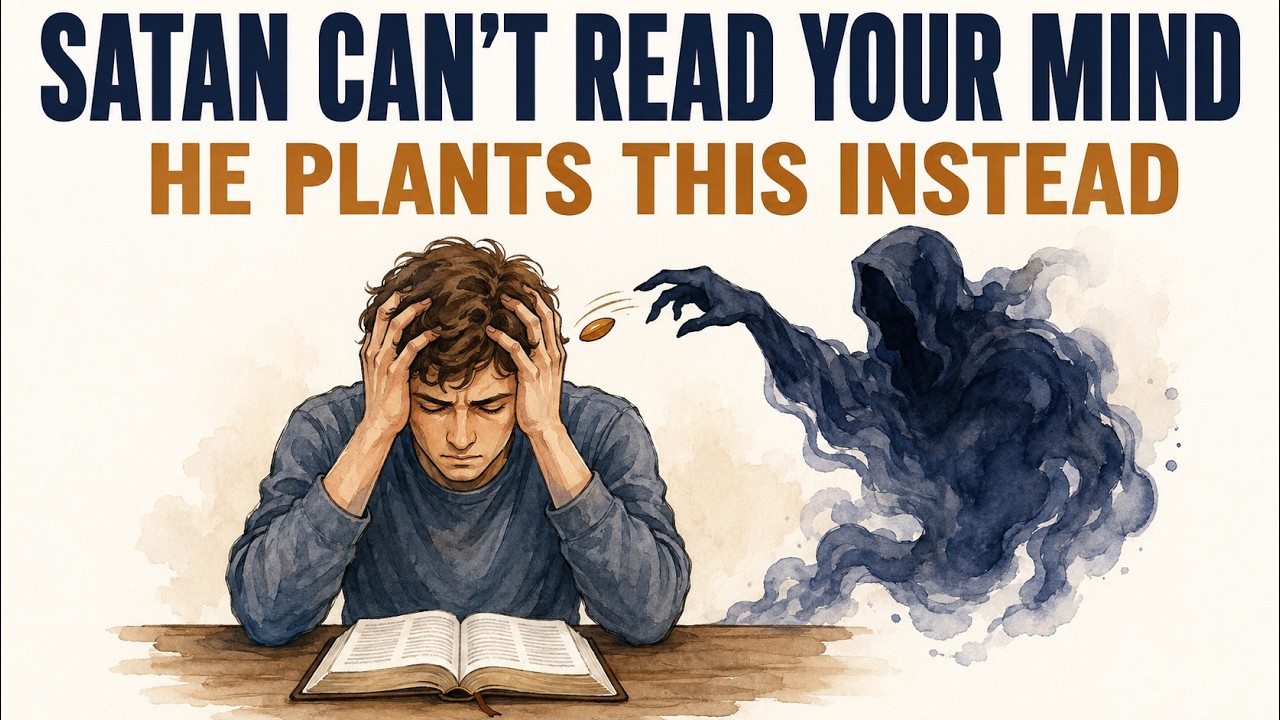
Most Christians believe the devil can hear what they’re thinking. He can’t. He never could. 3:00 in the morning, wide awake, replaying an argument that already ended, rehearsing the version where you finally said the right thing. That’s not him listening in. That’s something else, and almost nobody’s been taught to see it.
Here’s the weapon he actually uses instead, and here’s what should stop you cold. Two verses in the New Testament, same author, name it directly. One describing what he throws at you, the other describing what you’re commanded to do about it. Once you see the connection between those two verses, you’ll never read spiritual warfare the same way again.
Paul already knew exactly which piece of armor was built to hold the line. Paul lists six pieces of armor in Ephesians 6. A belt, a breastplate, sandals, a shield, a sword, and a helmet. Four of them you put on yourself. You fasten them. You strap them. You take them up. The last two are different. And take the helmet of salvation, and the sword of the spirit, which is the word of God.
That word take in most English Bibles is doing a lot of hiding. In Greek, it’s dexasthe, receive, as in open your hands and let something be placed there. Not built, not earned, not manufactured through enough prayer or enough discipline. Received. Paul uses that exact verb [music] for only two things on the entire list.
The helmet guarding your mind, and the sword right beside it. It That’s not a stylistic accident. Out of six pieces of armor, the two Paul says you can only receive are the two aimed at the exact same target he’s about to name. So, what does he actually attack? And what does that mean if you’re someone who has been trying for years to think your way out of a battle you keep losing? Go to 2 Corinthians chapter 10.
Paul describes spiritual warfare in some of the most specific language he ever uses. We destroy arguments and every lofty opinion raised against the knowledge of God, and we take every thought captive to obey Christ. That word thought in Greek is noema, a mental perception, something that forms in the mind and if left unchallenged sets up residence there.
Paul isn’t telling you to fight an enemy you can see. He’s telling you to arrest something that only exists inside your own head. Now, here’s the part that should stop you. Two chapters earlier in the same letter, Paul writes almost the same word about someone else. We are not unaware of his schemes. The Greek behind schemes is noemata, the plural of the exact same word Paul used two chapters later for what you’re told to capture.
Do you see what that means? The thing the enemy launches at you >> [music] >> and the thing you’re commanded to seize before it lands are named with the exact same word. Not because you’re handed a weapon to match his, because he only has one move, plant a thought and hope it goes unchallenged, [music] and scripture only gives you one countermove, capture it before it becomes something you believe.
Not because he can read your mind, because he doesn’t need to. He only needs one thought to sit there long enough to start feeling true. Knowing that doesn’t disarm it though. A noema doesn’t stop showing up just because you can name it in Greek. So, what actually stops it from winning? That question is where the helmet comes back in.
Starting with a word most people read straight past. The Greek word for helmet is perikephalaia, peri meaning around and kephale meaning head. Literally, the thing that encircles the head. Simple enough, but here’s what almost no one notices. Perikephalaia shows up exactly twice in the entire New Testament.
Not in every letter did Paul write about spiritual armor. Twice total in two two both from the same author. When a writer only reaches for a word twice, in two different letters years apart, it’s not a coincidence. Here’s the detail hiding in plain sight. The other verse is 1 Thessalonians 5:8, written to a different church in a different year.
And for a helmet, the hope of salvation. Same Greek word. Almost the same phrase. Except Paul adds one more word, and that word changes what this helmet is actually built to stop a noema from doing. Think about how discouragement actually works. It never goes after your hands or your feet. It goes after what you expect.
Whether the thing you’ve been praying for is actually coming. Whether the promise you’re holding on to is real, or just something you talked yourself into believing. That’s hope. Not optimism. Not a feeling. The confident expectation that what God said is still true. Even when the evidence in front of you says otherwise. A noema doesn’t need to attack your circumstances.
It only needs to attack what you expect from them. It doesn’t always look dramatic from the outside. Someone who used to talk openly about a specific request, a job, a marriage, a friendship falling apart, has quietly stopped mentioning it out loud. Not because they stopped praying, but because saying it kept feeling like proof it wasn’t coming.
That’s not backsliding. That’s a noema doing exactly what it was designed to do. So, why does Paul, describing the exact same piece of armor twice, feel the need to add hope the second time? To answer that, we have to go back further than either letter he wrote. Seven centuries further, to a battlefield and a helmet that didn’t fit the person [music] wearing it.
Saul is a warrior king, and David is a shepherd boy standing in front of Goliath with nothing but a sling. So, Saul does what seems obvious. He takes his own armor, the best he has, and puts it on David. His bronze helmet was on David’s head. His mail on David’s shoulders, his sword was strapped over the top of it all.
David takes a few steps and stops. I cannot walk with these, he tells Saul, for I have not tested them. And he takes it all off, every piece, and walks toward Goliath with a staff, a sling, and five stones he picked up off the ground. Look at what actually failed here. Saul’s armor wasn’t defective. It was untested.
Armor built for another man’s body, another man’s years of training handed to someone who had never worn it under pressure. It wasn’t that the armor was bad, it wasn’t his. Now, hold that image next to Isaiah 59, written centuries later, describing someone else putting on armor for battle. The chapter leading up to it isn’t a hopeful one.
Isaiah is describing a nation drowning in its own injustice. Truth has collapsed in the public square, and anyone who tries to do right becomes a target. Then verse 16. God looks for a man, someone to stand in the gap, to intercede, to fix what’s broken. He finds no one, not one volunteer. So, the text says his own arm brought him salvation.
God doesn’t wait for a deliverer who never shows up. He goes to war himself. He put on righteousness as a breastplate and a helmet of salvation on his head. That’s the difference between the two scenes standing side by side. Saul had one volunteer in front of him, willing but untested, and handed him armor built for a different body entirely.
God had no volunteers at all. Nobody stepped forward. Nobody stood in the gap. So, instead of waiting for someone qualified to wear it, he put it on himself and [music] went first. Read that again. Because the identity of who’s speaking changes everything about what comes next. This isn’t a soldier.
This isn’t a king. Isaiah is describing [music] the Lord, God himself, dressing for war against the darkness of the world, wearing a breastplate of righteousness and a helmet of salvation on his own head before either one was ever given to a human being. Paul didn’t invent that image in Ephesians 6. He borrowed it. And when he tells you to receive the helmet, he isn’t describing armor built for a stranger and handed to you untested, the way Saul’s armor was handed to David.
He’s describing the armor that God wore first, tested in exactly the situation you’re standing in now. Fitted because the one who wore it originally is the one now placing it on your head. David couldn’t walk in armor built for someone else on a body that had never carried its weight under pressure. You’re not being asked to.
The helmet of salvation was never untested equipment handed down and hoping it might work. It already went to war. It already survived. >> [music] >> And now it’s being placed on you by the same hands that wore it into the dark first. This is where the Greek gets specific in a way most translations flatten out.
In Ephesians 6:17, Paul doesn’t use the ordinary Greek word for salvation, soteria, the word he uses almost everywhere else in his letters. Here, he reaches for soterio, a form tied directly back to that exact phrase in the Greek translation of Isaiah 59:17. Paul isn’t making a general reference to salvation as an idea.
He’s pointing straight at the moment God put this helmet on [music] himself. There’s a practical reason ancient soldiers never forged their own helmets. A Roman legionary’s gale was shaped, reinforced at the crown, and tested by an armorer before a soldier ever put it on. Not because the soldier couldn’t be trusted, but because nobody finds out whether a helmet holds under a sword strike [music] by testing it himself in the middle of a battle.
You find that out beforehand from someone whose only job is making sure [music] it already works. Paul’s first readers, watching Roman soldiers every day, would have understood immediately why the helmet on this list was something to be received, not something to be forged. The same logic behind a soldier’s armor is the logic behind the one piece Paul says you can only receive.
And this isn’t a private moment between you and a piece of armor. Paul writes elsewhere that it’s the spirit of God renewing the mind, anakainosis, a continual remaking, not a one-time fix. The same spirit who raised Christ from the dead is the one doing the work of keeping this helmet in place on your head today. In whatever noema you’re carrying into this week, do not be conformed to this world, but be transformed by the renewing of your mind.
That renewal isn’t something you generate through effort. It’s the Holy Spirit’s ongoing work pressing back every day against a world trying to pour your thinking into its mold. Conversion changed your heart once. The spirit renews your mind daily. That’s not a metaphor. That’s the mechanism behind the helmet actually staying on.
So, take every noema captive. That’s not a suggestion for someday. That’s a command for right now, for whatever’s been sitting uncontested in your head since before you clicked on this video. Because here’s the shift this passage is asking you to make. You’ve probably spent years treating your thought life like a performance review, grading yourself on how well you managed to think the right things, feel the right amount of faith, stay positive enough for long enough.
You’ve been keeping score on a battle that was never yours to win by scorekeeping. That’s not what Paul is describing. He’s describing a mind under attack, being handed a piece of equipment it was never expected to build on its own. If you are watching this at 11:00 at night because your mind will not stop replaying the meeting from Tuesday, the thing you should have said, the version of you that handled it better, that has the shape of a noema.
It has been sitting in you for days, unchallenged, telling you who you are based on 11 seconds you can’t get back. Not because it’s true, because you never took it captive. You just let it move in and start paying rent. If you have prayed [music] for the same thing so many times, you’ve started apologizing to God for asking again. Sorry.
I know I’ve brought this up before. That’s the shape of a noema, too. Not from him, never from him. A God who tells you to receive a helmet, not manufacture one, was never going to be the one making you feel foolish for still needing [music] it. And if you’ve rehearsed the same defense of the same choice, word for word, the same three sentences, four or five times this month, like a lawyer prepping for a case nobody else is trying, that’s a noema wearing the costume of self-awareness.
It feels like honesty. It functions like a cage. Here’s what’s actually happening in all three of those moments. The enemy isn’t reading your mind to know what will hurt you. He’s watching what you already believe about yourself, and he’s offering you one more sentence that confirms it. He doesn’t need new information about you.
He only needs old information to keep feeling current. He’s not surveilling you. He’s reinforcing what you already believe, which means the fight was never about being smart enough to out-argue him. It was never about having the right verse memorized at the right moment, the way David might have hoped Saul’s sword would somehow make him stronger than he actually was.
The fight is about whether you receive what’s already been extended to you, or whether you keep trying on armor that was never built to fit a human being in the first place. Picture the difference in practice. Not white-knuckling through a hard morning, gritting your way into feeling okay by force of will. Something closer to opening your hands during a prayer you don’t have words for, >> [music] >> and letting whatever’s being placed there settle without needing to understand it first.
That’s what receiving looks like when nobody’s watching. Paul doesn’t leave that posture undefined. He tells you exactly [music] what it looks like next and exactly what it produces. The peace of God, which surpasses all understanding, will guard your hearts and your minds in Christ Jesus. That word guard, phroureo, was a term Roman citizens knew from daily life.
It described a garrison, soldiers stationed at a city gate, standing watch, checking everything that tried to pass through before it was allowed in. Paul isn’t asking for a feeling of calm to visit you occasionally on the days you manage to have enough faith for it. He’s telling you the peace of God takes up a fixed post, not somewhere in general, but specifically at the entrance to your mind.
And the one standing at that post isn’t your own discipline. It’s the spirit of God himself examining what tries to walk in before it’s ever allowed to settle. That doesn’t mean the thought never shows up again. 11:00 will still come. The old defense will still form on your tongue. But something is now standing between the thought and where it wants to live.
And a garrison doesn’t need you to feel strong. It only needs you to let it stand there. You are not the thought that keeps returning. You are not the version of yourself the enemy keeps handing you at 11:00 at night or the reason you’ve started praying more quietly than you used to. You are the one who was handed a helmet before you knew you needed one, tested, worn, and already proven by the only one who ever went to war wearing it first.
Satan was never going to read your mind. He didn’t need to. All he ever needed was one thought left standing long enough to start feeling true. And scripture already told you which piece of armor was built to stop exactly that. That’s what receiving looks like when you trace it all the way back, not proving yourself worthy of protection, not earning a helmet through enough good days in a row, just opening your hands for something that was already finished before you ever needed it.
The same way it was already finished before David needed it, before Isaiah wrote it down. If someone you love has been fighting the same thought for months and quietly calling it weakness, they need to hear this. David took off the armor that was never his. You don’t have to. This one [music] was made to fit before you were born.
You Might Also Enjoy

A Milionária Jogou o Dinheiro No Engraxate… Então Ele Voltou Para Comprar A Empresa Dela
O Empresário Riu Do Sonho Do Peão… Até Precisar De 8 Caminhões Dele Para Salvar A Fábrica

Dono Disfarçado Deixou A Carteira Para Testar A Garçonete… Até Ela Colocar O Próprio Dinheiro Dentro.

A Empresária Riu Quando a Costureira Pediu Demissão… Até Perder Seus Maiores Clientes Para Ela

A Costureira Salvou O Vestido De 40 Anos Da Mãe Do Milionário… Então Ele Bateu À Sua Porta