Manager Barked “Get Out!” at Black Man in Wheelchair — Then Learned He Owned the Building
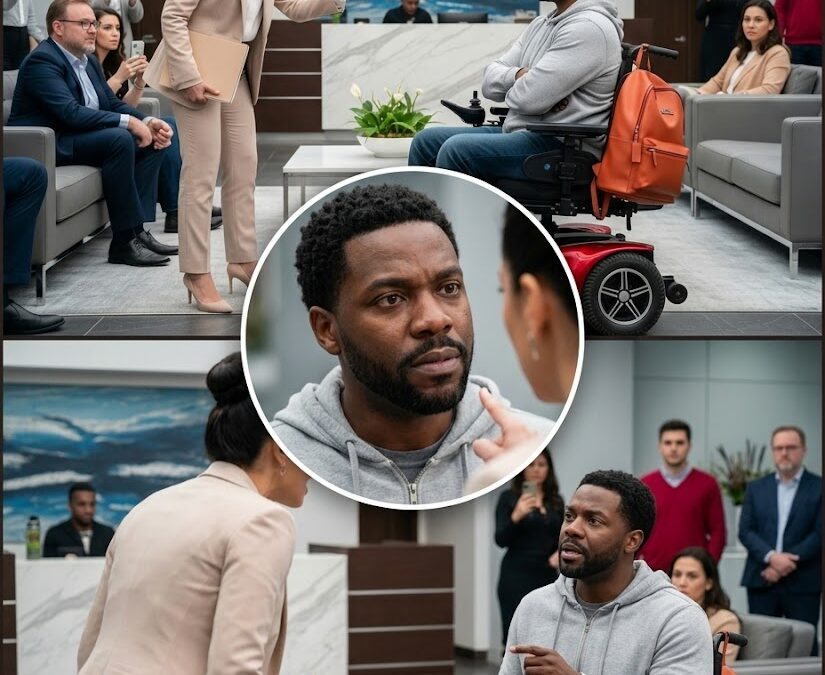
Manager Barked “Get Out!” at Black Man in Wheelchair — Then Learned He Owned the Building 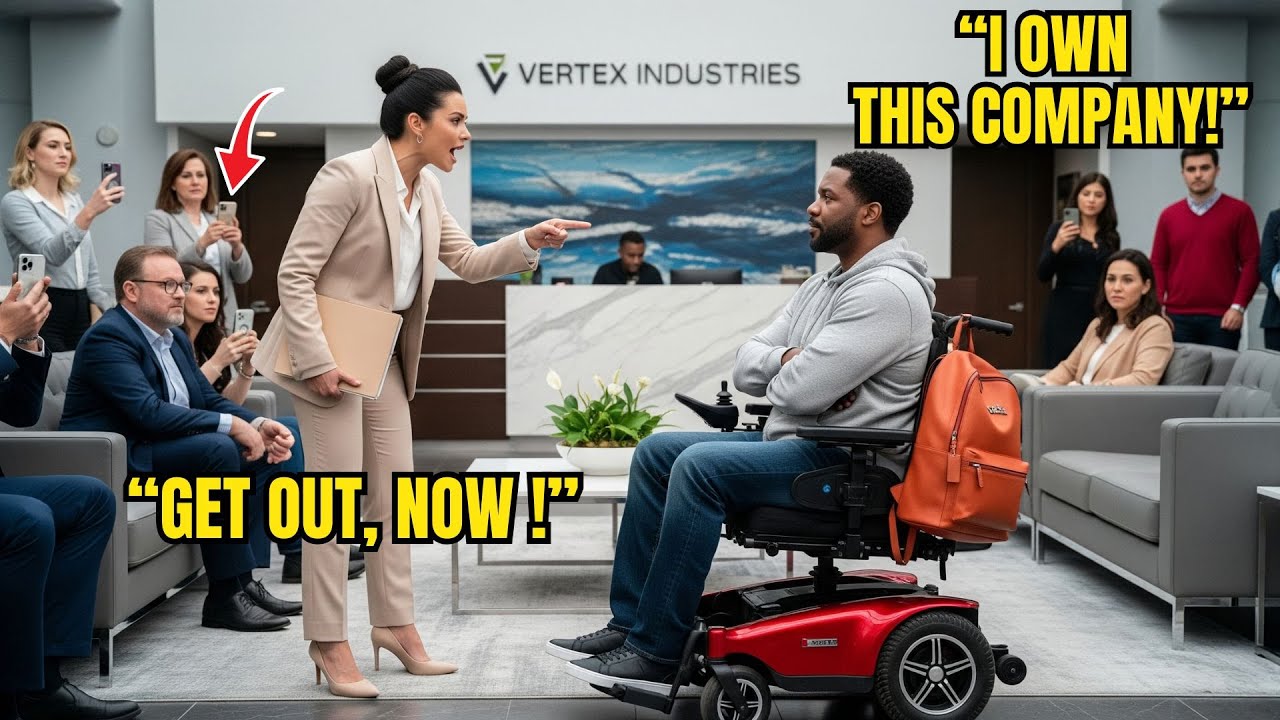
A white woman’s face contorts with rage as she points toward the exit. Get out of my building now. Steven Gilbert, a distinguished black man in a wheelchair, sits calmly in the lobby of Vertex Industries as people stare. The woman, Brier Wilson, stands with her arms crossed, glaring down at him with undisguised contempt.
I want this trespasser escorted out immediately, Brier announces loudly to everyone in the gleaming corporate lobby. He clearly doesn’t belong here. Steven remains perfectly composed, his expression unreadable as he reaches into the inner pocket of his tailored suit jacket. Brier takes an instinctive step backward, her eyes widening slightly.
The security guard tenses. Steven extracts a platinum business card and a building access key card with owner emlazed across it in bold letters. What Steven does next will change not just Briar’s career, but the entire corporate culture of a Fortune 500 company. Steven Gilbert maneuvers his wheelchair through the revolving doors of the Vertex Industries headquarters.
The gleaming downtown tower rises 40 stories above the busy financial district, its glass exterior reflecting the morning sun. At 45, Steven projects quiet authority in his navy suit and burgundy tie. His investment firm has recently acquired this building and the tech company it houses, though very few people know this yet.
Today’s unannounced visit serves a specific purpose, to assess the company culture before revealing himself as the new owner. These undercover evaluations have become his signature method after acquiring a dozen similar properties in the last 5 years. The security guard at the front desk greets Steven with professional courtesy, though confusion flickers across his face when Steven mentions he has a meeting, but provides no specific details.
I can call up to verify your appointment, sir, the guard offers. That won’t be necessary just yet, Steven replies. I’m a bit early. From her desk behind a glass partition, Brier Wilson watches Steven with narrowing eyes. As office operations manager for the past 6 years, she considers herself the gatekeeper of Vertex’s prestigious space.
She rises from her chair, straightens her pencil skirt, and approaches with a clipboard clutched to her chest. 3 months earlier, a black software engineer filed a complaint about Briar’s excessive scrutiny of his building access. 6 months before that, a disabled employee requested a transfer, citing uncomfortable interactions. Both complaints vanished into HR files with no action taken.
“Can I help you?” Brier asks, her tone suggesting the opposite intention. “I have a meeting with leadership,” Steven explains pleasantly. “And you are?” She doesn’t offer to shake his hand. “Steven Gilbert,” he extends his hand anyway. After an awkward pause, she briefly touches his fingers. “I don’t see any Gilbert on today’s calendar.
” Her voice carries just loudly enough for nearby employees to hear. Steven notices her body language shift as she fully registers both his wheelchair and his race. Her stance widens, her chin lifts, and her grip on the clipboard tightens. He recognizes the reaction immediately, mentally filing it away.
This moment precisely exemplifies why he conducts these undercover visits. Brier had no idea that her next words would be replayed in a corporate boardroom, a legal deposition, and eventually a training video seen by thousands. “Who exactly are you meeting with?” Brier demands, her pen hovering over her clipboard.
The lobby’s morning bustle continues around them, but several employees slow their pace to observe the interaction. “I have an appointment with members of the executive leadership team,” Steven responds. The statement is technically true. He owns the company now. After all, we have procedures here at Vertex Industries.
Brier emphasizes each syllable of the company name as if Steven might be unfamiliar with it. All visitors must be pre-registered and escorted by an employee. Those are the proper channels. Behind her professional veneer, Briar’s thoughts race. Another unauthorized visitor trying to bypass security. always the same types thinking rules don’t apply to them.
The wheelchair doesn’t change protocol. If anything, it makes the executive floors even less accessible. Let me verify this supposed meeting. She walks to her desk and picks up the phone, deliberately keeping Steven waiting in the center of the lobby where everyone can see him. Hi Melissa, it’s Brier from operations. There’s someone here, a Steven Gilbert claiming to have a meeting with leadership. She pauses, listening.
No appointment. That’s what I thought. I Thanks. Brier returns with satisfaction, hardening her features. As I suspected, there’s no Steven Gilbert on today’s schedule. No meetings with anyone from leadership. There may have been a miscommunication, Steven offers calmly. Perhaps I could wait here until I can reach my contact.
This isn’t a waiting room for people who don’t have appointments, Brier replies, her voice rising slightly. You’ll need to leave and reschedule through proper channels. Steven notices a young black woman at a nearby desk watching the interaction with visible discomfort. Her employee badge reads Zoe Michaels software development.
Their eyes meet briefly and she quickly looks away. I understand your concern for security, Steven says, but I would appreciate a reasonable accommodation to make a phone call and sort this out. Everyone always wants special treatment, Brier says with a dismissive wave, but rules exist for a reason. Steven weighs his options. He could easily end this by revealing his identity, but that would defeat the purpose of his cultural assessment.
This interaction is providing exactly the kind of unfiltered insight he came for. As Steven reached for his phone to make a quick call, he had no idea Brier was about to cross a line that would cost her more than just her job. “Attention everyone,” Brier announces, raising her voice to carry across the lobby.
“This gentleman is being asked to leave the premises.” She gestures toward Steven as if he were a suspicious package requiring immediate attention. Conversations halt. Keyboards fall silent. Dozens of eyes turned toward them. “If you don’t comply immediately,” Brier continues, leaning closer to Steven.
“I’ll have no choice but to contact the police and report you as a security threat.” “I’d like to speak with your supervisor,” Steven requests, his voice leveled despite the public spectacle being made of him. “My supervisor doesn’t deal with trespassers,” Brier retorts. “Though I’m curious, can you even access the executive floors? The elevators require keycard authentication, and I’m not sure how you’d manage.
Her gaze flicks meaningfully to his wheelchair. Behind a nearby column, Zoe Michaels discreetly points her phone toward the confrontation, recording video with her thumb hovering over the stop button. I’m not trying to access anywhere without authorization, Steven explains, acutely aware of the audience Brier has gathered.
I simply need a few minutes to clarify this misunderstanding. Let me be clear, Brier says, crossing her arms. What you’re attempting is a common scam. People try to talk their way into secure buildings all the time. You’re not the first to try this approach. Steven sits straighter in his wheelchair, maintaining his dignity despite the heat rising in his chest.
Six pairs of eyes watch from the reception desk. Three security personnel hover nearby. A delivery person pauses with a stack of packages. all witnesses to this unnecessary humiliation. “Your kind always causes problems,” Brier adds. The deliberate ambiguity of her statement hanging in the air, a calculated imprecision that preserves plausible deniability while making her meaning clear to Steven.
A security guard steps forward, discomfort evident in his reluctant approach. “Ma’am, should I, yes,” Brier interrupts, “Escort him out. May I make one phone call first? Steven asks, reaching for his smartphone. I can verify my appointment. Get out now, Brier snaps, the force of her command silencing the lobby entirely.
Inside, Steven feels a familiar calm settling over him. The same focused clarity he experienced in courtrooms years ago. He could end this instantly, but something tells him to let it continue. Sometimes systems need to reveal their full dysfunction before they can be healed. He makes a swift mental calculation, document everything, gather evidence, then implement comprehensive change.
As Steven reached for his owner’s access card, his phone buzzed with a text from the company CEO that would change everything about this confrontation. I need to take this call, Steven says, wheeling himself toward a quieter corner of the lobby. It will only take a moment. Brier follows a few steps behind him, hovering like a prison guard.
Make it quick. Steven<unk>’s face reveals nothing of the determination burning within him. On the surface, polite accommodation. Beneath a strategic mind documenting every detail of this encounter. He’s experienced variations of this scene dozens of times. the assumptions, the thinly veiled contempt, the public degradation.
But unlike those previous occasions, today he possesses the authority to ensure real consequences. Jeffrey. Steven speaks into his phone. I need information on a Brier Wilson. She’s the operations manager at Vertex. He keeps his voice low, but doesn’t whisper. Nothing about his behavior should suggest guilt or uncertainty.
His executive assistant responds immediately. pulling her file now. Brier Wilson, six years with the company, promoted twice. Three formal complaints filed against her in the past 18 months, all from minority employees. No disciplinary action taken. Send me the company’s anti-discrimination policies and reporting structure, Steven instructs.
And inform Sandra Pierce I’ll be meeting with her shortly. Already done. She’s aware of your visit today, but not the specific timing. Perfect. Don’t mention what’s happening yet. I want to see how this plays out naturally. Steven recalls his previous company acquisitions. How often a single interaction like this revealed deep systemic problems.
His methodology developed after his own experiences with discrimination. Refined through his legal career representing victims of workplace hostility. The accident that put him in this wheelchair 5 years ago only strengthened his resolve to transform corporate culture. Across the lobby, Brier watches him suspiciously. In her mind, Steven<unk>’s composed phone conversation confirms her suspicions.
Trespassers often have accompllices, creating distractions while attempting unauthorized access. She strides back toward him, interrupting his call. Times up. You need to leave the premises immediately. I understand your concern, Steven replies calmly. Could I have the HR director’s contact information before I go? I’d like to follow up about this interaction.
Absolutely not, Brier says, her face flushing. Security. This man needs to be removed from the building now. In this moment, Steven makes a silent promise to himself and to everyone who works in this building. What happens next will become a turning point, not just for Brier Wilson, but for the entire organizational culture that enables her behavior.
He doesn’t simply want accountability for today. He wants systematic transformation that prevents situations like this from happening to anyone else. What Brier didn’t realize was that Steven wasn’t just documenting her behavior. He was already implementing a companywide response that would begin in exactly 17 minutes. Two security personnel approach from different directions, their reluctance evident in their hesitant steps.
The older guard, his name plate reading James, keeps his hands visibly away from his belt. A small courtesy that Steven notices immediately. Sir, the younger guard begins. Ms. Wilson has indicated that you’re trespassing and refusing to leave the premises. Before Steven can respond, Brier interjects.
He has no appointment and no authorization to be here. He’s been asked repeatedly to leave. I have legitimate business in this building, Steven explains to James directly. There appears to be a misunderstanding about my appointment. He’s lying, Brier interrupts again, stepping between them. I’ve checked with the executive offices myself.
There is no appointment. James studies Steven<unk>’s face, noting his calm demeanor and professional attire. Something doesn’t align with Briar’s characterization of the situation. Sir, who are you planning to meet with today? Briar’s posture stiffens at being circumvented. That’s irrelevant. I’m the operations manager and I determine who has legitimate access to this building.
I’m responsible for security. James counters quietly. I need to understand the situation. While they speak, Zoe Michaels approaches from her desk, a visitor badge in hand. I can sign him in as my guest if that helps, she offers. He can wait in our department’s conference room until his contact is available.
Briar turns to Zoey, eyes flashing. Return to your desk immediately. You’re interfering with security protocols. This could result in disciplinary action. Steven observes this additional display of authority abuse with clinical interest. The pattern is clear. Brier doesn’t simply discriminate. She actively silences anyone who challenges her behavior.
Her actions reveal not just personal bias, but a systemic failure of oversight. James shifts uncomfortably, caught between following Briar’s instructions and his own assessment of the situation. Brier senses her control slipping away. Her authority within Vertex depends on projecting absolute confidence in her decisions.
Any compromise now would undermine her position. This man is leaving immediately or I’ll call the police, she declares, pulling out her phone for emphasis. Steven<unk>’s phone vibrates with an incoming text. He glances down to see a message from Jeffrey. CEO Sandra Pierce is aware of the situation, watching security feed from executive floor, awaiting your signal.
Steven decides to extend this test further. If Brier is willing to escalate to this degree with a stranger, what daily indignities must employees endure? He needs to document the full extent of the dysfunction before implementing solutions. As Brier reached for Steven<unk>’s wheelchair to physically turn him toward the exit, she had no idea who was watching through the lobby security cameras.
Brier grasps the handles of Steven<unk>’s wheelchair and begins to turn it toward the exit. Do not touch me or my wheelchair without permission,” Steven states firmly, his voice cutting through the tense atmosphere like a blade. “Remove your hands immediately.” Several employees visibly flinch at the boundary violation.
A woman at the reception desk covers her mouth. The security guards exchange alarmed glances. Brier releases the wheelchair and steps back, her expression morphing from dominance to victimhood with practiced ease. He’s becoming aggressive, she announces to the growing audience. I was simply helping him toward the exit and he threatened me.
On the executive floor, CEO Sandra Pierce watches the security feed with growing concern. The live stream shows clear angles of the confrontation from three different cameras. Her finger hovers over the internal phone line, debating whether to intervene directly or continue observing. This has gone far enough, Brier declares, pulling out her cell phone.
I’m calling building management to report this incident. The irony of her statement isn’t lost on Steven. The building management company reports directly to his investment firm, a fact that will become painfully clear to Brier soon enough. While Brier steps away to make her call, Steven beckons James closer. I understand you’re in a difficult position, Steven says quietly.
You’re trying to do your job while sensing something isn’t right about this situation. James nods slightly. Sir, if you could just tell me who you’re here to see, maybe I can help sort this out without further escalation. That will become clear very soon, Steven responds. But I appreciate your professionalism in a challenging circumstance.
Zoe approaches again, this time with a business card. “My manager’s contact information,” she says, discreetly, handing it to Steven. “He’ll want to know about this.” Brier returns, her face flushed with renewed determination. “You’re interfering with my authority again,” she snaps at Zoe. “That’s two policy violations in one day, and you,” she turns to James, are failing to maintain building security protocols.
Both of you will face disciplinary action for this. Steven recognizes the deeper patterns at work. The weaponization of policy against those who show basic decency. The threat of consequences to maintain control. The creation of a culture where bystanders are punished for intervention.
This isn’t just about one prejudiced manager. It’s about a system that rewards compliance with toxic behavior. Steven discreetly holds his phone at his side. The video call to Jeffrey still active. He makes a subtle hand signal they’ve developed over years of working together. Jeffrey immediately understands.
Initiate protocol 17, their predetermined plan for organizational intervention when systemic failures are identified. As the elevator doors opened behind Briar, neither she nor Steven expected who would step out or what evidence they would bring with them. The elevator chimes softly as its doors slide open. CEO Sandra Pierce steps out, followed closely by Miguel Rodriguez, Vertex’s HR director.
Both wear expressions of grave concern. Brier continues her tirade, unaware of their presence. If security won’t remove you, I’ll call the police myself. You’re trespassing on private property, and I’ll have you charged. Is there a problem here, Brier? Sandra asks, her voice calm but carrying authority that immediately silences the lobby.
Brier spins around, her eyes widening at the sight of the CEO. Her demeanor transforms instantly, back straightening, voice softening, hands smoothing her skirt. Miss Pierce, I was just handling a security situation. This man entered the building without authorization and refuses to leave. Sandra steps forward, her gaze moving between Brier and Steven.
Could you explain exactly what’s happening? Of course, Brier responds, confidence returning. This individual claims to have a meeting with leadership, but there’s nothing in the system. When asked to leave, he became confrontational. I was simply enforcing our security protocols. Sandra observes Steven, who remains composed in his wheelchair, showing no signs of the confrontational behavior Brier describes.
He was argumentative when security approached, Brier continues, embellishing further. He refused to follow standard building procedures that apply to everyone. Steven remains silent, allowing Brier to construct her narrative without interruption. I have video of the entire interaction, Zoe says, stepping forward with her phone. If that would be helpful.
You recorded this without authorization. Brier attempts to intimidate Zoey. That’s a violation of company privacy policies. Hand over your phone immediately. Miguel, the HR director, speaks for the first time. Actually, Brier, employees are permitted to document potential policy violations. It’s in our updated handbook from last quarter.
This man was belligerent, Brier insists, her story evolving further. He was attempting to access restricted areas without proper credentials. Steven watches the interactions with experienced eyes. The company dynamics reveal themselves in real time. Briar’s confidence in facing no consequences. Sandra’s concern but hesitation to intervene decisively.
Miguel’s professional knowledge undermined by hierarchical difference. These patterns speak to deeper organizational dysfunction beyond a single biased manager. The tension in the lobby builds as employees pause to watch the confrontation. Security cameras continue recording from multiple angles. James stands at attention, awaiting clear instructions. Zoe clutches her phone.
Evidence secured. Brier senses control of the situation slipping away, but misunderstands the nature of her predicament. She believes this is about reasserting authority, not recognizing it as the moment her entire professional reality is about to change. The ID card in Steven’s hand was about to shatter Briar’s reality.
And everyone in that lobby was about to witness it. Steven removes the platinum access card from his jacket pocket again, this time holding it towards Sandra. Perhaps this will clarify the situation. Sandra’s eyes widen as she reads the card. Mr. Gilbert, I apologize for this reception. We weren’t expecting you until next week. That was by design, Steven responds, his voice carrying throughout the now silent lobby.
I find unannounced visits provide more authentic insights into company culture. Briar’s face drains of color as realization dawn. I don’t understand. Who is he? Steven Gilbert, Sandra explains, her tone measured, is the new owner of this building and the majority investor in Vertex Industries. The lobby erupts in whispers.
Employees exchange glances of shock and from some poorly concealed satisfaction. Brier stares at Steven as if seeing him for the first time. Her world tilts on its axis as she processes what this means. The man she just threatened to have arrested owns the company that employs her. Steven<unk>’s path to this moment began 15 years ago as a civil rights attorney representing victims of workplace discrimination.
After winning a landmark case against a Fortune 500 company, he recognized that legal victories rarely changed organizational culture. He leveraged his settlement to start an investment firm with a unique mission. acquire companies with documented discrimination issues and transform them from within. His approach is methodical.
Purchase controlling interest, conduct undercover assessments, then implement comprehensive reforms. The accident that left him paralyzed 5 years ago only strengthened his resolve, adding personal experience with disability discrimination to his professional mission. Mr. Gilbert’s investment firm completed the acquisition of Vertex last month, Sandra continues, addressing the gathered employees.
He’s here today as our new executive chairman. Steven turns his wheelchair to face the lobby. I want to be clear with everyone present. What you’ve witnessed today is part of my standard cultural assessment. I enter each new acquisition as an ordinary visitor to experience how the company treats people, particularly those from underrepresented groups.
Employees listen intently as Steven continues, “My goal isn’t to punish individuals, but to identify systemic issues and create meaningful change. I believe Vertex has tremendous potential, but there are clearly cultural challenges we need to address.” Brier attempts to recover. “Mr. Gilbert, there’s been a terrible misunderstanding.
Had I known who you were?” “That’s precisely the point, Ms. Wilson.” Steven interrupts gently. How we treat people when we don’t know their status or authority reveals our true character and the health of our organizational culture. Sandra nods grimly. Brier, we’ve had complaints about similar incidents before. Minor misunderstandings that were resolved, Brier protests weakly.
Three formal complaints in 18 months isn’t minor, Miguel interjects, holding a tablet with HR records displayed. Plus several informal concerns that employees were afraid to document officially. Steven gestures toward the executive elevator. Sandra Miguel, I’d like an immediate meeting with the leadership team. And Ms.
Michaels, he nods toward Zoe. I’d appreciate your participation as an employee representative. Zoe steps forward, surprised but determined. Yes, sir. As they move toward the elevator, Brier stands frozen in place, watching her career implode in real time. The lobby remains silent as Steven, Sandra, Miguel, and Zoe enter the elevator, leaving Brier alone with the consequences of her actions.
The doors close on Briar’s stunned expression as employees throughout the lobby begin to process what they’ve witnessed. not just discrimination exposed, but a glimpse of the systematic change about to transform their workplace. “This incident is merely a symptom of deeper institutional issues,” Steven begins, addressing the hastily assembled leadership team in the boardroom.
“My cultural assessment reveals patterns that should concern everyone in this room.” 12 executives shift uncomfortably in their leather chairs. The wall-mounted screens display data from Steven’s preliminary audit. employee satisfaction scores, turnover rates by demographic, and complaint patterns across departments. Over the past five years, Vert.
Ex has received 27 formal discrimination complaints. 18 came from employees of color, nine from employees with disabilities. Zero resulted in disciplinary action against management. The vice president of operations clears his throat. With all due respect, Mr. Gilbert, isolated incidents don’t necessarily indicate systemic problems.
True, Steven acknowledges, which is why I look for patterns. He taps his tablet, changing the display to a heat map of complaint concentrations. Notice how issues cluster under specific managers, with Ms. Wilson being particularly problematic. Sandra Pierce studies the data with growing concern. I had no idea the numbers were this stark when viewed comprehensively.
Few organizations do, Steven responds. Most HR systems track individual incidents rather than patterns, making it difficult to identify systemic issues. Jeffrey, Steven<unk>’s executive assistant, enters the room carrying additional tablets for distribution. A former data scientist, Jeffrey has worked with Steven for seven years, developing sophisticated analytics to identify workplace discrimination patterns. Mr.
Gilbert’s background may provide context for his approach, Jeffrey says, distributing the devices. Harvard MBA, former civil rights attorney with 12 successful discrimination suits against Fortune 500 companies and founder of Transformational Capital. The chief legal officer pales visibly. Transformational Capital, the investment firm that specializes in workplace culture overhauls.
the same. Steven confirms, “My firm doesn’t just acquire companies, we transform them. Our methodology has been refined across 15 acquisitions, resulting in measurable improvements in both employee satisfaction and profitability.” He turns to the chief financial officer. “Speaking of which, what’s the potential liability from these unressed complaints?” The CFO consults with the legal team briefly.
Conservatively, several million in settlements, if even half, pursued legal action, not counting reputational damage. Steven nods. Which is why addressing these issues isn’t just ethically right, it’s financially prudent. The head of public relations raises her hand. Should we prepare a statement about today’s incident? Not yet, Steven advises.
First, we implement substantive changes. PR without real reform is just damage control. Sandra appears caught between defending her leadership and acknowledging the failures documented before her. What do you recommend? A three-phase approach, Steven explains. First, an independent investigation of all complaints conducted by an outside firm with expertise in workplace discrimination.
Second, a comprehensive review of management practices with retraining or removal of problematic leaders. Third, implementation of new policies with accountability mechanisms. And Ms. Wilson, Miguel asks, administrative leave effective immediately, pending investigation. Steven decides, this isn’t about punishing one person.
It’s about changing a culture that enabled her behavior. In the HR office one floor below, Miguel pulls Briar’s personnel file, revealing a pattern that should have triggered intervention years ago. Complaints about excessive scrutiny of minority employees, dismissive treatment of accommodation requests, and selective enforcement of policies.
Each complaint includes the same resolution. Matter discussed with employee. No further action required. We failed these people, Miguel admits to his deputy. We documented everything but addressed nothing. Across the building, Zoe sits in a small conference room with five other employees developing the framework for an inclusion task force.
Their faces reflect cautious optimism, hope tempered by years of disappointment. Do you think anything will really change? asks a developer who’s been with the company for 8 years. I do, Zoe responds. I’ve never seen leadership this shaken up. By late afternoon, employees receive a companywide email announcing Steven’s acquisition and a forthcoming cultural transformation initiative.
The message emphasizes that changes will be substantive, not cosmetic, with opportunities for employee input at every stage. In her apartment that evening, Brier stares at the formal notice of administrative leave. The document outlines the investigation process and her rights during the review.
The clinical language does nothing to soften the reality. Her career at Vertex is effectively over. Meanwhile, representatives from an employment law firm arrive at Vertex, establishing a temporary office for interviews and documentation review. Steven meets privately with employees who previously filed complaints, listening to experiences that management dismissed for years.
“We thought no one cared,” one employee tells him. We filed the complaints because we had to, but we never expected anything to change. That ends now, Steven promises. What happens next will ensure your voices aren’t just heard, but acted upon. As Brier sat across from the employment attorney the next morning, the Manila folder they placed on the table contained evidence that would make her discrimination hearing unlike any the company had ever conducted.
3 days later, Brier sits rigid in her chair at the head of the conference table. Across from her, Steven, Miguel, Sandra, and a lawyer from the external firm conducting the investigation. The room’s atmosphere feels heavy with anticipation and dread. This is a formal review of conduct, not a criminal proceeding, the attorney clarifies, opening a thick manila folder.
We’re here to evaluate the pattern of behavior and determine appropriate next steps. The evidence lies organized before them. Zoe’s video from the lobby incident, six formal complaints filed over the past two years, 15 witness statements, and a statistical analysis showing Briar’s disproportionate enforcement of policies against minority employees.
Miss Wilson, could you explain your approach to the incident with Mr. Gilbert? Steven asks, his tone professional rather than accusatory. I was following security protocols, Brier begins, her voice steady despite her obvious discomfort. Anyone without proper identification must be verified or escorted from the premises. Yet security camera footage shows three white visitors that same morning who were offered assistance rather than confrontation when they lacked proper credentials.
Can you explain the difference in approach? Briar shifts in her seat. Those situations were different. They didn’t seem suspicious. What specifically made Mr. Gilbert seem suspicious to you? her response comes automatically. He was evasive about his purpose and wouldn’t provide contact information for his supposed meeting. The security footage shows he attempted to explain several times before you interrupted him,” the lawyer notes, reviewing the transcript.
“Would you characterize that as evasive?” Briar’s carefully constructed justifications begin to crumble under specific questioning. When asked to explain her comment about your kind always causing problems, she claims she meant unscheduled visitors, though her history of similar comments to minority employees suggests otherwise.
Steven observes her responses with clinical interest. He recognizes something important. Brier isn’t simply being defensive. She genuinely doesn’t perceive her behavior as discriminatory. Her biases operate below the level of conscious awareness, making them all the more insidious. Ms. Wilson, Steven interjects.
Do you believe you treated me the same way you would treat any visitor to the building? Absolutely, she responds without hesitation. Then why did you attempt to physically move my wheelchair without permission? Would you touch a non-disabled person’s body to redirect them? The question hangs in the air. For the first time, uncertainty crosses Briar’s face. Steven turns to the others.
This illustrates our challenge. The most damaging biases are often invisible to those who hold them. He addresses Brier directly. You’re not unique in this regard. Our systems often enable discriminatory behavior without requiring conscious malice. That’s what makes institutional bias so persistent and why addressing it requires more than simply removing individuals.
The external consultant who’s been silently observing speaks up. We’ve developed a rehabilitation program for managers exhibiting unconscious bias patterns. It includes education, guided reflection, and supervised reintegration. Steven nods. Miss Wilson, I’m offering you a choice. Vertex can terminate your employment or you can participate in this program which includes making a public acknowledgement of your actions and undergoing extensive training.
You want me to humiliate myself publicly? Brier asks incredulously. I want you to demonstrate accountability, Steven corrects. Real change begins with acknowledging harm. Brier stares at the evidence folder, the reality of her situation finally settling in. Her initial defensiveness gives way to a quieter, more reflective posture.
The easy path would be firing you, Steven continues. The harder, more meaningful path is transformation, yours and the companies. Which would you prefer? After a long silence, Brier looks up. I never thought of myself as that kind of person, but the evidence suggests otherwise, doesn’t it? It’s not quite an admission, but it’s a beginning.
A crack in the wall of denial that might eventually lead to genuine understanding. I’ll take the program, she finally says. I want to understand what I didn’t see. Steven nods. This isn’t about punishment. It’s about growth and preventing future harm. The journey will be difficult but potentially valuable for you and for everyone at Vert.Ex.
6 months later, as Steven wheeled himself into the company’s first diversity summit, even he wasn’t prepared for who would be standing at the podium. The transformation of Vertex Industries unfolds in methodical stages over the following months. What began with a confrontation in the lobby spreads throughout the organization like ripples in a pond, touching every department and process.
A new harassment reporting system launches companywide, featuring anonymous submission options and transparent tracking of resolution status. Complaints now flow directly to an oversight committee composed of representatives from every level of the organization, not just executive leadership. The management training program pioneered at Vert.
Ex catches the attention of industry peers. Its distinctive approach combining data analytics, psychological research, and practical scenario training produces measurable improvements in workplace interactions. Within 4 months, three competing tech firms request permission to implement adapted versions.
Steven meets with CEOs from similar companies, sharing insights from Vert.Ex’s ongoing transformation. The ROI on inclusion isn’t just moral, it’s financial, he explains during a panel discussion at an industry conference. We’ve seen a 23% reduction in turnover and a 17% increase in successful recruitment of senior talent. Zoe Michaels steps into her newly created role as director of inclusive culture with natural authority.
The same quiet courage that prompted her to record Briar’s behavior now shapes policies affecting thousands of employees. Her team develops evaluation metrics that identify potential discrimination patterns before they become entrenched. Quarterly employee satisfaction surveys reveal steady improvement.
The question, I feel valued regardless of my background or identity, shows the most dramatic increase from 62% agreement to 89% in just 6 months. In a development few would have predicted, Brier Wilson completes her rehabilitation program with unexpected commitment. Initially reluctant and defensive, she gradually develops genuine insight into her behavior patterns.
Her moment of reckoning comes during a recorded interview where she reviews the lobby video with a diversity consultant. I wouldn’t have believed I could act that way if I hadn’t seen it myself, she admits. The worst part is realizing I would have continued treating people like that without ever recognizing the harm I was causing.
Brier becomes an unlikely advocate for change, speaking candidly about her journey in management training sessions. I didn’t think of myself as biased because I didn’t use slurs or explicitly discriminate. But bias isn’t always about what you consciously believe. It’s about behaviors you’ve normalized without questioning. The Business Press takes notice.
Harvard Business Review publishes a case study on Vertex’s transformation, highlighting both the methodology and measurable outcomes. The subtitle, how confronting discrimination created competitive advantage, captures the dual nature of the changes. Ethical improvement yielding practical benefits. Stevens Investment Firm announces plans to implement similar initiatives at three additional portfolio companies.
The methodology, now refined through Vertex’s experience, becomes a blueprint for institutional change that other organizations can follow. Industry competitors, initially skeptical, begin adopting elements of the Vert.Ex model as evidence of its effectiveness mounts. The company’s improved retention metrics, particularly among women, people of color, and employees with disabilities, provide compelling evidence that inclusive workplaces perform better financially.
A year after Steven’s confrontation with Brier, Vert.Ex EX receives its first award for workplace culture, a remarkable turnaround from its previous reputation. At the one-year anniversary celebration of the new Vertex Culture Initiative, Steven had one final surprise that would bring his journey with Brier full circle.
One year to the day after Steven revealed his identity in the Vertex lobby, employees gather for the company’s inaugural inclusive excellence awards ceremony. The transformed atrium features a stage where once there was only a security desk, a symbolic reclaiming of the space where discrimination had been so publicly displayed.
Steven sits beside Sandre and Miguel, observing the gathering with quiet satisfaction. The metrics tell part of the story. Improved retention, increased productivity, stronger recruitment outcomes. But the real transformation shows in the atmosphere. Employees from different departments mingling comfortably, conversations flowing across hierarchical boundaries, a palpable sense of belonging that no spreadsheet can quantify.
Zoe approaches the podium with confidence that would have seemed impossible a year ago. It’s my honor to introduce our keynote speaker, the catalyst for Vertex’s transformation, Steven Gilbert. Step. Applause fills the atrium as Steven wheels onto the stage. He surveys the audience, hundreds of faces representing the company’s evolution from systemic dysfunction to emerging exemplar.
Transformation begins with truth. Steven starts, “My journey to this moment started 20 years ago when as a young attorney, I represented clients facing workplace discrimination. I believed then that legal victories would create lasting change. I was wrong.” He shares the story of his accident, how experiencing disability discrimination firsthand shifted his approach from litigation to systemic reform.
I realized we needed to change organizations from within, not just penalize them from without. Today, I want to recognize someone whose journey embodies the transformation we seek to create, Steven continues. Someone who had the courage to confront their own biases and grow from that reckoning. Please welcome Briar Wilson.
Murmurss ripple through the audience as Brier walks to the stage. Her posture communicates neither defiance nor shame, but a measured self-awareness that wasn’t present a year ago. I stand before you as both a cautionary tale and a testament to change. Brier begins, “A year ago, I humiliated a man because of unconscious biases I refuse to acknowledge.
Today, I can name those biases and recognize the harm they caused, not just to Mr. Gilbert, but to countless colleagues over the years. Her words land with authentic weight. Systems enable discrimination even when there’s no explicit intent to harm. I enforced those systems without questioning who they protected and who they punished.
Steven returns to the microphone to announce the expansion of their program to three additional companies in his portfolio. What we’ve built here isn’t just for Vertex. It’s a model that can transform workplaces everywhere. He presents special recognition to James, the security guard whose quiet integrity helped prevent further escalation, and to others who demonstrated moral courage during the organization’s challenging transition.
Later, in a quiet moment away from the celebration, Steven reflects on the journey. Despite meaningful progress, he harbors no illusions about the work that remains. Cultural transformation isn’t a destination, but a continuous process requiring vigilance and commitment. The ceremony concludes with the unveiling of the company’s new value statement, prominently displayed in the lobby.
Dignity is non-negotiable. As employees filter out, Steven exchanges a brief professional nod with Brier. Not friends, not fully reconciled, but mutually committed to a better workplace than the one they inhabited a year ago. True power isn’t in authority over others, Steven observes to Sandra, but in the courage to change systems, starting with yourself.
Has this story changed how you’ll handle discrimination you witness? Let us know your takeaway. We invite you to share your own workplace transformation stories in the comments. Your experiences may provide the road map someone else needs to navigate similar challenges. If you’ve enjoyed this story of workplace justice and transformation, make sure to hit that subscribe button on Beat Stories right now.
We deliver powerful real life narratives that not only entertain but also equip you with strategies to navigate similar situations in your own life. Don’t forget to like this video and turn on all notifications by clicking the bell icon. Every like helps our stories reach more people who might be facing similar challenges in their workplaces.
This isn’t the end of the story. It’s the beginning of what happens when truth meets visibility. At Beat Stories, we believe exposure is the first step to transformation. Subscribe and stay tuned because the next story might be yours.
You Might Also Enjoy
A Milionária Jogou o Dinheiro No Engraxate… Então Ele Voltou Para Comprar A Empresa Dela
O Empresário Riu Do Sonho Do Peão… Até Precisar De 8 Caminhões Dele Para Salvar A Fábrica

Dono Disfarçado Deixou A Carteira Para Testar A Garçonete… Até Ela Colocar O Próprio Dinheiro Dentro.

A Empresária Riu Quando a Costureira Pediu Demissão… Até Perder Seus Maiores Clientes Para Ela

A Costureira Salvou O Vestido De 40 Anos Da Mãe Do Milionário… Então Ele Bateu À Sua Porta